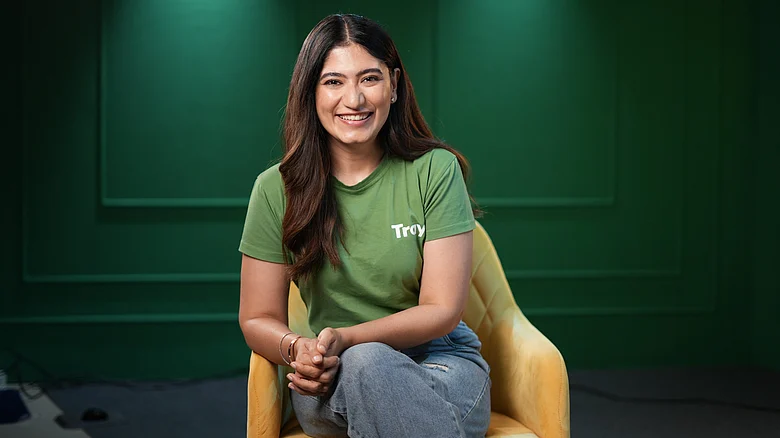

Traya’s holistic approach combines Ayurveda, Dermatology, and Nutrition to treat hair loss root causes
A clinical study published in IJRD found Traya’s regimen 3x more effective than minoxidil alone
The company maintains a 70% retention rate through proactive hair coaches
On the occasion of International Women's Day, Outlook Business in an exclusive interview features Saloni Anand, co-founder of Traya, who details the start-up's journey from a personal quest to help her husband to a data-driven clinical hair loss solution.
Anand explains that Traya’s "secret sauce" lies in its holistic triple-science approach, which integrates Ayurveda for internal balance, Dermatology for follicle health, and Nutrition to fill systemic gaps. By replacing traditional marketing with a focus on "Hope Stories" and proactive human "hair coaches," the brand has achieved a 93% effectiveness rate and a 70% retention rate.

1 October 2026
Get the latest issue of Outlook Business

Supported by nearly 50% female employees and AI-assisted diagnostics, Traya prioritises long-term consistency and data-driven personalisation to address the root causes of hair loss, ultimately aiming to restore both hair and self-confidence for its users.
To start, could you tell us the short version of your personal health journey that led you to start this company, what happened, and what made you decide to build a business out of it? If you could pick one vivid moment from that journey, what would it be?
Traya started because of Altaf, my co-founder and now my husband. He was in his late twenties, Altaf was running his own startup. He worked long hours and barely ate or slept. As a result, his health deteriorated. His thyroid levels dropped, uric acid increased, he gained weight, and then his hair started to fall out. It happened quickly and deeply affected his confidence. We tried everything. We visited clinics and dermatologists and explored Ayurvedic remedies and chemical therapies. Nothing worked alone.
Then we met an Ayurvedic practitioner who proposed a different method. Altaf was doubtful since we both had a background in allopathy, but he decided to give it a try. By combining Ayurvedic and allopathic treatments, along with a proper diet, things began to improve. His thyroid levels normalised, he lost weight, and his hair started to regrow. Friends began to notice and asked how he achieved these changes. We shared the advice, but not everyone had the same success because reversing hair loss takes time. Many people found it hard to stay consistent for four or five months. This prompted us to think. We ran a small digital ad and attracted our first 55 customers. Then, we paused all advertising and concentrated on serving them. Altaf and I became their personal hair coaches, answering questions and coordinating with dermatologists, Ayurvedic doctors, and nutritionists.
The standout moment came five months later. Out of those 55 customers, 36 showed visible improvement. That was the turning point. We realised this wasn't just Altaf's story; it could help others too. That marked the beginning of Traya.
Advertisement
When you look back to the early days, what was the first product or idea you tested with real users and what did their response teach you about the problem you were trying to solve? Can you give a specific customer example that changed your thinking?
The first thing we tested wasn't a product; it was the approach. Hair loss rarely has just one cause. It can be stress, gut health, hormones, nutritional gaps, or a mix of these factors. Treating it with one method or product doesn't work for most people.
At Traya, every customer begins with our online hair test. It looks at lifestyle, stress, gut health, hormonal markers, and diet to find the root cause, not just the symptoms. Then three fields come into play. Dermatology addresses the scalp and follicle health to encourage regrowth. Ayurveda helps restore internal balance. Nutrition helps fill any gaps; if your body lacks iron, protein, vitamin D, or zinc, hair is the first thing it stops nourishing.
Three specialists work together on the same issue, not separately. The hair test creates a detailed profile that allows us to design personalised plans with clear timelines. Doctors review everything before it goes to the customer. Diet plans are customised to individual preferences. Hair coaches support customers throughout the journey, not just at the time of purchase. One story that changed our perspective was Nikhil's. He came to us with severe hair loss and very low confidence; he wore a cap everywhere to hide his scalp. For him, it wasn't just cosmetic. It affected how he interacted with others and how he felt about himself.
After five months, we saw visible changes. His confidence returned along with his hair. He now says he looks better than in his wedding photos. That line stuck with us because it reflects what we’re really trying to achieve. It’s not just about hair. It’s about identity, self-worth, and how someone feels walking into a room.
Nikhil's journey inspired our brand film with Sunil Grover. But more importantly, it confirmed what we observed with our first 55 customers: those who remained consistent saw real transformation. Those who quit by month two did not. Our role doesn’t end with selling a product; it begins there.
Advertisement

Walk me through the product science in plain language: how do you combine Ayurvedic principles, dermatology and nutrition into a single offering and where does data-driven personalisation actually fit in operationally?
Combining three sciences does not mean putting three products in one box. At Traya, the three sciences create one treatment plan. Once the hair test identifies the root cause, our Ayurveda, dermatology, and nutrition doctors work together on a single regimen.
Three specialists, one patient file. Personalisation is present at every stage. The hair test is the starting point. After treatment begins, we continuously track the scalp's response, routine consistency, and changes in health markers. The plan adapts as needed. Month one may look different from month three because the body responds, and we make adjustments in real time. Every change is reviewed by a doctor.
Then comes the support layer. This is where Traya truly stands out. Every customer gets a hair coach, not a salesperson. A trained professional whose job is to keep you on track. They check in often, answer questions, bring concerns to doctors, and motivate you when you’re unsure if it’s working. Hair regrowth takes five to six months, which is a long time to stay disciplined on your own.
The coach makes it easier. So when I talk about personalisation, I don’t just mean a customised product. The treatment changes, the support changes, and the communication changes based on how and when each customer wants to engage. The science provides the framework, and the operational layer ensures it works effectively.
What clinical or research work underpins your claims and how do you balance traditional systems of knowledge with the expectations of regulators and clinicians?
The hair care industry faces a serious credibility issue. Many brands claim "99% hair fall reduction" but lack solid evidence. We chose early on to focus on proof instead of promises and data rather than drama.
Our major study was with MS Clinical Research Pvt Ltd. It lasted six months and involved 135 male participants in a single-blinded, parallel-controlled setup. We used diagnostic tools like Trichoscan and CaseLite for objective measurement, and there was a placebo group included. The study was designed like a pharmaceutical trial, not a marketing gimmick.
The result showed that Traya's customised regimen was three times more effective than 5% minoxidil alone. Minoxidil has been the gold standard for decades, so outperforming it by three times was a significant achievement for the entire category.
This study was published in the International Journal of Research in Dermatology. This is important because it provides independent scientific validation, not just our own claims. When it comes to balancing Ayurveda with clinical expectations, we don’t view Ayurveda as an alternative to evidence-based medicine. Instead, we see it as complementary. Ayurveda offers insights on internal balance and gut health, while dermatology provides clinical rigour. Nutrition addresses any gaps.
The study was designed to test whether integrating these three approaches could outperform the most effective single molecule. It succeeded. Every prescription we issue is reviewed by a doctor. Nothing reaches a customer without medical approval.
We also avoid making blanket claims. For example, we prescribe minoxidil only when it is appropriate for an individual’s diagnosis. Many people mistakenly believe that every Traya customer receives it. That is not accurate.


How much of your growth is organic vs paid, what mechanisms drive referrals, and what resources do you invest to keep referral cohorts healthy over time?
Our biggest growth driver isn't a campaign; it's results. When someone's hair visibly improves after five months, people notice. Friends ask. The family asks.
This drives word-of-mouth that no paid campaign can match. We do invest in performance marketing, including Meta, Google, and analytics tools to improve continuously. But we approach it in three layers. Awareness: We form strategic partnerships to spread our message. Rajkummar Rao felt genuine and relatable, just like the brand. Neena Gupta helped us connect with women and change how they approach hair loss.
These partnerships are not just about celebrity endorsements. Education: This is where we put most of our resources. The What The Health podcast, social content, and Hope Stories are all meant to help people understand their hair loss before we ask them to buy anything. If there's one growth strategy that has worked, it's being honest and letting customer outcomes drive support. Conversion and retention: This is where organic growth happens.
Our customer community includes people undergoing treatment who share their experiences and receive guidance from managers who respond quickly. When people feel supported rather than sold to, they promote the brand naturally, without needing a referral code. We keep advocacy genuine. Hope Stories share the whole experience—frustration at month two, doubt at month three, visible change at month five. That honesty resonates more than any polished testimonial. The numbers show this success: a 70% retention rate and 2.5 times growth in the last 12 months. This comes from people who trust us enough to stay and then trust us enough to recommend us to others.
How do you structure your customer education (content, consults, community), who owns that function internally, and how do you measure whether education actually changes behaviour? Can you share a content or community idea that directly impacted retention?
Education at Traya isn't just an aspect; it's our foundation. Content serves as the front door. Our What The Health podcast has over 150 million views. We don’t use it to sell Traya; we discuss health honestly. We cover gut health, stress, hormones, nutrition, and even women’s sexual health.
Experts like Dr Tanaya Narendra and Seema Anand contribute insights. We prioritise credibility, placing product discussions second. Consults form the backbone of our approach. Each customer connects with a hair coach who reaches out proactively, rather than waiting for issues to arise. Coaches check in with clients, offer motivation, highlight concerns to doctors, and adjust routines as needed.
I decided to make the shift from reactive to proactive care for a reason. Five to six months is a long time to stay disciplined without someone supporting you. Community serves as the glue. A customer at month two, feeling frustrated and uncertain, can see someone at month five sharing their results. That kind of peer validation carries more weight than anything we could say as a brand. Internally, our structure is designed to be collaborative.
Marketing creates content, the medical team ensures accuracy, and customer experience manages coaching and community. What allows it all to function as one system is the structured communication framework I implemented. This framework brings together the tech, customer experience, and medical teams around shared goals and clear responsibilities.
Before this, important details often fell through the cracks. Once we improved internal coordination, the customer experience changed for the better. For measurement, we look at adherence rates, repeat purchases, and customer satisfaction (CSAT). After transitioning to proactive coaching and launching the community, CSAT increased by 9 percentage points, and customer effort decreased significantly.
Technology and data play a role in your personalisation. What data do you collect, how do you ensure quality and privacy and do you use any predictive models or algorithms to make recommendations?
What we collect: the hair test captures lifestyle, diet, stress, sleep, gut health, hormonal indicators, and medical history. During treatment, we take scalp images with our Scalpie tool, track progress regularly, and monitor how consistently the regimen is followed. What we do with it: AI analyses the data to find root causes and suggests a personalised plan.
However, every recommendation is reviewed by a doctor before it reaches the customer. It’s AI-assisted, not AI-driven. That human check is essential. We use predictive models for treatment timelines, estimating how many months someone will need to see visible results based on diagnosis and patterns from our customer data.
Setting realistic expectations from the start has been one of our biggest ways to keep customers. Our adherence engine learns how each customer likes to engage, including which channel and what time of day, and adjusts outreach accordingly.
Personalisation at Traya is not just about what’s in the box; it’s also about how we support you after you open it. On privacy, we have a secure, in-house CRM. Nothing is shared outside. In health, if people don’t trust you with their data, they won’t trust you with their treatment.
What are the cultural principles you insist on as co-founder? How do you hire for long-term fit in a mission-driven health brand and how has your hiring evolved with scale? Tell me about a hiring decision that felt risky at the time but paid off.
Four non-negotiables. Be fearless. Fight for what’s right, explore, and experiment.
We celebrate failures as much as successes. If people fear mistakes, they won't take bold steps. Data over opinion. A 24-year-old can challenge a senior leader here if they've done their homework. The average age at Traya is 24. That energy is noxious. contagious. Customer obsession over product obsession. Focus on the problem, not the solution. We hire for empathy and curiosity.
In health, if your team doesn't genuinely care about the person on the other end, it shows. Direction and recognition. If people don't see how their work connects to the bigger picture, growth stalls. We recognise contributions every day, not just at annual offsites. Hiring has changed from Altaf and me doing everything, including personally coaching our first 55 customers, to finding people who share our values instead of just their skills.
Today, we're over 800 people with a nearly 50:50 gender ratio in leadership. This has been intentional from day one. The risky decision? Building our hair coach network. These trained professionals only provide post-purchase support. They motivate customers, track progress, and flag issues to doctors. Many questioned this approach. Why invest so heavily in people whose job is just to care? That’s exactly where the return on investment turned out to be. Hair coaches are why we have 93% effectiveness and 70% retention. They help someone who is frustrated and ready to quit in month three to stay on track and see results by month five. That decision changed everything for us. We call it Traya's magic.