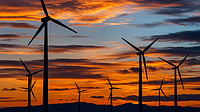
India achieves 50% non-fossil fuel power capacity, five years ahead.
Government rolls out rooftop solar and PM-KUSUM schemes empowering households, farmers.
Calls for global finance, technology and cooperation to accelerate clean energy transition.
Union Minister for New and Renewable Energy Pralhad Joshi advocated India’s commitment to a just, inclusive, equitable, affordable and sustainable global energy transition at the 16th Assembly of the International Renewable Energy Agency (IRENA) in Abu Dhabi, United Arab Emirates on January 11.
While addressing the assembly, the Union Minister stated that India’s approach to energy transition is guided by the principle of Vasudhaiva Kutumbakam- One Earth, One Family, One Future, and a long-term vision anchored in equity, inclusivity and policy stability. He reiterated India’s commitment to achieving 500 GW of non-fossil fuel installed power capacity by 2030 and net zero emissions by 2070.

1 April 2026
Get the latest issue of Outlook Business

Highlighting a major milestone, Joshi informed that India has already achieved 50% of its installed electricity capacity from non-fossil fuel sources in 2025, five years ahead of its Nationally Determined Contribution (NDC) target under the Paris Agreement. India’s renewable energy capacity has crossed 266 GW, placing the country among global leaders in renewable energy deployment.

The Union Minister underlined that as one of the world’s fastest-growing major energy markets, India is prioritising reliable and resilient power systems through accelerated deployment of energy storage solutions, grid modernisation, development of Green Energy Corridors and innovative bidding mechanisms such as hybrid and round-the-clock renewable energy projects. He also highlighted India’s efforts to strengthen clean energy supply chains and expand domestic manufacturing across solar, wind, batteries and electrolysers, contributing to both national self-reliance and diversified global supply chains.
Emphasising the people-centric nature of India’s energy transition, the Union Minister highlighted flagship programmes aimed at empowering households and farmers. Under the PM Surya Ghar: Muft Bijli Yojana, around 2.5mn households have benefitted from rooftop solar installations in less than two years, with a target to cover 10mn households by March 2027. Under the PM-KUSUM scheme, about 2.17mn farmers have benefitted through replacement of diesel pumps and solarisation of agricultural feeders.

The Union Minister noted that the global energy transition will require unprecedented investment and cooperation. India alone is expected to require around $300bn by 2030, creating significant opportunities across renewable generation, storage, green hydrogen, grids and manufacturing. With stable policies and transparent markets, he said, India continues to remain one of the most attractive destinations for clean energy investment.
Calling for enhanced international cooperation, Joshi stressed the importance of technology transfer, access to low-cost finance, capacity building and harmonisation of standards, particularly to support developing countries in scaling up renewable energy without compromising development aspirations.
Reaffirming India’s strong support for IRENA, he stated that India stands ready to share its experience, institutions and technical expertise and to work closely with all member countries, especially Least Developed Countries and Small Island Developing States, to accelerate the global renewable energy transition. Union Minister emphasised that India’s energy transition is not only about capacity addition, but about people, opportunity and a shared sustainable future.

Climate Finance Imperative
According to World Energy Transitions Outlook 2023, published by International Renewable Energy Agency (IRENA), global renewable power capacity must triple to more than 11,000 GW by 2030, requiring around $5trn annually in clean energy investment this decade. India’s projected $300bn need underscores the urgency of mobilising affordable international finance for emerging economies.