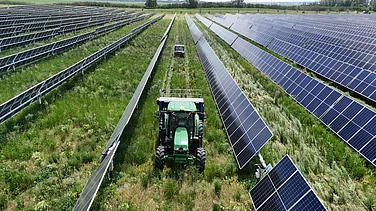

India needs $170 billion annually in climate investment by 2030, but currently raises only $50 billion, with international capital covering just 17% of that.
Global ESG assets are projected to exceed $40 trillion by 2030, but India's cumulative sustainable debt issuance stands at under 1% of the global pool.
India's domestic carbon market and bilateral carbon corridor with Japan offer Indian companies a path to monetise decarbonisation efforts and attract institutional capital.
India's climate ambition is quantifiable. To meet its 2030 Nationally Determined Contributions, fund the Viksit Bharat vision, and remain on a credible path to net zero by 2070, India requires approximately $2.5 trillion in investment by the end of this decade — roughly $170 billion annually. This is the financing required to power India's low-carbon growth story: renewable energy deployment, industrial decarbonisation, energy efficiency, and clean transportation.
India's tracked green growth finance reached $50 billion annually in FY2021-22 — a record high, but covering barely one-third of the annual requirement. More concerning is the composition: 83% of that financing was domestically sourced, with international capital contributing only 17%, or roughly $8.3 billion per year. The deep-pocketed, long-tenor institutional capital - sovereign wealth funds, infrastructure PE, pension capital, DFIs that India needs to bridge this gap is not yet flowing at the scale or into the sectors the country requires. On the longer horizon, India faces a $10 trillion funding gap against its net-zero 2070 pledge.

1 September 2026
Get the latest issue of Outlook Business

This capital will not arrive as aid or official development assistance. It will arrive as investment — institutional, structured, priced, and conditional. The question for India Inc. is whether it understands the conditions.



Advertisement
When Global Capital Turns Green
In global sustainable debt markets, 2024 was a record year: $1.05 trillion in aligned green, social, and sustainability bonds priced across 10,331 deals — a 31% year-on-year increase — bringing cumulative global GSS+ issuance past $6 trillion. Against this, India's cumulative sustainable debt issuance stands at $55.9 billion as of end-2024 — a strong 186% increase since 2021, but under 1% of the global pool.
Beyond debt markets, UN PRI signatories, the world's largest institutional investors, now represent $128.4 trillion in assets under management across 5,300+ organisations, all operating under a responsible investment mandate. Global ESG assets are projected to exceed $40 trillion by 2030, comprising over 25% of total global AUM. The One Planet Sovereign Wealth Funds framework, which commits signatories to Paris-aligned investment decision-making, has mobilised $37 trillion in assets. Seventy-four percent of sovereign wealth funds surveyed in 2024 consider climate risk essential to managing financial exposure; 69% view climate-conscious investing as a route to improved long-term returns.
Advertisement
It is the mainstream of how large-scale, long-duration capital now allocates and it is precisely the class of capital whose time horizons match India's green finance needs.
What Global Allocators Want
When a sophisticated institutional investor evaluates an Indian industrial or infrastructure asset today, it’s ESG due diligence is a structured legal and financial inquiry: What are verified Scope 1 and Scope 2 emissions - measured, not estimated? Is there a science-based transition plan, and is it Paris-aligned? What is the physical climate risk exposure — heat stress, water scarcity, flood risk — over the investment horizon? Is climate risk governed at board level, with named executive accountability?
SEBI's BRSR Core framework, mandating independent assurance of nine sustainability KPIs for India's top 1,000 listed companies, with the universe expanding progressively from FY 2026-27, is the regulatory vehicle through which this shift is being institutionalised domestically. Treating BRSR Core as a compliance obligation misses the strategic point. Companies that build verified ESG data infrastructure ahead of mandatory thresholds send a legible market signal to exactly the class of global capital India needs most.

Harnessing Carbon Markets
The most underutilised dimension of India's green growth financing opportunity is the carbon market architecture that is now operational. At the domestic level, India's Carbon Credit Trading Scheme introduces a compliance carbon market with mandatory sectoral decarbonisation trajectories for eight energy-intensive industries — aluminium, cement, chlor-alkali, fertiliser, iron and steel, paper, petrochemicals, and textiles — creating a compliance demand signal. Companies that invest in energy efficiency and low-carbon processes ahead of notified benchmarks will hold surplus credits to monetise; those that do not will face compliance costs on a fixed regulatory timeline.
At the international level, the bilateral carbon corridor with Japan under Article 6.2 of the Paris Agreement is a technology-finance corridor bringing Japanese technology and capital into India, generates carbon credits for both sovereign NDC accounts, and creates commercial revenue for Indian project hosts. Japan's Ministry of Economy, Trade and Industry is actively incentivising Japanese corporates to deploy energy-efficient and low-carbon technology in India making JCM one of the few channels through which international green finance flows directly into Indian industrial decarbonisation. First-mover advantage in project origination is real and material today.
The strategic logic for India Inc. is coherent and compounding: decarbonise operations, generate carbon credits under CCTS or JCM, monetise them domestically or internationally, and use that verified emissions performance to demonstrate a credible transition pathway to institutional investors. These are not parallel tracks. They are mutually reinforcing — and the legal and regulatory architecture connecting them is live.
Why Legal Enforceability Matters
Climate finance, carbon markets, and ESG disclosure are operationally distinct but legally integrated. Capital flows to where it can price risk accurately. Carbon markets function where credits are credible and independently verified. Disclosure frameworks work where they generate comparable, assured data that investors can act on. What connect all three are the rigour, legal, regulatory, and governance that Indian businesses invest in now, not later.
India's position in the emerging climate economy is extraordinary — not as a supplicant for green capital, but as a carbon project host of significant scale, a green manufacturing destination, and a test case for how a large, fast-growing emerging economy delivers on its development imperative and its climate commitments simultaneously.
The frameworks are live. The capital is mobilising. The question for India Inc. is no longer whether the climate transition is coming, it is whether they are structurally positioned to access the capital, meet the obligations, and contribute to the country's green growth story before the window closes.
(Umang Pathak is senior specialist, climate change, ESG & regulatory practice at Trilegal. The views expressed are personal)