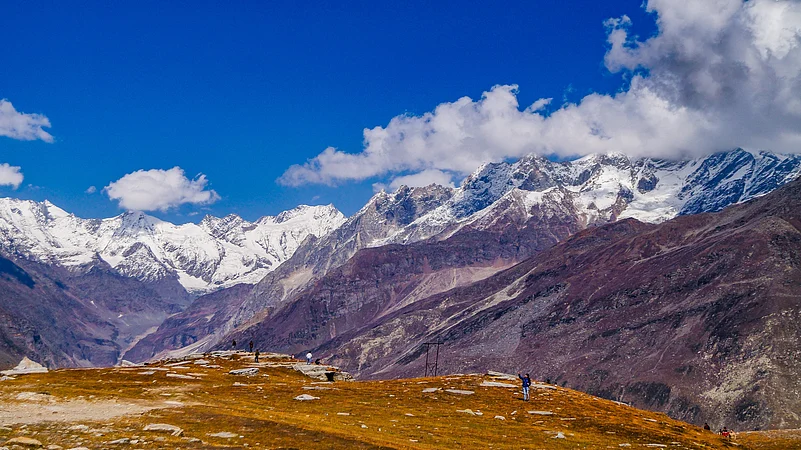

Snow cover across Himachal’s four major river basins dropped 12.72% in 2023–24.
Scientists attribute the decline to rising temperatures, erratic precipitation and climate extremes.
Reduced snowmelt threatens agriculture, biodiversity and downstream water availability in the Himalayas.
The snow cover is steadily declining in Himachal Pradesh. The total snowfall area in the four river basins of Chenab, Beas, Ravi and Satluj reduced to 17,437.4 square kilometres in 2023-24, according to a report published by the Himachal Pradesh State Centre on Climate Change (SCCC).
Based on the report, it was 12.72% lower than in the winter of 2022-23, prompting the environmentalists to term it as a `Snow Drought’.

1 September 2026
Get the latest issue of Outlook Business


Reason for Decline
The report further stated that the decline in snow cover indicates towards the impacts of climate change.
"Rising winter temperatures, altered precipitation patterns, and an increase in the frequency of extreme weather events, are all effects of climate change, may be responsible for this decline," it also states.
The ecological balance and traditional farming methods that depend on snowmelt are also at risk due to the decreasing amount of snow cover, which also affects downstream areas' access to water. According to the report, integrated climate adaptation strategies and continuous monitoring are essential to reducing the long-term effects of this trend on the agriculture, hydrology and biodiversity of the Himalayan region.
Advertisement
The report also stated that the findings are based on mapping of the four river basins using Advanced Wide Field Sensor (AWiFS) satellite data.
Down To Earth reported that the snow cover was 20,210 square kilometres in the winter of 2018-19, and the highest snow cover of 23,542 sq km was recorded in 2019-2020 and it dropped to 19,183 sq km in 2020-21. In 2021-22, it rose to 23,244 sq km.
In the winter of 2022-23, a total of 19,979 square kilometres of area across the four river basins was covered by snow. The Satluj basin recorded the highest snow cover at 8,868 sq km, followed by Chenab at 7,049.67 sq km, Beas at 2,174 sq km and Ravi at 1,886 sq km.
Advertisement
The snow cover along the basins reduced to 17,437.4 square kilometres in 2023-24. While most river basins showed a negative snow cover trend from October to January in 2022-23, the basins registered recovery between February and April, indicating comparatively higher snowfall during the latter part of the winter.
The report added that integrated climate adaptation measures and sustained monitoring were crucial to mitigate long-term impacts on agriculture, hydrology and biodiversity in the Himalayan region.
In the past two decades, a steep decline in average snowfall in Shimla and Manali was recorded. Neither of the tourists’ destinations has received any snowfall so far this winter.
Compared to earlier times, the higher reaches of Kullu, high-altitude regions of Lahaul-Spiti and Kinnaur mostly have no snow. Environmentalists attribute the trend to rising greenhouse gas emissions, unsustainable development and mushrooming of high-energy-consuming industries, reported Down To Earth.

Western Indian Himalayas More Vulnerable
According to a 2019 report by the International Centre for Integrated Mountain Development (ICIMOD), the western Indian Himalayan Region is more prone to risks from climate change compared to the Eastern Himalayan ranges.
The Himalayas, considered the “third pole” for the amount of ice and water they hold, are particularly vulnerable to the effects of climate change. Some parts of the Himalayas, like the Hindu Kush Himalayan Range, are warming at a faster rate than the global average. Both snow cover and glacier mass in the Himalayas have been on the decline in recent decades.