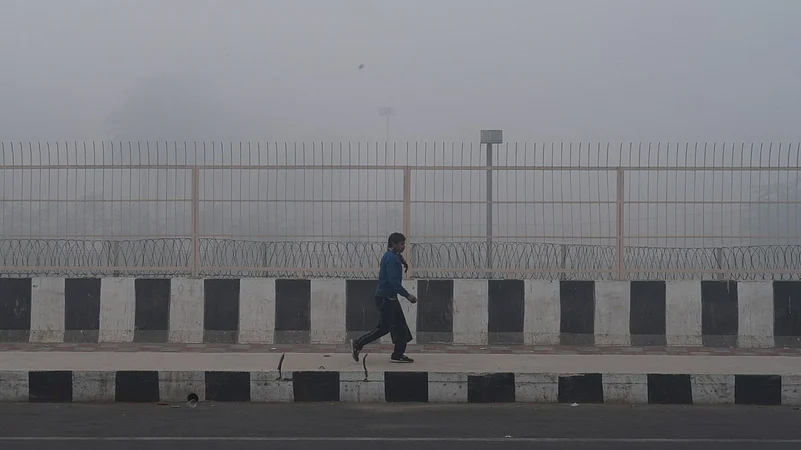

Delhi records worst January air quality in two years, AQI plunges into severe zone.
Low wind speed and high emissions worsen pollution across Delhi and neighbouring regions.
IMD forecasts fog, light rain and winds, offering limited relief later this week.
Delhi records ‘most polluted January day in two years’ as its air quality levels slipped into the most toxic ‘severe’ zone on January 18, reported Hindustan Times. This accounts for the most polluted January day in two years and the worst the air has been in the second half of the month since 2019.
The national capital recorded an average AQI of past 24 hours as 440 at 4 pm on January 18, according to the CPCB’s bulletin. The reading was comparatively worse than 400 on January 17 and the highest for the month since 447 on January 14.

1 September 2026
Get the latest issue of Outlook Business

Delhi also saw its first severe air quality day of the year and the first since December 29, 2025 on January 18, with a reading of 401, reported The Times of India. It was also the second-worst this winter, after a peak of 461 on December 14.
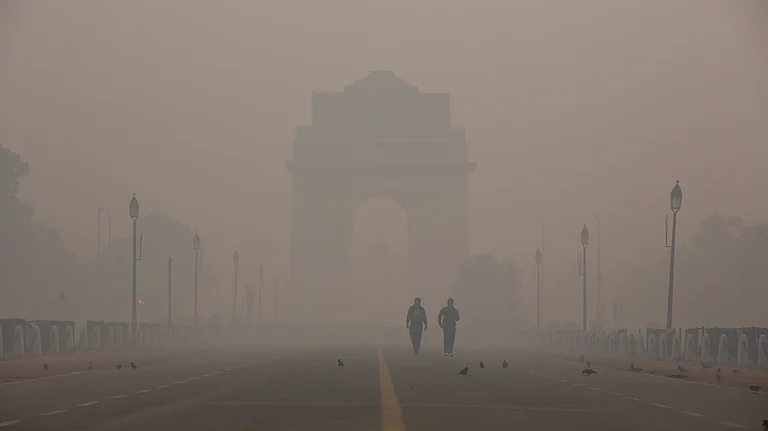
A thick layer of fog blanketed parts of Delhi on January 19. The India Meteorological Department (IMD) predicted moderate to dense fog in the early hours and "partly cloudy sky", issuing a yellow warning.
Experts told The Times of India that emissions from both the local and neighbouring districts remained high in addition to the meteorological conditions that played a key role in the increase of air quality levels in the national capital.
Advertisement
Sunil Dahiya, founder and lead analyst at think tank Envirocatalysts, said low wind speed, stable atmospheric conditions, stagnation of local emissions and a higher contribution from neighbouring districts on the city’s east and south-west resulted in a surge in pollutants.

Weather Could Take a Turn
"Partly cloudy sky. Moderate fog at many places with dense fog at isolated places during morning hours," read the IMD's forecast for Delhi-NCR in its daily weather bulletin.
On January 19, the minimum temperature in Delhi is expected to remain between 7-9 degrees Celsius and the maximum temperature around 24-26 degrees Celsius. On January 18, the minimum temperature in Delhi was recorded at 5.3 degrees Celsius, while the maximum was 22.7 degrees Celsius.
Advertisement
The IMD has forecast heavy rainfall in parts of the country on January 23. "Two Western Disturbances in quick succession are likely to affect the Western Himalayan region during next week with the possibility of isolated heavy rainfall/snowfall on 23rd January," the IMD stated in its news release published on January 18.
Meanwhile, isolated to scattered light to moderate rainfall or snowfall is expected over Jammu-Kashmir-Ladakh-Gilgit Baltistan-Muzzaffarabad, Himachal Pradesh during January 19 and21. Fairly widespread rainfall or snowfall during January 22 and 24, with isolated heavy falls over Kashmir-Ladakh-Gilgit-Baltistan-Muzaffarabad and higher reaches of Himachal Pradesh on January 23.



Isolated to scattered light to moderate rainfall over Punjab, Haryana, Chandigarh, Uttar Pradesh and Rajasthan during 22-24 January, stated the latest IMD news release. Thunderstorm activity is likely over Uttarakhand on 23 and 24 January; Punjab, Haryana, Chandigarh, Delhi and Rajasthan on 22 and 23 January.
"Very light rain/drizzle accompanied with strong surface winds speed reaching 20-30 kmph likely on 23 January 2026," IMD stated.