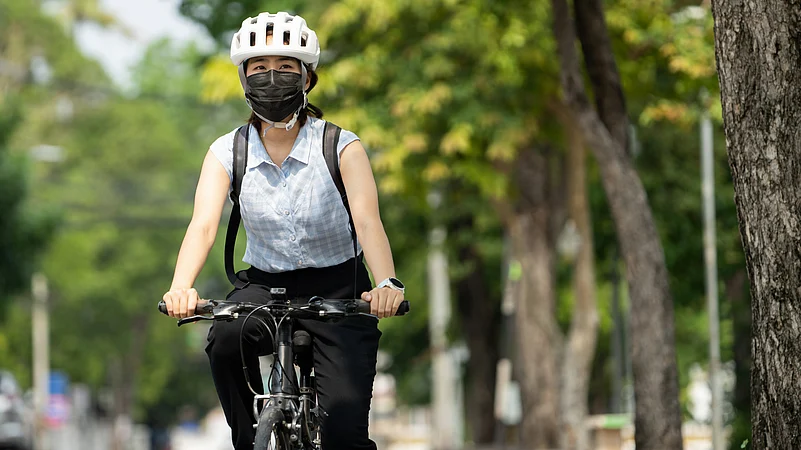


Bicycling in Global South cities is driven by economic necessity, not lifestyle choice.
Car-centric urban design exposes cyclists to unsafe roads, heat stress and daily risks.
Policy neglect prevents cycling from delivering climate, health and equity benefits.
Bicycling offers significant benefits for the planet, including reduced greenhouse gas emissions and improved air quality, however, a major disconnect was found between city planning and the reality of the road in low- and middle-income countries (LMICs), according to a University of Chicago Institute for Climate & Sustainable Growth report.
Survival Over Lifestyle
Researchers studying four rapidly expanding cities—Delhi, Chennai, Dhaka and Accra—found that bicycling is primarily a tool for economic survival. The typical cyclist is an adult man from a household earning well below the city average, working as a vendor, factory hand or security guard.

1 April 2026
Get the latest issue of Outlook Business

For these individuals, the bicycle is an affordable way to navigate dense, congested urban environments, with many commuting for 30–50 minutes each way. Unlike in many high-income nations, bicycling in these contexts is not a "lifestyle choice"; as soon as these riders can afford an automobile, they typically stop cycling.

Hostile Urban Environments
The study reveals that most modern infrastructure in these cities is aggressively automobile-oriented, leaving cyclists to face routine near-misses and crashes as they navigate a landscape of multi-lane roads and complex junctions designed for speed.
In addition, the daily commute is plagued by blocked pathways; even where dedicated tracks exist, they are frequently obstructed by parked cars, street vendors or motorcycles escaping congestion, often forcing cyclists to skip the tracks entirely.
This physical strain is exacerbated by significant environmental stress, including extreme heat and seasonal flooding, which compel many workers to time their journeys carefully to survive the harshest weather conditions.

The Policy Blind Spot
Despite its importance, bicycling remains largely "invisible" to policymakers. When it does appear in planning documents, it is often framed as a recreational activity for beautification projects or as a welfare tool, such as schemes providing bikes for schoolgirls.
This leads to fragmented infrastructure being built in affluent neighbourhoods where few people cycle, while the arterial routes used by daily workers remain underserved.
A Path to Inclusive Growth
To foster a truly sustainable mobility transition, the report argued that health and environmental agencies must advocate for infrastructure based on the actual "lived experiences" of cyclists.
Future investments should focus on nurturing existing bicycling cultures by clearing tracks of motorised vehicles and supporting the fragile, local repair networks that sustain daily riders.
By prioritising safety and social inclusion, cities can create more equitable and environmentally positive transport systems.
Climate and Equity Lens
The findings align with evidence from UN-Habitat report which highlight walking and cycling as low-cost climate mitigation tools that also improve public health and equity in low and middle income cities.
However, the report warns that without safe, inclusive infrastructure, active mobility benefits remain unrealised, reinforcing social and environmental inequalities.