


India’s renewable capacity has surged, but transmission and storage are struggling to keep pace.
Closing these gaps will be crucial to integrating more solar and wind beyond 2030.
Smarter grids, energy storage, domestic manufacturing and better market design can turn the generation boom into reliable clean power.
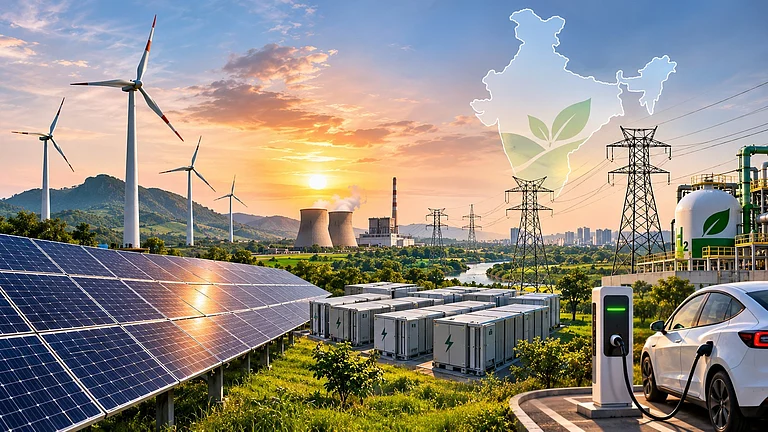
India’s renewable energy story in mid-2026 is one of genuine scale. Non-fossil capacity has crossed 300 GW, solar alone stands above 164 GW, and the country added a record 55 GW of non-fossil capacity in FY 2025-26. More than half of India’s installed power capacity is now non-fossil, and the 500 GW target for 2030 is within mathematical reach. These numbers matter. They reflect competitive tariffs, expanding domestic manufacturing, sustained tendering and private capital that treats renewables as mainstream infrastructure.
Yet the real test of the transition is shifting. Generation capacity is the easiest metric to celebrate and the least sufficient one. A whole-of-ecosystem approach—renewable generation tightly coupled with smart transmission and battery storage—remains incomplete. Two structural gaps now dominate the pathway to 2030 and beyond: the lag in transmission and system flexibility relative to variable renewable energy (VRE) growth, and the still-limited scale and integration of energy storage.

1 November 2026
Get the latest issue of Outlook Business

Transmission And System Flexibility
India’s renewable build-out has outpaced the grid’s ability to absorb, evacuate and balance it. Curtailment in high-RE states, delayed inter-state transmission projects, and inadequate real-time flexibility continue to impose economic and operational costs. Variable solar and wind require more than copper wires; they need advanced forecasting, dynamic line rating, flexible conventional generation, demand response and market signals that reward system value rather than mere megawatt-hours.
Advertisement
Projects face evacuation constraints, developer’s price in higher risk, and the system operator is forced into conservative operating margins. Without accelerated investment in inter-regional corridors, intra-state strengthening and digital grid technologies, further capacity additions will increasingly hit soft ceilings of grid absorbability rather than hard ceilings of resource or capital.
The Missing Storage Layer
Battery energy storage systems (BESS), pumped hydro and longer-duration solutions are the essential firming layer that converts intermittent generation into reliable supply. While India has begun issuing storage tenders and hybrid projects are gaining traction, operational storage remains modest relative to the VRE fleet. Round-the-clock renewable supply, peak shaving, frequency regulation and higher renewable penetration all depend on storage scaling at a pace closer to generation itself.
Advertisement
Cost declines in lithium-ion and emerging chemistries help, but policy and market design have not yet fully internalised storage as core infrastructure. Without clearer revenue-stacking pathways, capacity mechanisms that value flexibility and domestic manufacturing depth that reduces supply-chain risk, storage deployment will continue to trail the generation curve.

Closing The Gaps
First, treat transmission and storage as parallel infrastructure priorities rather than sequential afterthoughts. Time-bound, ring-fenced funding for critical transmission corridors and storage parks linked to renewable energy zones can compress the lag. Hybrid tenders mandating co-located or contracted storage, and viability-gap support calibrated to system benefits, would accelerate deployment.
Second, modernise market and operational frameworks. Strengthening the real-time market, expanding ancillary services that pay for flexibility, and embedding AI/ML forecasting into system operations would reduce the need for conservative reserves. Peer-to-peer trading, virtual power plants and demand-side aggregation can unlock distributed flexibility that eases pressure on centralised infrastructure.
Third, deepen domestic manufacturing and skills across the full value chain—not only modules and cells, but inverters, battery packs, grid-forming equipment and digital control systems. Production-linked incentives and standards that reward quality and performance over lowest first cost will matter as much as volume targets.
Fourth, align state and central policy so that land, permitting and grid-connection processes do not become the binding constraint. Single-window clearances with statutory timelines, and clearer allocation of transmission charges that reflect actual system impact, would reduce friction for developers while protecting the grid.




The Stakes Beyond 2030
India’s renewable surge has already redefined the economics of power. The next decade will determine whether that surge becomes a resilient, high-penetration system or remains a generation success story constrained by integration limits. The whole-of-ecosystem approach is the difference between meeting a capacity target and delivering reliable, affordable, low-carbon power at scale.
The policy and institutional machinery already exists within MNRE, the Central Electricity Authority, Power Grid Corporation and the system operators. What is required is sharper prioritisation of the two bottlenecks that now dominate: grid flexibility and storage depth. Close those gaps with the same urgency that drove the generation boom, and the 2030 target becomes not merely achievable but the foundation for a deeper industrial and energy transition well beyond it.
Renewables have moved from complementary source to central driver. The ecosystem that supports them must now catch up.
Disclaimer: The author is Delhi-based energy transition expert. The views expressed are personal.