




The figure originated from the government’s incentive scheme for low-value UPI transactions and is now being discussed as one possible basis for future MDR.
Only around 4% of P2M UPI transactions exceeded ₹2,000 in FY26, although they accounted for roughly two-thirds of total transaction value.
Any future MDR would be a merchant-side charge, with the government indicating that consumers and small vendors such as hawkers and vegetable sellers would continue to use UPI free of charge.
Parliament has passed the Taxation and Other Laws (Amendment) Bill, 2026, which amends Section 10A of the Payment and Settlement Systems Act, 2007.
This legislative update grants the central government the authority to formally designate specific digital payment methods that must remain free of bank and provider fees, replacing the earlier reference to payment modes prescribed under Section 269SU of the Income-tax Act. This development sparked speculation regarding the return of merchant discount rates on digital transactions.

1 September 2026
Get the latest issue of Outlook Business

Reserve Bank of India Governor Sanjay Malhotra said that talks of imposing the fee are still at a premature stage.
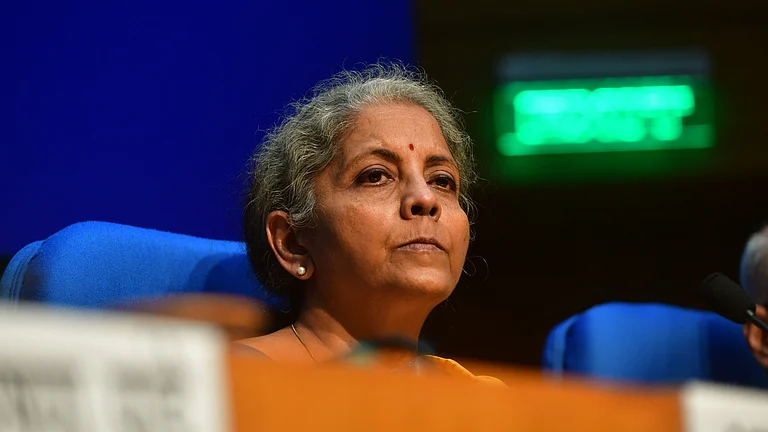


Addressing concerns over everyday retail impacts, the Finance Minister said the proposed MDR will exempt small-scale vendors, including those selling tea and vegetables, as well as hawkers.
Origins of the Threshold
The limit possesses a clear history. Since January 2020, UPI transactions have not attracted MDR charges, a change enacted through modifications to Section 269SU of the Income-tax Act, 1961, and Section 10A of the Payment and Settlement Systems Act, 2007.
The ₹2,000 figure originates from the government's UPI incentive scheme, earlier called the 'Incentive Scheme for Promotion of RuPay Debit Cards and Low-Value BHIM-UPI Transactions (Person-to-Merchant)'.
Advertisement
Authorities have utilised this specific limit since FY2021-22 to identify low-value P2M transactions eligible for state incentives.
In FY2024-25, the government restructured and renamed the initiative as the 'Incentive Scheme for Promotion of Low-Value BHIM-UPI Transactions (Person to Merchant - P2M)'.
The updated programme received an estimated outlay of ₹1,500 crore, offering a 0.15 per cent incentive for small-merchant transactions up to ₹2,000.
Under this scheme, transactions above ₹2,000 at small merchants received no incentive but remained at zero MDR, while large merchants also received no incentive, irrespective of transaction value.
"₹2,000 was originally a fiscal-targeting line for subsidy, not a payments-cost line," Tanvi Kanchan, associate director at Anand Rathi Share and Stock Brokers, told Business Standard.
Advertisement
The Mathematical Case
Data explains why the ₹2,000 limit makes sense. Reuters reported that policymakers are considering different approaches, including linking charges to merchant turnover and establishing a ₹2,000 threshold for larger merchants.
"Only about 4 per cent of P2M UPI transactions were above ₹2,000 in FY2025-26, but that slice accounted for roughly two-thirds of total transaction value," Kanchan said.
This concentration of transaction value makes the threshold an appealing option for balancing infrastructure costs with consumer convenience.
Impact on Key Stakeholders
Cost dynamics remain merchant-centric. MDR is a merchant-side charge, and the government intends to keep UPI free for consumers. The government has stated that any future MDR would apply only to a limited set of merchant transactions above a specified threshold.
"Banks and payment providers would get a legal route to recover processing, settlement and infrastructure costs directly from large merchants, rather than relying solely on central incentives," Kanchan said.
The overlapping figures have created significant confusion among digital payment users regarding impending charges.
"Because both reference the same number, it reads in public discourse as if the government has already decided ₹2,000 is where UPI charges kick in...In fact, policymakers are considering a ₹2,000 threshold, but the government has not officially confirmed this limit," Kanchan said.









