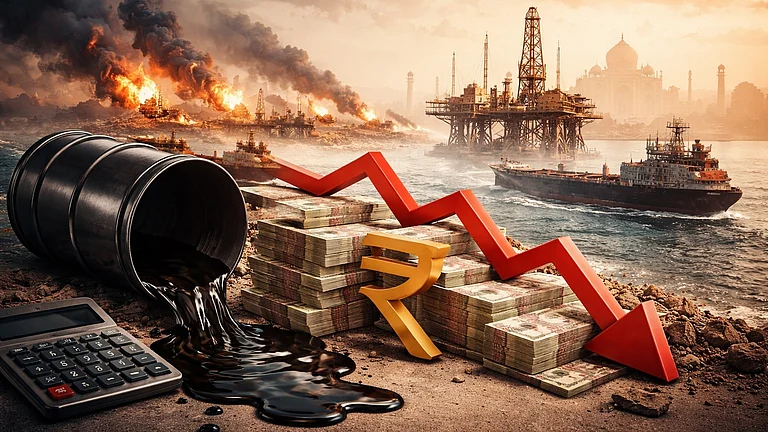
Prime Minister Narendra Modi detailed how India successfully navigated the global energy crisis triggered by the West Asia conflict involving the US, Israel, and Iran
India expanded its energy diplomacy by diversifying its fuel import sources from 25 to over 40 countries during the crisis
The government absorbed over ₹75,000 crore in losses for state oil marketing firms and slashed excise duty by ₹10 per litre to protect consumers from soaring petrol and diesel rates
Prime Minister Narendra Modi on Saturday detailed how the administration took correct steps across all tiers to manage the fallout of the West Asia conflict.
The conflict involving the US, Israel and Iran began on February 28. It forced the closure of the Strait of Hormuz and triggered a global surge in energy costs.

1 October 2026
Get the latest issue of Outlook Business

"The war troubled every country, leading to the biggest energy crisis of the 21st century," Modi said. "During the biggest energy crisis of the 21st century, the will power of New India and its efforts prevailed heavily," he added.
India swiftly evaluated the unfolding situation and executed a clear strategy. The government balanced domestic resources with targeted diplomatic efforts to secure energy supplies.
Mitigating Fuel Price Shocks
The government absorbed significant financial hits to protect citizens from soaring petrol and diesel rates. Between April and June, state oil marketing firms incurred losses exceeding ₹75,000 crore on petrol and diesel.
Advertisement
The public exchequer covered this substantial deficit. Policymakers also slashed excise duty by ₹10 per litre to alleviate the direct burden on consumers.
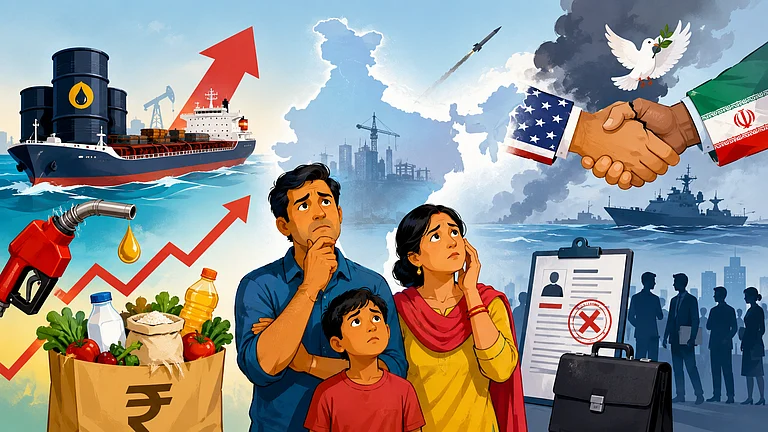
During the conflict, the cost of crude oil jumped from $70 to $120 per barrel. This global shock caused petrol and diesel costs to climb between 40% and 50% globally, forcing some nations to ration fuel supplies.
"Our country does not possess vast oil reserves. As the crisis escalated, crude oil prices surged from $70 to $120 per barrel, and import routes were blocked. Diesel and petrol prices rose by 40% to 50% in many countries across the world, with some nations even resorting to rationing supplies," Modi said.
Advertisement
"Yet, India never faced such a situation, not even for a single day," Modi said.
"Only then could India recover from the crisis," Modi said. "No matter how big and unexpected the challenge may be...the new India neither backs down from its resolves...nor slows down its pace."
Expanding Energy Diplomacy
The administration heavily utilised diplomatic channels to secure alternative energy sources during the conflict.
India historically purchased its fuel and energy from just 25 or 26 countries prior to the West Asia disruptions. Officials rapidly diversified these supply chains as the war escalated. Strategic diplomatic engagements enabled the nation to source fuel from over 40 different countries.
"During this very period of war, India’s friendships with other nations proved invaluable. Before the crisis began, India imported fuel and energy from only twenty-five or twenty-six countries. However, the crisis showcased the prowess of Indian diplomacy...Amidst the war, India began sourcing fuel from over forty countries," Modi said.
"India sent a clear message to the world that national interest and the welfare of its citizens are paramount," Modi said.
Overcoming LPG Supply Disruptions
Domestic interventions played a central role in stabilising cooking gas availability. India relies on overseas markets for 60% of its LPG requirements. Historically, 90% of these imports traversed the Gulf through the Strait of Hormuz.
The government directed oil refineries to alter their production lines to address the sudden supply blockade. Facilities were reconfigured within seven days to manufacture LPG.
This rapid adjustment boosted domestic LPG production from 35,000 metric tonnes to 54,000 metric tonnes.
Authorities concurrently restricted commercial LPG supplies and initiated a rapid rollout of piped natural gas (PNG). The campaign successfully connected over 1.1 million households to PNG networks.
Market analysts had projected that domestic gas cylinder rates could hit Rs 2,000. However, the government managed to hold prices below the ₹950 mark.
"In a very short span of time, India connected over 1.1 million households to PNG...Given the prevailing circumstances, the price of a domestic gas cylinder could have soared to ₹2,000, a figure predicted by major market experts. Yet, even now, a domestic LPG cylinder is being provided for less than ₹950," he added.
Refining Capacity and Resilience
Robust industrial infrastructure supported the national response. India currently maintains the fourth largest refining capacity globally.
In contrast, the United States has not constructed a new refinery in 50 years, and European refining capabilities have witnessed a steady decline.
Modi expressed gratitude to the public for maintaining stability during the crisis. He credited citizens for standing firm, confronting market rumours and actively foiling conspiracies designed to create domestic unrest.
"In the way the countrymen confronted those spreading rumours, fear, and confusion...They foiled the conspiracies to create instability in the country...The country has moved forward on the strength of that very trust," he said.