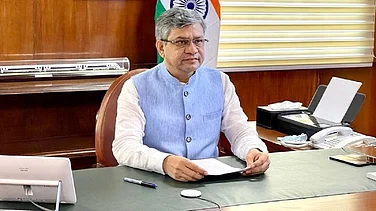
Oil and Natural Gas Corp (ONGC) should increasingly be seen as a "gas-and-oil" company rather than an oil-and-gas producer, its chairman Arun Kumar Singh said, underscoring a strategic shift as natural gas output outpaces crude oil.
"Gas is now slightly more than oil in our portfolio," Singh told analysts, adding that ONGC's future growth will be driven largely by gas production even as crude output remains broadly flat without major new discoveries.
"We should call ourselves a gas and oil company, not an oil and gas company." Singh said gas is emerging as the dominant growth driver for the state-run explorer, with rising domestic demand, supportive pricing reforms and new field developments pushing production higher.

1 September 2026
Get the latest issue of Outlook Business

"Gas is a more valued fuel in the Indian context, and ONGC is gradually becoming a more gas-heavy company," Singh said, adding that gas output already exceeds oil and will continue to expand over the coming years.
While oil production is likely to remain flat, gas output will rise as newer fields are put into production. With one of the best pricing in the world, gas is now a more lucrative portfolio, he said.
"ONGC produces and sells more gas than oil. In fact, gas is now a little more than oil," he pointed out.
Singh said gas is becoming increasingly attractive relative to oil due to pricing reforms, with 'new well gas' linked to 12 per cent of crude prices, and described India's rising gas demand - including from transport - as a key structural driver.
Advertisement
He added that while oil production is likely to remain broadly flat without major discoveries, ONGC's growth trajectory will increasingly be "gas-led", reinforcing its transition toward a more diversified energy portfolio.
ONGC's exploration and production (E&P) business now accounts for roughly two-thirds of the group, with gas output already exceeding oil and expected to expand further in the coming years.
He said government policy support, including reduced royalties, continued market-linked pricing reforms and a push to fund deepwater exploration, has improved sector economics and left more revenue with upstream producers.
Singh noted that 'new well gas' production is rising sharply and already accounts for about a quarter of total gas output, and added that it could reach 30-36 per cent in the near term and eventually dominate ONGC's gas portfolio as mature fields decline.
Advertisement
He said ONGC expects annual gas production growth of around 7-8 per cent, supported by new projects, including DUDP, DSF fields and offshore developments, such as 98/2 wells, many of which are scheduled to come online over the next fiscal year.

The company continues to drill around 500 wells annually, including exploratory and producing wells, and reported a reserve replacement ratio of more than 1.1 in FY25-26, indicating replenishment of produced reserves.
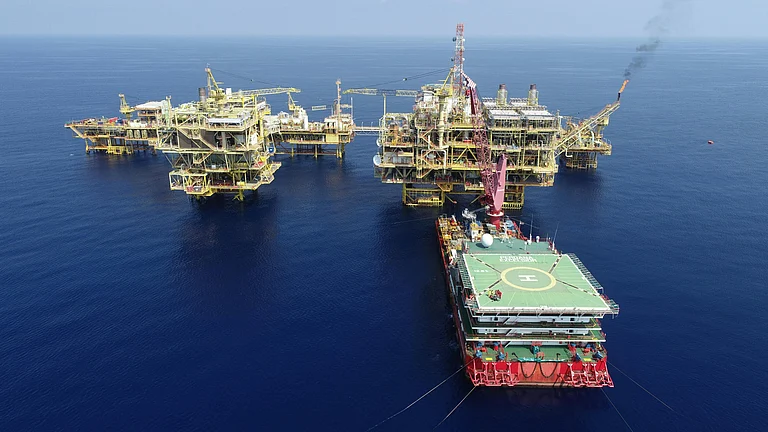
Singh said ONGC is executing about Rs 33,000 crore in offshore projects aimed at sustaining and increasing output, while also targeting improved recovery from mature fields, such as Western Offshore assets, which account for the bulk of current production.
Western Offshore operations are undergoing a major technical service partnership (TSP) programme with BP, covering 100 per cent of the asset base, with early operational gains already visible, he noted.
On overseas operations, Singh said production from Russia's Sakhalin remains stable, while Mozambique's LNG project is advancing toward potential completion by 2028. Venezuela's output could also rise if regulatory conditions improve, he said.


ONGC also expects a turnaround in its petrochemicals arm OPaL and growth in its renewable energy subsidiary ONGC Green, which is targeting nearly 3 gigawatts of capacity next year.