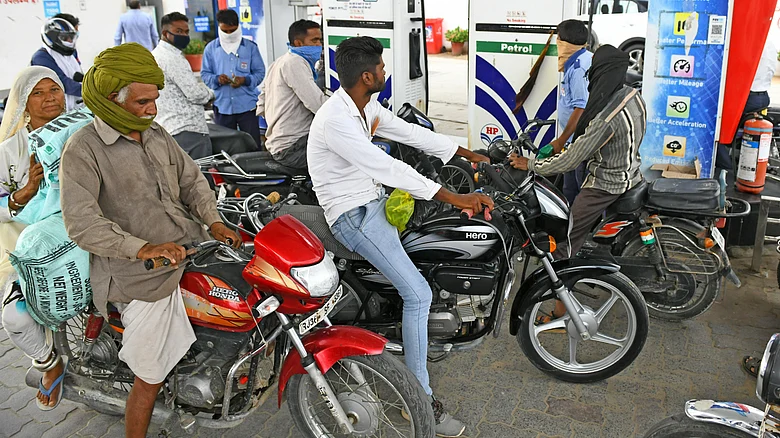
State OMCs posted ₹77,821 crore FY26 net profit, a 3-4% margin on ₹20 lakh crore turnover, in line with global refining benchmarks.
FY26 profits are comparable with FY23-24's ₹80,986 crore; FY25 was artificially low due to ₹40,434 crore LPG under-recoveries.
Earnings insulated from Strait of Hormuz disruption as refiners used pre-conflict crude inventory; higher crude costs will hit Q1 FY27 earnings.
State-run oil marketing companies (OMCs) posted a combined net profit of ₹77,821 crore in FY 2025-26, but the earnings reflect a return to normal profitability rather than a crisis-driven windfall, according to government and industry data reviewed amid criticism over fuel price hikes following the West Asia conflict.
The profit pool, spread across Indian Oil Corporation, Bharat Petroleum Corporation Limited and Hindustan Petroleum Corporation Limited, amounts to a net margin of roughly 3-4% on combined turnover estimated near ₹20 lakh crore, broadly in line with global commodity refining benchmarks.
Criticism from opposition parties has centred on the 130% jump in profits from FY2024-25 levels. However, FY2024-25 profits had fallen sharply to ₹33,602 crore after OMCs absorbed ₹40,434 crore in LPG under-recoveries to keep household cylinder prices capped, creating what officials describe as an artificially depressed comparison base.

1 October 2026
Get the latest issue of Outlook Business

Adjusted for that one-off burden, FY 2025-26 profitability is broadly comparable with FY2023-24 combined profits of ₹80,986 crore, rather than an exceptional spike.
Advertisement
Industry officials argue the scale of earnings must be viewed against the size of operations. India's three OMCs together generate annual revenue of about ₹20 lakh crore, while individual refiners such as IOC alone post turnover close to ₹10 lakh crore annually. Analysts say a 1-3% operating margin is typical for large commodity refiners and necessary to sustain capital expenditure, refinery upgrades and working capital requirements.
A single refinery expansion programme can cost between ₹50,000 crore and ₹60,000 crore, with the sector targeting refining capacity expansion beyond 310 million tonnes per annum by 2030.
The companies also contend that FY2025-26 earnings were largely insulated from the impact of the Strait of Hormuz disruption because refiners were processing 50-60 days of pre-conflict crude inventory purchased before the escalation in West Asia.
Advertisement
As a result, the higher crude acquisition costs, freight premiums and insurance surcharges linked to the conflict are expected to be reflected mainly in Q1 FY2026-27 earnings, due for publication in August.
The Strait of Hormuz carries nearly one-fifth of global crude flows and its disruption triggered a sharp rise in oil prices and shipping costs across Asia.
The government has defended recent retail fuel price increases - about ₹7.50 per litre in petrol and diesel and ₹6 per kg in CNG, saying India's pump price revisions remain moderate compared with neighbouring economies despite the supply shock.

Since the crisis began in late February, retail petrol and diesel prices in India have risen by about 8-9%, according to official estimates, compared with increases ranging from 20% to 67% in several neighbouring countries.
New Delhi also cut excise duty on petrol and diesel by ₹10 per litre effective March 27, 2026, adding to earlier excise reductions announced in 2021 and 2022.
Officials said cumulative excise relief since 2021 totals ₹23 per litre on petrol and ₹26 per litre on diesel.



The government further argued that roughly half of OMC profits flow back to the exchequer through dividends and taxes, helping fund infrastructure spending including highways, railways and metro projects, while retained earnings support energy security investments and refining expansion.
The debate over OMC profitability has intensified as crude prices remain elevated following the Iran-linked supply disruption and concerns over prolonged instability in the Gulf shipping corridor.