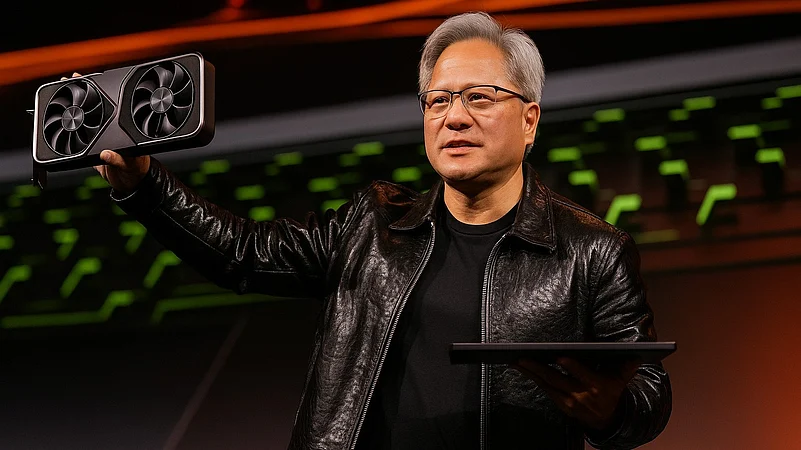

Huang calls Nvidia potential "trillion-dollar company"; connectivity critical for agentic AI's distributed computing.
Marvell essential for AI scaling; copper hitting limits, industry shifting to optical rack connections.
Marvell's silicon connects servers to networks; largest global R&D hub outside California now in India.
Nvidia CEO Jensen Huang has highlighted the growing importance of connectivity in powering next-generation artificial intelligence infrastructure as he joined Marvell chief Matt Murphy on stage at Computex 2026 and described the semiconductor company as a potential "trillion-dollar company".
"The next trillion-dollar company, ladies and gentlemen," said Jensen Huang, as soon as he arrived on the stage, drawing applause from the audience on Tuesday.
Marvell stocks soared over 30% after the Nvidia chief's announcement, according to various media reports.

4 July 2026
Get the latest issue of Outlook Business

Earlier this year, Nvidia announced $2 billion investment in Marvell Technology to deepen their strategic partnership.
Huang on Tuesday highlighted the importance of connectivity in enabling AI infrastructure, with Marvell's technology playing a crucial role in scaling and interconnecting data centres.
"Useful AI has arrived. It's the reason why your demand is going through the roof. It's the reason why my demand is going through the roof," said Huang at the global technology event organised by the Taiwan External Trade Development Council.
He said that the new computing pattern that makes it possible is called agents, and these agents have a particular computing platform, a computing pattern that is disaggregated and distributed.
Advertisement
"When you take a computing problem, and you disaggregate it into a lot of parts, and you distribute it across the entire data centre. What's necessary is connectivity. That's the reason why Matt's doing so well. That's the reason why Marvell is so essential," he said.
Agentic AI acts as a digital worker rather than merely responding to queries under conventional generative AI. The model relies on large-scale computing infrastructure, making connectivity a critical component of AI deployment.
Murphy said the industry is facing growing challenges in scaling connectivity using conventional copper-based technologies inside data centres.
Copper cables are hitting a hard ceiling because the interconnects face severe signal degradation, escalating power requirements, and extreme heat generation at terabit data speeds.
Advertisement
Murphy – whose company established its largest global research and development hub in India outside its California headquarters – emphasised that the traditional use of copper cabling within server racks is reaching its physical limits.


"Going forward, even the connections within the rack will become optical, and the whole industry knows this is coming. So, we've been preparing for this moment, not just Marvell, but the industry," he said, adding: "The future of AI data centres is all optically connected infrastructures.” Marvell said its silicon solutions connect everything from server components inside a rack to geographically distributed networks, helping scale AI clusters without sacrificing performance.