Prime Minister Narendra Modi on Tuesday slammed those who question his government’s development record, once again calling them "Naraz Fufa" (angry uncle), as he inaugurated and laid foundation stones for ₹35,000 crore-worth development projects.
Addresing the 'NaMo for Viksit Bharat' programme at Vadodara in Gujarat, he also took a swipe at Congress leader Rahul Gandhi's 'Chhatron Ki Goonj' initiative, stating that youngsters would not be misled by "Jhooth ki Goonj" (echo of lies).
India is scripting a new saga of manufacturing, spanning "chips to ships", with components, final products and the supply chain for self-reliance being set up in the country, he said.

1 October 2026
Get the latest issue of Outlook Business

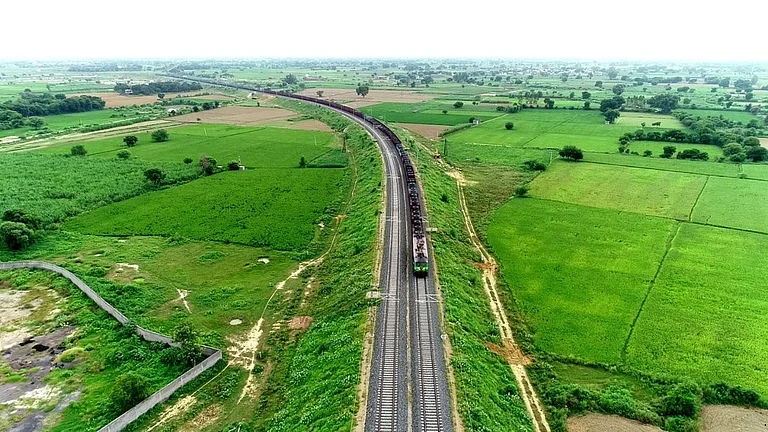
The projects the PM inaugurated included a 2,800-km dedicated freight corridor, which he called a “historic achievement for the 21st century” and a testament to how the country's work culture has transformed over the past 12 years.


He also slammed the previous Congress-led regime for the slow pace of development.
A double-stack container freight train recently transported cargo equivalent to that carried by over 250 trucks from Jawaharlal Nehru Port in Mumbai to Vadodara in a single trip, Modi said.
Targeting those who would question the utility of the corridor project, he said, "Now Naraz Fufa ji will start shouting: what would happen to truck drivers and the trucks they had purchased? "This Fufa ji has found something new to complain about," Modi said, without naming Rahul Gandhi. The PM, notably, had recently used the folksy term at an event in Delhi to target naysayers.
Advertisement
“After 2014, India built 50,000 modern rail coaches, but the previous (Congress) regime could not build even 50,000 toilets in 10 years,” Modi said.
He inaugurated three key sections of the Western Dedicated Freight Corridor, connecting Jawaharlal Nehru Port in Navi Mumbai with Dadri in Uttar Pradesh, marking the project's completion.
“Dedicated freight corridors are the lifeline of a fast-developing India. India’s transformation is accelerating because of this modern freight network,” Modi said.
Earlier, passenger and goods trains had to run on the same tracks, slowing down both passenger travel and freight movement, but the Dedicated Freight Corridor has changed this, he said.
Advertisement
“After 2014, with your blessings, when I reached Delhi, and as soon as we arrived there, we began accelerating this project. Work on the 2,800 km dedicated freight corridors has been completed today,” he said.
“Today, the Eastern and Western Freight Corridors are becoming the main backbone of the country's trade and business,” Modi said. More than 430 freight trains operate daily on the two corridors, he added.
“The idea for the Dedicated Freight Corridor began in 2004. In 2006, a special company was established to carry out this work, and until 2014, files just kept shuffling from one place to another," he said.
“Unfortunately, even these files weren't fortunate enough to get a dedicated corridor. The files would get stuck, hang around and wander aimlessly,” Modi said.
Referring to Rahul Gandhi's 'Chhatron Ki Goonj' youth outreach initiative, he said, "At every nook and corner, you will find people who will try to mislead you through 'Jhooth Ki Goonj', but today's youth will stand with the truth." The prime minister said the youth could see how focused the government was on working across sectors, including solar, wind, hydro and nuclear energy.
"The youth of the country have to become experts in AI, and we want our youth to excel in the field," he added.
Modi flagged off freight train services from New Sanand, New Makarpura, New Umbergaon and New JNPT in Navi Mumbai. He also flagged off a passenger train service between Tanda Road and Vadodara.
He said India had emerged as a major manufacturer of railway coaches, metro coaches and locomotives in the last decade. Since 2014, India has manufactured about 50,000 modern rail coaches, and 2.5 lakh wagons were added to the railway fleet.
A 100-km journey that earlier took 6.5 hours for a freight train can now be covered in less than half the time, while a 30-hour journey by truck can be completed in 10-12 hours on the Dedicated Freight Corridor, the PM noted.
He said the corridors had reduced fuel consumption, lowered freight costs, saved time and benefited the environment.
The freight corridors were also enabling farmers from eastern and western India to transport flowers, vegetables and fruits to major markets more quickly, he said.
Rail connectivity was also reaching parts of the country where it had been absent for decades, with tribal areas in Gujarat, Madhya Pradesh and Maharashtra being connected through these projects, he pointed out.
During the previous government, only one or two trains would be announced in the budget and take a long time to materialise, but now, new trains are being launched one after another, Modi said.
Infrastructure projects in roads, railways, metros, airports, gas pipelines and housing for the poor not only made life easier but also generated lakhs of employment opportunities, he added.
The railway budget this year stood at ₹2.75 lakh crore, several times higher than 12 years ago, and railway modernisation was creating thousands of new jobs, Modi said.
He further said India had developed a solar PV module manufacturing capacity exceeding 200 gigawatts, helping expand the PM Surya Ghar: Muft Bijli Yojana.
So far, 55 lakh families, including 11 lakh in Gujarat, have installed rooftop solar panels, creating employment opportunities, he said.
The future would depend on an electric ecosystem and industries like data centres and AI, which require large amounts of water and electricity, he said, adding that India was preparing the ecosystem needed to become a global superpower in AI and was signing international agreements regarding uranium and critical minerals.
Earlier, Modi walked on an elevated ramp to arrive on stage, and was greeted by the audience, mostly Gen Z youth. He reciprocated with folded hands and waved back.