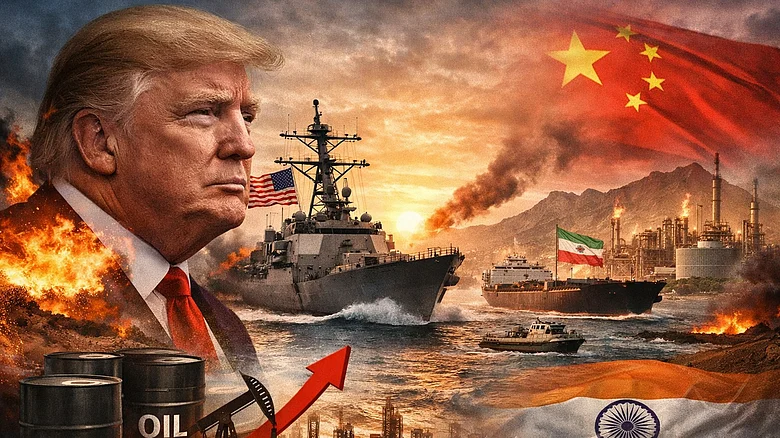

Disruptions to Iranian oil flows may push Chinese buyers towards alternative supplies, increasing competition for the barrels India relies on.
Freight rates and war-risk insurance have risen sharply, adding to costs for a country that imports nearly 90% of its crude and much of its LPG from the Middle East.
India-Iran trade remains relatively small, but higher global crude, freight and insurance costs could widen India’s trade deficit and create broader inflation risks.
US Treasury Secretary Scott Bessent launched an 'economic D-Day' campaign against Iran on August 24, 2026, revealing a fresh wave of sanctions. These updated measures broaden the scope of secondary penalties to encompass shipping, aviation, gold, technology and digital assets.
"We are launching an economic onslaught against Iran's financial connections around the globe...economic asphyxiation of this regime," Bessent said.

1 October 2026
Get the latest issue of Outlook Business

Global energy markets reacted quickly. On August 25, 2026, Brent crude traded near $92 a barrel, recovering from a drop of over 2 per cent during the prior session. For India, the primary macroeconomic threats stem from subsequent inflationary pressures instead of immediate crude shortages.


China Drives Oil Competition
Global supply shifts loom. India faces secondary threats from the tightening sanctions.
"India's direct exposure to Iranian crude is currently very limited...India's bigger exposure comes from second-order effects, particularly through China," Sumit Ritolia, Lead Research Analyst at Kpler, said.
Advertisement
China imported 823,000 bpd of Iranian oil in July and 534,000 bpd in August 2026, ICRA data showed. A disruption in these flows alters global procurement. "If China...is forced to source oil elsewhere, it will increase competition for the alternative barrels that India relies on," Ritolia said.
Chinese buyers have shown restraint recently. "Even during the Strait of Hormuz blockade...Chinese haven't been buying much oil aggressively because they have been tapping their own reserves," Prashant Vasisht, Senior Vice President at ICRA Limited, said.
International Energy Agency members have liquidated approximately 293mn barrels out of 400mn barrels of strategic reserves, Vasisht said. Meanwhile, Russian crude supplies to India are running at maximum volumes of 2.5mn-2.8mn bpd, Ritolia said. This accounts for about half of India's imports, leaving limited additional volumes available.
Advertisement
Rising Freight Shipping Costs
Transport logistics face strain. Freight and insurance premiums are escalating rapidly.
Vessel traffic through the Red Sea has plummeted to 22-23 ships daily, down from 77 previously, Vasisht said. Analysts said shipping costs across major routes surged by 137-411 per cent since late February 2026, while war-risk coverage for a single voyage through the Strait of Hormuz spiked to $7.5mn-$10mn.
These bottlenecks pose acute macroeconomic risks. India relies on overseas markets for nearly 90 per cent of its crude needs, alongside sourcing 90 per cent of its liquefied petroleum gas from the Middle East.
Trade deficits are already expanding. In July 2026, the country's merchandise trade shortfall expanded to almost $32bn. During this period, inbound shipments of petroleum products and crude oil climbed by 17.6 per cent annually, reaching $18.31bn.
Direct Trade Impact Limited
Bilateral commerce remains low. The commerce ministry stated that direct India-Iran trade reached $1.04bn during the April-June quarter of FY27, as outbound shipments plunged 57.2 per cent year-on-year to $149.38mn.
During the quarter, basmati rice led outbound shipments to Iran, totalling $103.13mn. Simultaneously, provisional figures indicated imports from Iran surged to $890.32mn, driven by a low base effect. Payments present a structural hurdle.
"Most of our exports go through UAE and then payment comes through UAE...We used to invoice only UAE, so we used to get dollars," an Indian exporter said.
Pharmaceutical exports also face local hurdles. "Fortunately for us, a couple of years ago, Iran established local manufacturing units...India no longer enjoyed the same position," Namit Joshi, Chairman of Pharmexcil, said.
New Delhi previously halted Iranian oil shipments in May 2019. A temporary 30-day waiver allowed a brief resumption in April 2026, facilitating 133,000 bpd. Domestic refiners completely ceased procurement once this exemption ended.