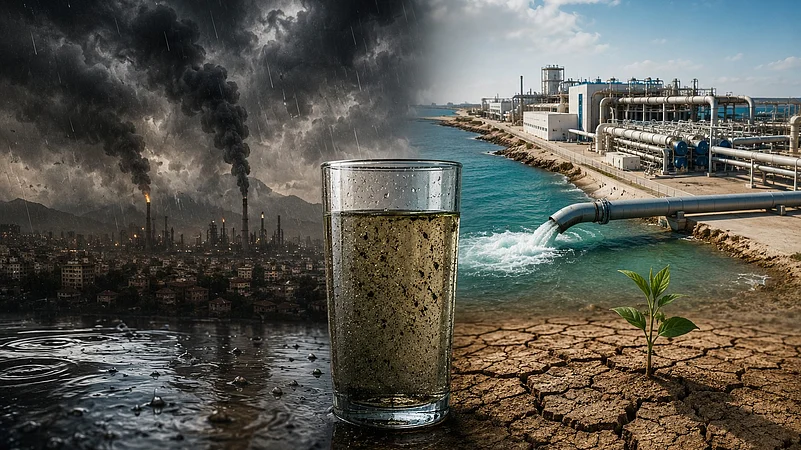

Acid rain and environmental changes triggered by conflict can affect water quality, soil health and groundwater systems for years.
West Asia's heavy reliance on desalination makes water security vulnerable to disruptions in energy and infrastructure networks.
Experts say diversified water sources, modular desalination and wastewater reuse are key to building more resilient water systems.
The “black rain” witnessed over Tehran following US-Israel strikes in March on refinery infrastructure was not merely an environmental after-effect of the conflict. It exposed how vulnerable modern water systems become when energy infrastructure disruption begins to alter air, soil and surface water chemistry. When sulphur dioxide (SO₂) and nitrogen oxide (NOₓ) exceed normal limits in atmosphere, they return through rainfall and begin to alter the chemistry of surface water. It can release metals like aluminium, cadmium, mercury, and lead from soil and sediments into the water and strain treatment systems.
For water distribution bodies, this shows up as rising treatment loads and falling predictability. For citizens, it shows up as something less precise through irregular water quality, minor health issues, and growing dependence on secondary sources. The signal is weak, but persistent.

1 September 2026
Get the latest issue of Outlook Business

The impact begins changing soil behaviour, weakening recharge quality, and gradually pushing contaminants into groundwater pathways. Recovery is slow and often incomplete. In parts of Europe, lakes impacted by acid rain took over a decade of intervention to stabilise and even then, original conditions were not fully restored.
This is one side of the risk. The other is sharper.
Ripple Effect
In much of West Asia, water is not sourced; it is produced. The region accounts for 40% of the global desalinated water. In Saudi Arabia, the UAE and Kuwait, desalination underwrites daily life. In several of these systems, more than half, and in some cases nearly all, drinking water is produced, not sourced, running into tens of millions of cubic metres each day.
Advertisement
This creates scale. It also creates dependence.
Desalination, by design, has scaled through size and concentration. Large plants, high energy use, and coastal clustering work efficiently, but only as long as each part of that chain holds. When they are disrupted, the impact is immediate. Capacity does not decline gradually; it drops.
Rebuilding that capacity is slow. A large plant can take three to five years to commission under normal conditions. Under stress, timelines stretch. Demand, meanwhile, does not.
The consequences tend to move in sequence. Urban supply tightens first, followed by industry. Power systems begin to feel pressure, given their reliance on water for cooling. Food systems are already dependent on imports in many of these countries, which become more exposed. The stress is not isolated; it travels across sectors.
Advertisement
The underlying vulnerability here is not just scarcity, but concentration. Much of the Gulf’s water security today rests on a limited network of mega-scale desalination facilities positioned along the coast. A plant such as Ras Al-Khair in Saudi Arabia produces over 3 million cubic metres a day — enough to sustain entire urban clusters. But systems built at that scale are deeply interlinked with energy supply, intake quality, transmission pipelines, and uninterrupted operations. Disruption in one layer quickly spills into another. Unlike conventional reservoirs, these are engineered systems that require stability at every stage. Once interrupted, recovery is rarely immediate, even after physical infrastructure is restored.
At that point, water risk begins to shape economic behaviour, and potentially, population movement. The current model of water infrastructure has been built for efficiency. Large plants, centralised systems, and predictable inputs work when conditions are stable. It is less effective when variability becomes the norm.

Derisking Concentration
A more resilient approach starts with diversification. Smaller, modular desalination systems can reduce dependence on single assets. They may be marginally more expensive per unit, but they are less exposed. In parallel, treated wastewater can be scaled as a meaningful second source.
What this demands is a shift in how we design treatment systems. The challenge is no longer just handling volumes but dealing with variability. For a long time, water infrastructure has been planned on the assumption of continuity, with the expectation that environmental conditions will broadly hold and that disruptions will be temporary. That assumption is weakening.
There is an older principal worth revisiting. Systems that endured did not rely on a single source or a single structure. They distributed risks, stored excess, and allowed for recovery.



That idea feels less historical and more practical today. Because the emerging challenge is not absolute scarcity. It is the growing gap between availability and reliability.
And once that gap widens, it is difficult to close quickly. The destroyed desalination plants and acid rain-infected soil and groundwater will take years to rebuild and return to normalcy.
Disclaimer: Yashovardhan Agarwal is MD Weslpun BAPL & Director Sintex. The views expressed are personal.