




Adani Ports' ₹13,360 crore Vizhinjam stake sale faces Kerala government's approval objection.
Kerala says the concession agreement requires prior approval for a 49% ownership transfer.
Adani maintains the dilution complies with the agreement after Vizhinjam entered its second operational year.
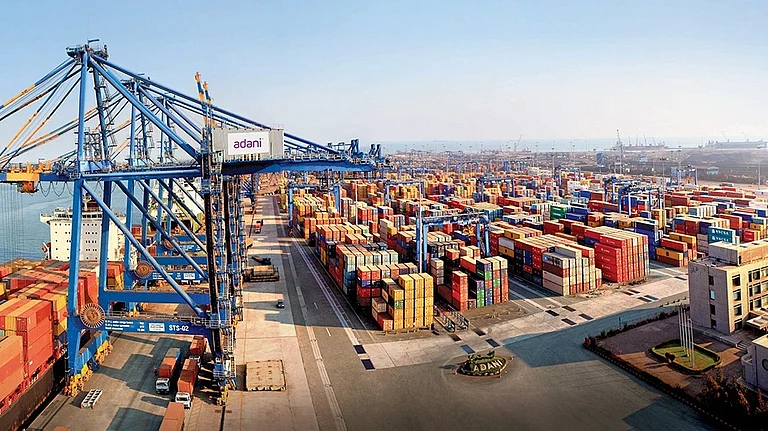
Adani Ports and Special Economic Zone (APSEZ) proposed sale of a 49% stake in Kerala's Vizhinjam International Seaport to Switzerland-based Mediterranean Shipping Company (MSC) Group for $1.397 billion (around ₹13,360 crore) has triggered a dispute with the Kerala government, which says the transaction cannot proceed without its prior approval under the concession agreement governing the project.
The proposed transaction, disclosed by APSEZ to market regulator SEBI on June 30, would rank among the largest foreign investments in India's port infrastructure if completed. However, the Congress-led Kerala government has objected to the deal, arguing that it amounts to a change in ownership requiring state approval. A state-appointed panel is currently examining the proposal.

1 September 2026
Get the latest issue of Outlook Business



Why Kerala Has Objected
The Vizhinjam port is being developed under a public-private partnership between the Kerala government and Adani Vizhinjam Port (AVPPL) under the Design, Build, Finance, Operate and Transfer (DBFOT) model.
According to the concession agreement signed in August 2015, the concessionaire cannot undertake or permit any change in ownership without the prior approval of the state government.
The agreement specifies that any transfer of 25% or more of the concessionaire's total equity constitutes a change in ownership requiring prior approval from the government from the perspective of national security and public interest.
Advertisement
The Kerala government argues that Adani's proposed sale of a 49% stake clearly falls within this provision.
Chief Minister V.D. Satheesan has conveyed the state's concerns to APSEZ, saying the government wants Vizhinjam to remain a globally competitive transshipment hub with equal access for all shipping lines. Officials have expressed concerns that MSC's ownership could create a dominant position in container traffic, given the company's status as the world's largest container shipping line.
The concession agreement also requires the port to operate on a "common-user" basis, providing non-discriminatory access to all vessels, shipping lines and cargo operators.
Adani Says Stake Sale Is Permitted
APSEZ has maintained that the transaction complies with the concession agreement.
Advertisement
The company informed SEBI that it signed a share purchase and subscription agreement with Mundi Ltd., a subsidiary of Terminal Investment (TiL), MSC's terminal operating arm, on June 29.
According to Adani, the concession agreement required it to retain at least 51% ownership during construction and the first year of commercial operations. Thereafter, it is required to maintain a minimum stake of 26%.
Since Vizhinjam has entered its second year of commercial operations, Adani argues that it is permitted to dilute up to 74% of its holding while continuing to comply with the agreement.
AVPPL also informed Kerala's ports department about the transaction on July 1, stating that disclosure to SEBI was required before approaching the state government for consent.
The transaction remains subject to regulatory and other customary approvals, although no timeline has been announced for completion.
Why Vizhinjam Matters
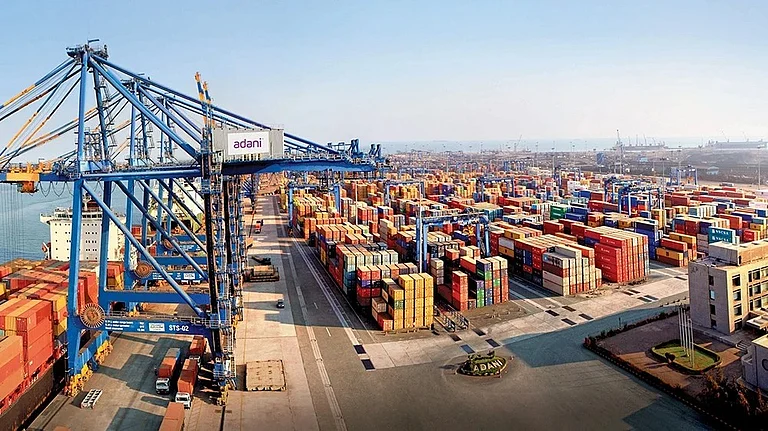
Vizhinjam is India's first deep-water container transshipment port and is expected to reduce dependence on foreign ports such as Colombo by handling domestic and regional transshipment cargo.
The first phase of the project became operational in December 2024 with an annual handling capacity of one million twenty-foot equivalent units (TEUs), which is expected to increase to three million TEUs in the next phase scheduled for completion by December 2028.
The Kerala government invested ₹5,595 crore in the first phase, while the Adani Group contributed ₹2,454 crore. The Centre also provided viability gap funding of ₹817 crore.
The project has been awarded under a 40-year DBFOT concession, extendable by another 20 years.
Under the agreement, any disputes between the parties are to be resolved first through conciliation, failing which the matter may proceed to arbitration under the rules of the International Centre for Alternative Dispute Resolution in New Delhi.









