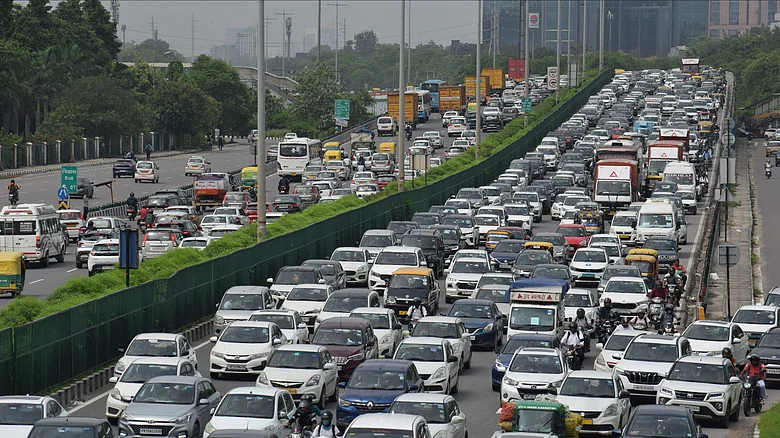

Delhi enforces 'No PUC, No Fuel' with real-time ANPR-enabled monitoring system.
Over 15,000 vehicles denied fuel during first four days of crackdown.
Experts question PUC relevance as it misses key particulate pollution metrics.
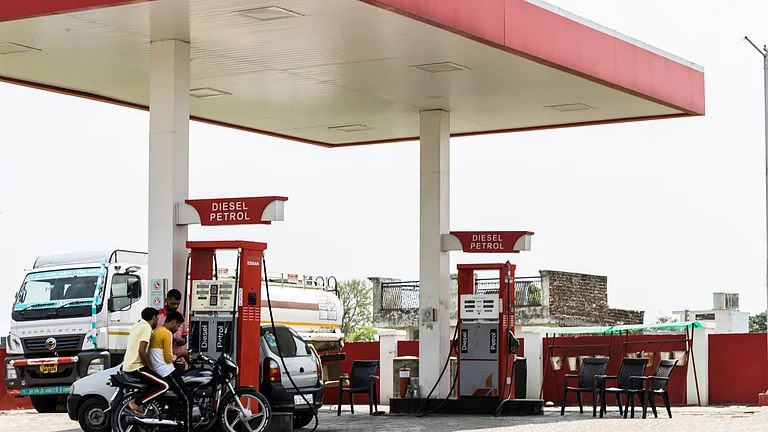
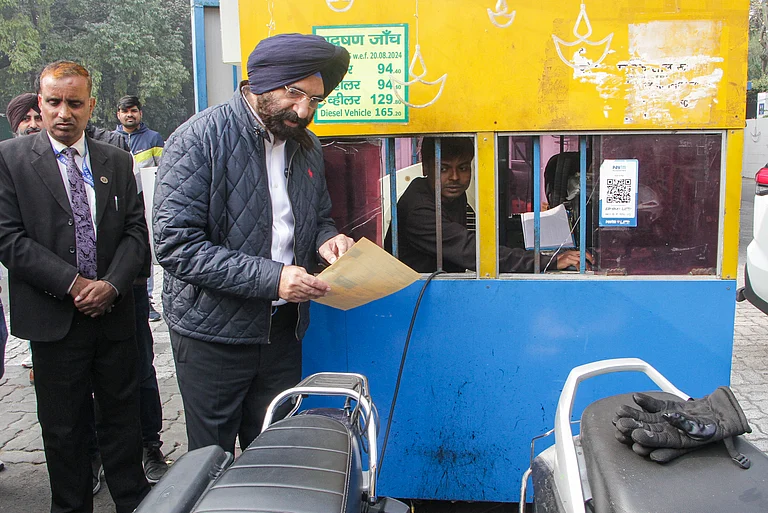
Chief Minister Rekha Gupta recently called for permanent and stricter implementation of Delhi's 'No PUC, No Fuel' rule. The numbers that followed were striking. Over 15,000 vehicles were denied fuel across the city for not carrying a valid Pollution Under Control (PUC) certificate, within four days of the drive from April 26 to 29. Fuel pumps in Delhi are now linked to centralised databases and equipped with Automatic Number Plate Recognition (ANPR) cameras. The system can verify a vehicle’s PUC status in real time and issue e-Challans.
The reach this creates would have been difficult to imagine even five years ago.

1 October 2026
Get the latest issue of Outlook Business

The intent is right. Vehicular emissions are a dominating contributor to Delhi’s air quality crisis and strict action is needed to tackle these. Measures like ‘No PUC, No Fuel’ can be effective in ensuring that vehicles hold a valid PUC certificate; they are far less equipped to answer whether the certificate reflects a meaningful test at all.
As enforcement becomes permanent, it raises an important question: what exactly are we enforcing? The PUC certificate has been the backbone of India's in-use vehicle emissions regime since the early 1990s. The test primarily measures Carbon Monoxide (CO) and Hydrocarbons (HC), and smoke opacity for diesel vehicles. That was reasonable for the fleet size and emissions standards of that era. The problem is that what drives Delhi's AQI today is not CO or HC, but fine particulate matter (PM2.5 and PM10). These fine particles remain suspended in the air for longer periods and penetrate deep into our lungs. WHO has repeatedly flagged these as the dominant health risk from urban air pollution. And the PUC test, the instrument at the centre of India's vehicular emissions enforcement architecture, does not measure them. This is a central design limitation of the system as it currently operates.
Advertisement
What The Numbers Don’t Tell Us
The result is a structural decoupling that every serious observer of this sector has seen play out repeatedly. As enforcement intensity rises, compliance rates improve, and certificate counts go up; while the air quality needle barely moves. This is not a failure of intent. The Delhi government's recent actions demonstrate genuine resolve, and the operational infrastructure that has been assembled is more sophisticated than anything that existed just a few years ago.
The problem is upstream of enforcement - the measurement framework does not capture the dominant pollutants. There is a secondary limitation that compounds this. PUC tests are conducted at idle. Their real-world emissions under stop-and-go Delhi traffic, at high load, and on elevation, are a different story. A vehicle that passes an idle test comfortably may be a significant emitter on the Gurgaon-Delhi Expressway (NH-48) at 8 pm.
Advertisement
Age Is Not A Proxy For Emissions
This measurement gap has a direct bearing on another policy instrument that Delhi has reached for increasingly in recent years - age-based End-of-Life (EoL) vehicle bans. In the absence of reliable in-use emissions data, EoL restrictions offer a convenient and visible response. But they are a proxy, not a diagnosis. A well-maintained 2012 car running on quality fuel may emit less than a poorly maintained 2021 car. Emissions performance and vehicle age correlate loosely at best. Until measurement catches up, blanket age-based rules will remain the default, even where more targeted and evidence-based approaches are available.

Technology Exists And The Pathway Is Incremental
Remote sensing devices at roadsides can measure real-world tailpipe emissions from moving vehicles without interfering with traffic. And On-Board Diagnostics (OBD) scans can offer a continuous data stream on vehicle health and emission levels. OBD is already mandated in newer vehicles under government rules. Neither approach can displace the PUC system, but with proper studies and pilots, both have the potential to complement it. A logical approach could be a tiered one - PUC as a baseline compliance filter, with remote sensing and OBD data used to flag high-emitting vehicles for targeted follow-up.
With strong enforcement technology now there, measurement framework is what needs to catch up. Until it does, the paradox will persist - stricter enforcement, increasing PUC certificate counts, and an AQI that continues to surprise us even in April
(Vinay Kumar is Programme Manager at Energy Policy Institute at the University of Chicago. The views expressed are personal.)