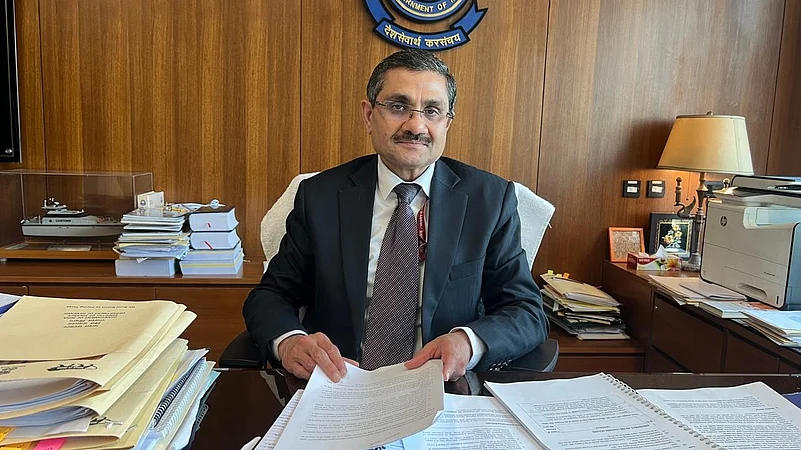
The Customs department should accelerate the deployment of artificial intelligence, machine learning, and real-time analytics to reduce physical interface with trusted taxpayers, Central Board of Indirect Taxes and Customs (CBIC) chairman Vivek Chaturvedi said on Wednesday.
Outlining 5 pillars for the Customs department to follow over the next decade, Chaturvedi said the CBIC intends to create a "unified, trusted taxpayer ecosystem" which records consistent compliance by businesses in GST, customs and other indirect tax payments. This would bring synergy across the indirect tax division.
The CBIC chief also asked the customs department to handhold MSMEs and conduct outreach programmes so that small businesses can reap the benefits of customs deferred duty payment schemes like Eligible Manufacturer Importer (EMI) and also the Authorised Economic Operator (AEO).

1 September 2026
Get the latest issue of Outlook Business

Chaturvedi said technology should act as a "great enabler" for customs and the ambition should be to move towards a near-touchless, near-paperless experience for businesses registered as AEOs.



Currently, there are over 6,000 entities, including importers, exporters, logistics providers, custodians or terminal operators, custom brokers and warehouse operators with AEO certificates.
AEO is a voluntary compliance programme, which enables Indian Customs to enhance and streamline cargo security through close cooperation with the principal stakeholders of the international supply chain.
"Customs must accelerate the deployment of artificial intelligence, machine learning, and real-time analytics, cyclical and predictive applications. The ambition should be to move towards a near-touchless, near-digital experience," he said.
Advertisement
The adoption of AI would lead to a reduction of transaction costs and dwell costs for businesses.
Chaturvedi also highlighted the need for seamless inter-agency coordination and deep data integration and global reciprocity of Mutual Recognition Agreements (MRA).
India has already signed MRAs on AEO with 11 countries, and many are in the pipeline.
The CBIC chairman said the next decade for the Customs department should be defined by deeper technology adoption, more MRAs and a seamless experience for trade.