New Delhi is pushing practical cooperation in trade, technology, agriculture, healthcare, energy and sustainability under its four-part chairship theme.
Proposed initiatives include a BRICS invoice discounting mechanism, global value-chain action plan, MSME portal, startup fund and digital public infrastructure cooperation.
The expanded bloc’s diverse geopolitical interests, particularly over the West Asia conflict, could make it difficult to maintain a common political position.
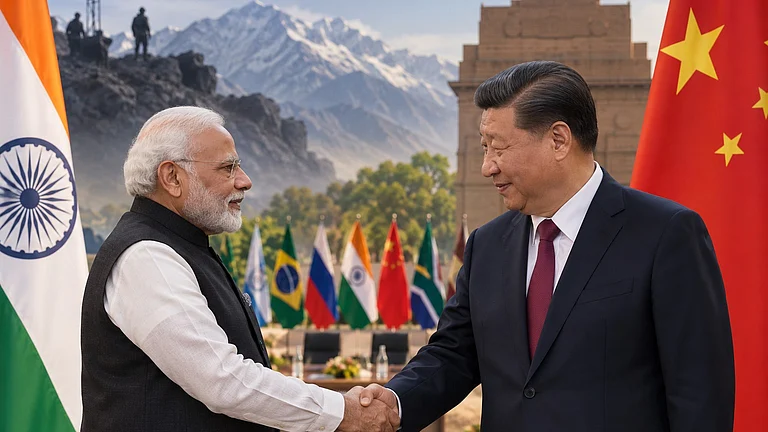
The 18th BRICS Summit, to be held in New Delhi on September 12-13, 2026, comes as the grouping enters a new phase following a major expansion in membership. What began as BRIC — Brazil, Russia, India and China — has evolved into a broader forum representing emerging and developing economies.
South Africa joined in 2011, while Egypt, Ethiopia, Iran, Saudi Arabia and the UAE became members in 2024. Indonesia followed in 2025, taking the total membership to 11, alongside partner countries.

1 October 2026
Get the latest issue of Outlook Business

India’s 2026 chairship is built around “Building for Resilience, Innovation, Cooperation and Sustainability”, with the agenda focused increasingly on practical economic and development cooperation rather than only geopolitical coordination.


From BRIC To A Larger Emerging-Market Bloc
BRIC’s first foreign ministers’ meeting was held on the sidelines of the UN General Assembly in 2006, followed by the first summit in Yekaterinburg in 2009.
Over time, the grouping has expanded both geographically and in terms of its economic priorities. Its discussions now cover trade, finance, technology, healthcare, agriculture, energy, climate, urban development and cooperation among businesses.
Advertisement
India’s challenge this year is to turn that wider membership into tangible outcomes despite differences among members.
India’s Four-Part Agenda
New Delhi’s chairship broadly revolves around four priorities. Resilience focuses on preparing economies and supply chains for geopolitical disruptions, climate events, health emergencies and other shocks.
Innovation emphasises areas such as artificial intelligence, fintech, digital public infrastructure and data-based solutions.
Cooperation covers trade, development finance, institutional coordination and greater economic engagement.
Sustainability centres on climate action, green financing, energy transition and sustainable development.
Trade And Supply Chains In Focus
Trade is expected to be a major component of the summit. India is pushing work on the BRICS Economic Partnership 2030, strengthening the multilateral trading system with the WTO at its core and improving the participation of smaller businesses in global value chains.
Advertisement
A proposed BRICS invoice discounting mechanism could help smaller exporters access trade finance, while principles for evaluating export-oriented MSMEs have also been adopted.
The BRICS Global Value Chains Action Plan 2026-2030 is another key initiative, aimed at making supply chains more diversified and resilient while encouraging investment and market access among members.
MSMEs And Startups
India is also seeking to make BRICS more relevant to smaller businesses and entrepreneurs.
The proposed BRICS MSME Cooperation Portal would link businesses with financial institutions, technology centres, training organisations and policymakers across member countries.
A BRICS Incubator Network is intended to connect startup incubators, while the proposed BRICS Startup Innovation Fund could provide financing to early- and growth-stage companies.
The impact of these initiatives, however, will depend on funding, implementation and participation from businesses.
Agriculture And Healthcare
Agriculture is another priority, with India promoting the BRICS Network on Digital Agriculture to encourage the use of AI, geospatial technology, digital infrastructure and data-driven farming solutions.
Other initiatives include a forum on farmers’ rights in seed systems and BRICS AGRIN, focused on agricultural inputs, genetic resources and information.
Healthcare cooperation has also expanded. The BRICS Health Ministerial Declaration adopted in July covers universal health coverage, pandemic preparedness, digital health, affordable medicines, vaccines and medical technologies. Mental-wellness cooperation, coordinated through NIMHANS, is another emerging area.
Energy, Climate And Urban Development
Energy security is particularly significant given the bloc’s mix of major producers, consumers and rapidly industrialising economies.
BRICS members have adopted principles covering smart grids and energy storage, along with a digital centre of excellence to support knowledge-sharing, capacity building and pilot projects.
The wider agenda includes renewables, hydrogen, biofuels, critical minerals, carbon capture and energy efficiency.
Climate resilience is also being incorporated into urban planning. Voluntary principles for climate-resilient urban infrastructure aim to encourage governments to account for climate and disaster risks in infrastructure decisions.
India is additionally pushing an urban research and knowledge network and a mobility hub focused on sustainable public transport, training and expert exchanges.
Digital Cooperation
Technology cuts across many of these initiatives. A proposed BRICS Digital Public Infrastructure Repository would facilitate knowledge-sharing and potential pilot projects, while digital tools are being incorporated into agriculture, healthcare, energy and public services.
For India, the broader objective is to position BRICS as a platform for practical cooperation on technologies and systems that can support development.
The Geopolitical Challenge
The biggest test for the Delhi summit could be maintaining consensus on geopolitical issues, particularly West Asia.
The expanded grouping brings together countries with differing regional interests and foreign-policy positions. With Iran and the UAE both members, for instance, the bloc may find it difficult to produce strong common positions on sensitive conflicts.
That makes India’s larger challenge clear: translate an increasingly diverse BRICS membership into practical economic cooperation while keeping political differences from derailing the grouping’s agenda.