






Sensex ends 4-day losing streak amid value buying in beaten-down stocks
Crude above $106 and FII selling keep market sentiment cautious
Gold, silver hit upper circuits after govt raises import duty to 15%
Benchmark stock market indices opened higher on Wednesday, snapping a four-session losing streak as investors resorted to value buying after the recent sharp correction, although elevated crude oil prices and continued foreign fund outflows capped gains.
At around 10:30 am, the BSE Sensex was up 157.16 points or 0.21% at 74,716.51, while the NSE Nifty50 gained nearly 82 points or 0.35% to trade around 23,462.

1 September 2026
Get the latest issue of Outlook Business

The recovery came after benchmark indices had fallen nearly 4% over the previous four sessions amid concerns over rising oil prices, weakening rupee and escalating tensions in West Asia. Despite the recovery, overall sentiment remained cautious due to continued uncertainty around the US-Iran conflict and fears of further pressure on India’s macroeconomic position.



Among Sensex gainers, Asian Paints rose 3.22%, while Adani Ports & Special Economic Zone gained 2%. Tata Steel, Bharat Electronics and Bharti Airtel also traded higher. On the losing side, Power Grid Corporation declined over 2%, while Titan, NTPC, Bajaj Finance and State Bank of India traded lower in early deals.
Crude Prices, Rupee Weakness Keep Investors Cautious
Brent crude continued to trade above $106 per barrel on Wednesday as hopes of an early resolution to the US-Iran conflict weakened further. The prolonged disruption in the Strait of Hormuz and uncertainty surrounding global oil supplies continued to remain a major concern for investors.
Advertisement
The Indian rupee had recently touched a fresh all-time low of 95.63 against the US dollar, adding to concerns over imported inflation and foreign capital outflows. Rising crude prices are expected to keep pressure on the currency in the near term.
VK Vijayakumar, Chief Investment Strategist at Geojit Investments, said the market had initially discounted an early resolution to the West Asia crisis and lower crude prices, but those expectations now appear increasingly difficult. He added that India’s macroeconomic risks have increased, while downside risks to growth and upside risks to inflation have also risen.
According to Vijayakumar, the continuing global AI trade and rising uncertainty around crude oil prices are likely to keep foreign institutional investors on the selling side. He advised investors to remain cautious and said pharmaceuticals appear relatively safer in the current environment, while long-term investors can gradually accumulate large banking stocks on declines.
Advertisement
FIIs Continue Selling
Foreign Institutional Investors remained net sellers in Indian equities, continuing the recent trend of capital outflows from domestic markets.
According to exchange data, FIIs sold shares worth ₹1,959.39 crore on Tuesday. Persistent foreign selling has remained one of the key reasons behind the weakness in benchmark indices over the past few sessions.
Analysts said foreign investors are increasingly shifting towards global AI-linked trades, particularly in markets such as the US, South Korea and Taiwan, where technology and semiconductor stocks have continued to rally sharply.
Global cues, however, remained supportive on Wednesday morning. Asian markets including Japan's Nikkei, South Korea's Kospi, Shanghai's SSE Composite and Hong Kong's Hang Seng traded in positive territory, helping Indian equities recover from early losses.

Gold, Silver Prices Surge After Import Duty Hike
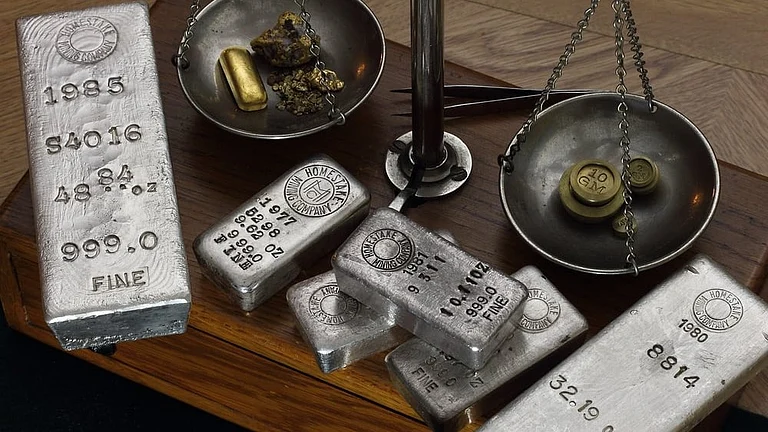
Bullion prices witnessed a massive rally after the government sharply increased import duties on gold and silver to 15% from 6% in an attempt to curb precious metal imports and reduce pressure on India’s foreign exchange reserves.
The move comes amid the ongoing geopolitical crisis and rising concerns over India's import bill due to elevated crude oil prices. The government's decision followed Prime Minister Narendra Modi's recent appeal urging citizens to avoid unnecessary gold purchases and reduce non-essential foreign exchange spending.
Following the duty hike, silver prices on the Multi Commodity Exchange hit the 6% upper circuit at ₹2.95 lakh per kg, while gold prices surged to the 6% upper circuit at ₹1.62 lakh per 10 grams.
In the international market, spot silver traded around $87.40 per ounce, while spot gold remained above $4,700 per ounce. Rising geopolitical uncertainty and fears of prolonged energy disruptions also boosted demand for safe-haven assets globally.
Despite the surge in bullion prices, jewellery stocks remained under heavy selling pressure due to fears of weaker consumer demand. Shares of Kalyan Jewellers fell more than 5%, while Sky Gold and Diamonds also declined sharply. Titan Company and PN Gadgil Jewellers traded lower as investors worried that higher gold prices and government discouragement of discretionary purchases could hit sales volumes in the coming months.









