




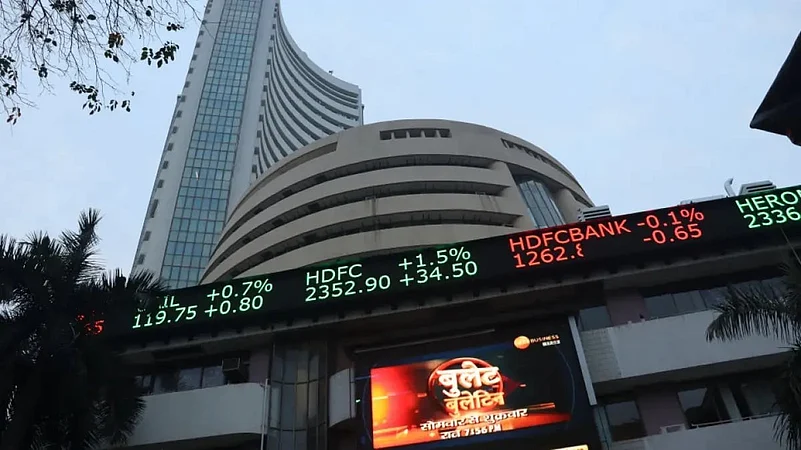

BSE falls for fifth straight session, down 8.62% in a week.
Jefferies, Nuvama downgrade BSE, citing options-volume and market-share concerns.
Closing auction session and tighter bank guarantee norms add pressure on trading volumes.
BSE shares extended their decline for the fifth consecutive session on Tuesday, with selling pressure intensifying after back-to-back rating downgrades from Jefferies and Nuvama Institutional Equities.
The stock fell to a low of ₹3,308 per share on the NSE, down 0.72%. In the previous session, BSE shares had settled 3.34% lower at ₹3,332. The stock has declined 8.62% over the past week.

1 September 2026
Get the latest issue of Outlook Business

Brokerages Flag Pressure On Options Volumes
Nuvama Institutional Equities downgraded BSE to "Hold" from "Buy" and cut its target price by 21% to ₹3,240. The brokerage cited concerns over the impact of the closing auction session on options volumes, tighter bank guarantee norms and limited scope for further market-share gains.


Nuvama also reduced its earnings-per-share estimates for BSE by 6.3% for FY27 and 15% for FY28.
Global brokerage Jefferies had earlier downgraded BSE to "Underperform" and reduced its target price by 16%.
According to Nuvama, BSE's average daily premium traded volume has fallen to its lowest level since January 2025 at ₹18,100 crore. The brokerage identified lower trading velocity and declining participation as key concerns.

Closing Auction Session Adds To Concerns
Nuvama said the introduction of the closing auction session has increased uncertainty around final settlement prices, making the path of option premium decay less predictable.
Advertisement
This has weakened theta-harvesting strategies and reduced leverage for buyers who relied on rapidly declining premiums. It has also affected seller participation because of greater uncertainty around option decay.
The impact has been particularly visible in expiry-day contracts, which declined 33.2%, compared with a 23.6% fall in non-expiry contracts, Nuvama said.
BSE's average daily premium traded volume market share has also declined 130 basis points from July to 36.3%.
Tighter bank guarantee norms from the Reserve Bank of India are another near-term headwind, according to Nuvama. The brokerage expects stricter collateral requirements to increase capital intensity for intermediaries and reduce turnover efficiency in high-frequency strategies.
Advertisement
Nuvama expects the impact to be gradual but believes the changes could limit BSE's recovery through FY28.
Further Market-Share Gains Seen As Limited
The brokerage also sees limited scope for further gains in BSE's contract market share, which is already around 52%. However, its share of average daily premium traded volume remains lower at about 36%, largely due to a lower contribution from non-expiry days.
"VIX recovery remains the key swing factor; a move to 16-18 could lift premium per contract," Nuvama said.
Jefferies, meanwhile, flagged risks to BSE's revenue from domestic proprietary traders, which account for nearly half of the exchange's notional turnover.
The brokerage also identified higher securities transaction tax, RBI's bank guarantee norms and changes to the closing auction session as key headwinds.
BSE's options average daily traded turnover has declined 12% month-on-month so far in August, Jefferies said, adding that the exchange's market-share gains outside T+0 and T+1 days have also slowed.









