
Women leaders often navigate dual expectations of authority and approachability
India is the fastest-growing major diamond market with strong long-term potential
Forevermark focuses on natural diamonds, traceability and premium global design
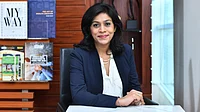
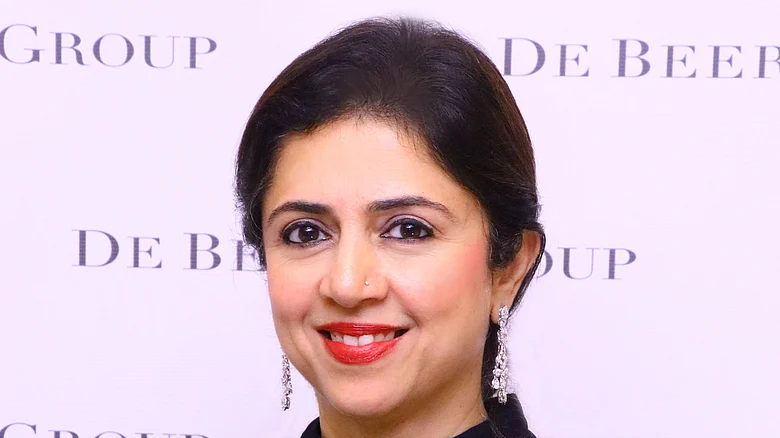
As a woman in top leadership, you often find yourself navigating a double-set of expectations. There is a constant push-and-pull between being authoritative and approachable. To get past them, you have to stay anchored in your 'why'...says Shweta Harit, Global Senior Vice President at De Beers Group and CEO of Forevermark.
On business, she mentions India as the fastest-growing major diamond market, with significant room for penetration compared to the US. She says that Forevermark will remain focused on natural diamonds, differentiating itself through strict selection standards, traceability from mine to finger, and international design tailored to Indian tastes.

1 October 2026
Get the latest issue of Outlook Business

In an interview with Outlook Business, Harit spoke about women's leadership, India’s growing importance in the global diamond market, and the brand’s focus on natural diamonds.
Edited Excerpts:
What has shaped your leadership journey has evolved over decades. the most?
My journey has been an evolution of purpose. I’ve always believed leadership isn't about the title on your door but about the depth of your impact. When I joined De Beers, I didn’t just find a company. I found a mission to make lives brilliant.
Working with a product that takes billions of years to create teaches you a specific kind of patience. It’s shaped my view of leadership. We are temporary guardians of these natural treasures. At De Beers, our 'Building Forever' ethos means every decision must create real value for the communities where we source these diamonds and the people who wear them. What cleared my path was a commitment to being authentically present. I’ve learned that when you lead with genuine care for people and the planet, you don’t just grow, you create a space where everyone is empowered to shine. My goal is to ensure our legacy is as enduring as the diamonds we discover.
Advertisement
As a woman in top leadership, what challenges have you faced?
As a woman in top leadership, you often find yourself navigating double set of expectations. There is a constant push-and-pull between being authoritative and approachable. I’ve always viewed these hurdles as catalysts for excellence. To get past them, you have to stay anchored in your 'why.' When you lead with a clear vision and a track record of delivery, the stereotypes eventually fade.
At De Beers, we recognise that inclusivity isn't a box to check; it’s a business imperative. We are focused on shaping the future by ensuring that the next generation of women leaders doesn't just have a path, but a platform. My philosophy is simple: as you rise, you must lift. Leadership isn't defined by gender. It’s defined by the courage to act with integrity and the vision to leave the world better than we found it. Barriers are only there to show us how far we can actually go.
Advertisement
How do you view India's diamond industry growth?
India has now become the number two diamond market in the world...actually India is growing at a 12% CAGR. In the last couple of years it has grown by 12% and we are estimating a similar growth in this year which is 10 to 12% which will make it the fastest growing market.
You’ve announced plans to open 100 Forevermark stores by 2030. Why focus on physical retail?
Forevermark is positioned as an internationally designed brand with a premium price point, and when we entered the Indian market, we consciously chose to retain that premium positioning.
While e-commerce is expanding rapidly, often with more affordable propositions, diamond jewellery remains a high-involvement purchase. Most customers are still hesitant to buy such pieces purely online without a physical touchpoint. Digital platforms certainly help us reach Tier 1 and Tier 2 cities more quickly, but when it comes to higher-value purchases, the journey becomes more assisted. It turns into a more personalised, almost VIP experience involving direct conversations over WhatsApp, sharing detailed videos and images because beyond a certain price, customers prefer to see and evaluate the product closely before making a decision.

You do not deal in lab-grown diamonds. Why is that?
Absolutely not.
Lab-grown and natural diamonds are fundamentally different products. Lab-grown diamonds are created in laboratories using high-pressure, high-temperature technology, whereas even the youngest natural diamond is around a billion years old, formed long before dinosaurs or humans existed. With natural diamonds, you are dealing with something that is truly a geological wonder.
The pricing dynamics are also very different. Lab-grown diamond prices have been falling sharply. Today, a one-carat lab-grown stone can cost as little as $50 at wholesale, roughly ₹5,000. That makes it a completely different value proposition. Jewellery, ultimately, is an end market with space for multiple segments, but lab-grown diamonds are increasingly moving toward the fashion and fast-fashion category rather than the realm of timeless, rare luxury.
What about resale value and appreciation of natural diamonds?
We offer both buy-back and exchange options, broadly in line with what market leader Tanishq provides. It’s close to a 100% buy-back value, and around 90% in the case of an exchange, ensuring customers feel secure about the long-term value of their purchase.
That said, comparing gold and diamonds can be challenging. Gold prices are heavily influenced by geopolitical factors and macroeconomic uncertainty. Diamonds, on the other hand, need to be viewed over a longer horizon. If you look at a 20-year period, diamond prices have largely held steady. There was a sharp spike post-Covid during the so-called “revenge buying” phase, but beyond that surge, prices have broadly stabilised when seen over the longer term.
How strategically important is India for De Beers globally?
When I look at any category or market, I focus on penetration levels. In the US, roughly 70 out of every 100 jewellery pieces sold are diamond. In India, that number is still only around 12 to 15. That clearly indicates significant headroom for growth.
The broader environment is also supportive. The economy remains stable, the middle class continues to expand, and wedding volumes are robust. These structural tailwinds give us confidence in the long-term opportunity, which is why we have chosen to expand our retail network here. We see India as the fastest-growing market for us and our number one focus market, with substantial room for further growth.
How does Forevermark differentiate itself in a competitive market?
For Forevermark, the starting point is our diamond standard. We are extremely selective about the stones we use and are the only brand that can tell the complete story from mine to finger.
We do not accept certain colours, and we avoid visible inclusions on the table of the diamond. That level of selection is why we describe them as the world’s most beautiful diamonds. Each one is handpicked to meet our criteria.
Design is another differentiator. Our studio is based in Milan, which gives us an international design language. At the same time, we adapt thoughtfully to the Indian market with modern mangalsutras serving a good example. Overall, our aesthetic remains global, and we are focused exclusively on diamonds.
How do you see Gen Z and branded jewellery evolving in India?
It's very early days for lab-grown in India. At a deeper level, Indians still believe in legacy. Every time I buy something, I think about what I can pass on. It’s in our culture.
India still has 60% of the jewellery market in the unorganised sector. There is a lot of shift yet to happen towards organised and branded retail. My sense is Gen Z will prefer branded jewellery over family jewellers. They will also want jewellery they can wear, not just store in lockers.
They’ll want to know where their diamonds came from. Since we own the mines, we can tell that story. Sustainability will matter.
What are the biggest challenges and opportunities ahead? How much market share are you targeting?
You have to have a unique proposition. I am the only one who can talk about the “mine to finger” story. Forevermark has an inscription on every stone, a unique number. Not every diamond qualifies to be a Forevermark diamond. That differentiation matters.
It’s too early to talk about market share. We started retail three months ago. When I get to 100 million, I think I’ll be at 1%.