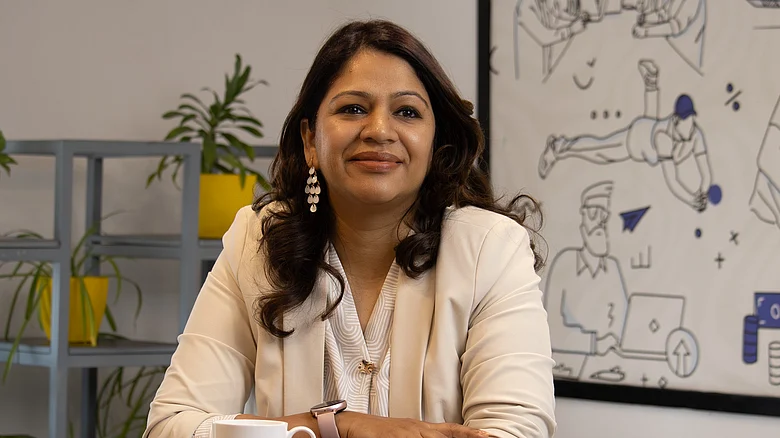

Leadership roles come with scrutiny and accountability and it is not gender-specific, says Paisabazaar CEO Santosh Agarwal.
She joined the fintech firm as an Assistant Manager in 2011 and rose through the ranks to lead a key vertical at the PB Fintech group.
Agarwal credits the culture at Policybazaar and Paisabazaar for prioritising merit, consumer value and long-term business outcomes.
Leadership roles always come with scrutiny and accountability, and it’s part of the job rather than something gender-specific, according to Paisabazaar CEO Santosh Agarwal. She joined the fintech firm as an Assistant Manager in 2011 and has since climbed the ranks to lead one of the key verticals of the PB Fintech group.
"When you are responsible for millions of consumers and large teams, performance is constantly evaluated... What has helped me immensely is the culture of the organisation. Both Policybazaar and Paisabazaar have built systems that prioritise merit, consumer value and long-term business outcomes over anything else," Agarwal told Outlook Business in an interview.

1 October 2026
Get the latest issue of Outlook Business

She also discussed her 16-year journey at the firm, including her maternity break and the responsibilities that come with leading a large financial services company.
"I do think visibility matters. When more women lead large platforms, it normalises leadership diversity. But the real goal is to reach a point where it is no longer noteworthy — just expected," Agarwal said ahead of International Women’s Day (IWD) 2026.
Advertisement
Here are the edited excerpts from the interview:
Fintech talks a lot about inclusion. But are financial products in India truly designed with women in mind, or are women still treated as a niche segment rather than the default customer?
In India, financial decision-making at the household level has traditionally been male-led. While more women today are financially independent and earning, participation in formal financial products still lags. At Paisabazaar, for instance, women account for roughly 10% of our 5.7 crore consumer base.
A significant proportion of women even today still rely on fathers or spouses for major financial decisions like tax planning and investments, which indicates that behavioural and awareness gaps persist alongside access gaps.
The industry has made progress — we see Banks offering preferential home loan rates for women, specialised savings products, and targeted business loans. But I would say that the financial services industry still has a large opportunity to treat women as a core customer segment by developing more products tailored to their income patterns, career breaks, entrepreneurship journeys, and risk preferences.
The larger issue, however, is financial literacy. Personal finance needs to be embedded into mainstream education as a life skill — not just for women, but for all young Indians. Sustainable inclusion will come when financial confidence grows alongside financial independence.
Advertisement
Women remain underrepresented in senior roles across financial services. From your experience, what is the one structural change that would genuinely move the needle, not just optics?
If I had to choose one structural shift, I would want to see more women hold core business and P&L roles early in their careers. I think women are still well-represented in HR, marketing, or compliance, but fewer are systematically placed in leadership tracks for business, sales, or technology. If women are not present there early, representation at the top will naturally remain limited.
Another challenge is rethinking career continuity. Women’s careers are often non-linear due to life stages. Organisations need structured returnship programs, role redesign, and performance frameworks that recognise outcomes over presenteeism.

You returned to work soon after childbirth and have spoken about that phase. Looking back now as CEO, what is the responsibility of leadership in making that transition easier for other women?
Returning to work after childbirth is deeply personal and often overwhelming for new mothers. Looking back, I realise how important it is for organisations to allow women to transition back at their own pace.
I chose to resume work 90 days after childbirth, initially for shorter hours, and that gradual re-entry helped me reclaim my professional rhythm. The support from the Policybazaar leadership, my team and my family was instrumental in easing my return to work.
I strongly believe the responsibility from a leadership standpoint goes beyond maternity policies. It is about building a culture where motherhood is not seen as a career disruption, but as a life stage that can coexist with ambition. Flexible work models, empathetic managers, and outcome-driven performance evaluation make a meaningful difference. Even more important is removing the unspoken pressure to “prove commitment” after returning.
A career spans three to four decades — a few months or even a year of pause does not define long-term growth. In fact, motherhood builds resilience, patience, adaptability and sharper prioritisation — qualities that strengthen leadership.
When organisations move from token gestures to real structural support, they don’t just retain women — they build stronger, more balanced leadership teams.
As one of the few women leading a large fintech platform, do you feel the scrutiny or expectations placed on you are different?
Leadership roles always come with scrutiny and accountability — and rightly so. When you are responsible for millions of consumers and large teams, performance is constantly evaluated. I have always viewed that as part of the job rather than something gender-specific.
What has helped me immensely is the culture of the organisation. Both Policybazaar and Paisabazaar have built systems that prioritise merit, consumer value, and long-term business outcomes over anything else. My 16-year journey at the Group — from leading the life insurance business at Policybazaar to now serving as CEO of Paisabazaar—reflects that culture. Growth here has been driven by performance and impact, not by gender.
For the founders and leadership here, the belief has always been simple: if you deliver value to consumers and build sustainable businesses, you will grow. That fairness and transparency make ambition possible — for everyone.
I do think visibility matters. When more women lead large platforms, it normalises leadership diversity. But the real goal is to reach a point where it is no longer noteworthy — just expected.
Paisabazaar is expanding its product universe. As you build for the next phase, how do you ensure women customers are not an afterthought in product design and distribution?
At Paisabazaar, we rely heavily on consumer data and behaviour insights to shape product journeys. I think the starting point is to stop thinking of women as a niche segment. Women are not a sub-category of consumers — they are half the market. Product design must reflect that reality.
Distribution is equally important. Digital access has improved significantly, but awareness and financial confidence gaps remain across several segments, including women. That is why free credit score access, simplified comparison tools, and educational content are critical levers — they lower entry barriers.
As we expand into payments, savings, and investments, our objective is to build intuitive, transparent, and trust-led journeys that work for diverse life stages and financial realities. Inclusion cannot be a campaign — it has to be embedded in how products are structured, priced, and presented.
In your journey through fintech, what has changed the most for women in the industry over the past decade and what has stubbornly not changed?
A decade ago, fintech itself was nascent. Today, it is a key part of the financial services industry. What fintechs have done is present new opportunities and built access – to opportunity, to capital and to leadership roles. Today, more women than ever are raising capital, leading P&Ls and building scalable businesses.
One change I would like to see is mid-career attrition. Many ambitious and talented women still have to drop off at life stages such as motherhood, because of lack of structural support and the fact that shared caregiving norms are still evolving. That’s also a reason representation thins out sharply at senior-most decision-making levels.
If a 25-year-old woman wanted to build a long career in finance or even start her own fintech, what would you tell her that you wish someone had told you?
Be the most prepared and the most disciplined person in the room. Talent matters, but consistency and integrity matter more over the long term.
Do the hard work: understand your domain deeply, ask questions, and build expertise. When you combine competence with character, you naturally become a force to be reckoned with.
Expect tough challenges along the way, but always have faith in your capability.
And don’t hesitate to go the extra mile for something you genuinely believe in. Careers are long. If you stay curious, resilient, and committed to learning, the opportunities will follow.