
The power sector must accelerate decarbonisation, with the transition to SF6-free technologies emerging as a key step towards cleaner and more sustainable electricity infrastructure
India has begun adopting SF6-free switchgear, but a broader industry push backed by clear policy and regulatory support is needed
Collaboration between industry, utilities and policymakers can help accelerate innovation and create a roadmap for widespread adoption
The power industry is a crucial front in the pressing global effort to mitigate climate change. It is essential to move towards decarbonisation and efficiency in the production, transmission, and distribution of power.
In this endeavour, the transition toward Sulphur hexafluoride (SF6) - free technologies presents a significant opportunity to build cleaner, more sustainable, and future-ready power infrastructure.

1 September 2026
Get the latest issue of Outlook Business

As India rapidly expands its power distribution infrastructure to support industrial growth, renewable integration, electric mobility, and urbanisation, the choices made today will shape the environmental footprint of the grid for decades.
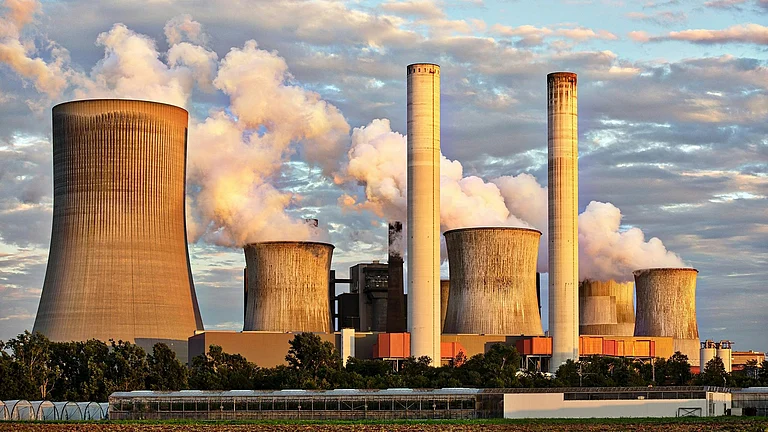

A recent International Energy Agency (IEA) report indicates that the global power industry is responsible for contributing disproportionately to energy-related greenhouse emissions, thereby further necessitating urgent decarbonisation.
Why SF-6 Matters
One such contributor to greenhouse gas emissions is SF6. SF6 is being used as an insulating medium in electrical equipment, primarily due to its superior dielectric strength and arc quenching capabilities. It also has a strong potential to cause global warming.
Advertisement
As such, SF6 alternatives must be included in order to achieve sustainable electrical infrastructure. These substitutes not only provide equivalent functionality, but also considerably lessen the carbon footprint linked to electrical operations.
Making the switch to these environmental-friendly options is a concrete step toward meeting the emission reduction targets set forth in global climate agreements.
The need to decarbonise power infrastructure is made more urgent by the growing electrification of daily life and industry, including the emergence of electric vehicles and the skyrocketing need for cooling that requires a lot of electricity. Modern society's reliance on electricity for basic services and economic activity could be severely disrupted if significant progress is not made in lowering emissions from these systems.
Advertisement
Thus, achieving sustainability in electrical systems is essential to the larger endeavour of halting climate change and ensuring a low-carbon, resilient future.
The Environmental Cost of SF6
Sulphur hexafluoride (SF6) has long been used as an insulating medium in electrical equipment because of its superior dielectric strength and arc-quenching capabilities.
However, despite its technical efficiency, SF6 is also one of the most potent greenhouse gases recognized under the Kyoto Protocol (1997), with a global warming potential (GWP) nearly 23,500 times greater than CO2 over a 100-year period. Adding to the concern, SF6 remains in the atmosphere for nearly 3,200 years.
The widespread use of SF6 in medium-voltage (MV) switchgear and other electrical equipment therefore presents a significant environmental challenge. This impact is further exacerbated by leakages during equipment operation, maintenance, and end-of-life handling, increasing the urgency for cleaner and more sustainable alternatives.
As global climate commitments intensify, reducing dependence on SF6 has become critical to building environmentally responsible and future-ready power infrastructure. Considering India’s updated Nationally Determined Contribution (NDC) targets to reduce 47% emissions by 2035 and achieve net-zero emissions by 2070, the transition toward SF6-free technologies is becoming increasingly important.
This shift will require stronger adoption of sustainable alternatives, improved end-of-life handling procedures, and a broader transformation in the way power infrastructure is designed and deployed.
Transitioning to Alternative Technologies
The search for viable alternatives to SF6 has accelerated innovation in sustainable switchgear technologies. These substitutes not only lessen the potential harm that SF6 poses to the environment, but they also enhance operational dependability and energy efficiency. The goal of MV switchgear innovations is to swap out SF6 with environmental-friendly alternatives that work with renewable energy systems.
Today fully tested and validated SF6-free GIS and RMU technology solutions exist with the leading OEMs electrical industry. These technologies are witnessing growing adoption globally among utilities and industrial customers. It’s time for India to take SF6-free switchgear adoption as a mission, given the growing demand of electrical infrastructure in coming years.
Encouragingly, utilities in India have already begun adopting SF6-free technologies to support cleaner power distribution infrastructure. Recently, a utility in Delhi deployed a sustainable-pure air Ring Main Unit (RMU) pilot project in the state, replacing SF6 with pure air insulation. The deployment is estimated to reduce nearly 75 tons of CO2 equivalent emissions during the capex phase alone.
Similarly, another one in Mumbai has also introduced SF6-free RMUs as part of its efforts to build more sustainable and future-ready distribution networks. These initiatives signal a growing shift toward environmentally responsible grid infrastructure in India.
Collaborative Initiatives and Regulatory Actions
Cooperative efforts and regulatory steps are needed across national and international levels to address hazardous nature of prolonged SF6 usage and hasten the implementation of alternative technologies. Industry partnerships, research collaborations, and knowledge-sharing platforms, can fuel innovation which is essential to the development of sustainable solutions.
At the same time, regulatory bodies should establish clear SF6 phaseout timelines for new medium-voltage (MV) installations, aligned with India’s Nationally Determined Contribution (NDC) targets. The European Union, under its revised F-gas regulations, has already announced restrictions on the installation of new SF6-based electrical equipment from January 2026 in several applications where viable alternatives exist.
India should similarly work toward a phased roadmap for SF6-free infrastructure adoption to accelerate the transition toward cleaner and future-ready power distribution systems, while ensuring compliance with safety, reliability, and performance standards.
(This article has been authored by Udai Singh, MD & CEO, Schneider Electric Infra Ltd. & Vice President-Power Systems, Schneider Electric India. Views expressed are personal)