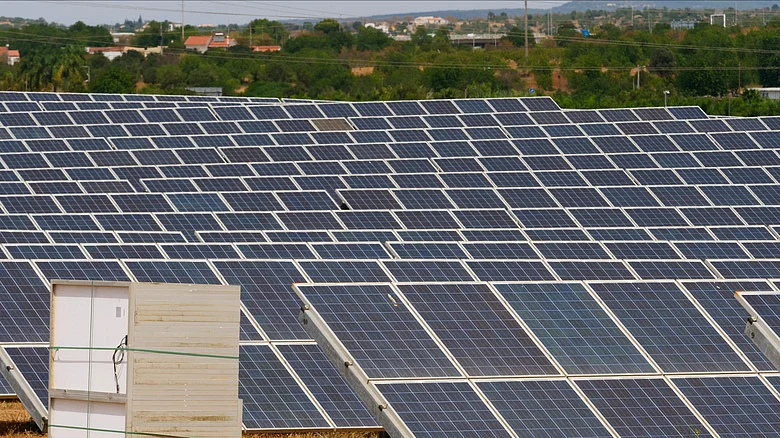

India’s daytime solar surplus is crashing electricity prices and increasing power curtailment nationwide.
Storage, flexible contracts and demand shifts are emerging as critical grid solutions.
Without reforms, rising solar additions could worsen curtailment and weaken renewable investment economics.
On 3 May, the price of electricity on India’s main power exchange fell to ₹1.85 a unit by 8 am — and kept falling. Through midday, power was selling at close to zero Rupee, with solar plants offering six times more than the grid could absorb. By evening, prices climbed back to ₹4–5 a unit, many times the daytime rate. Between May and December last year, India lost 2.3bn units of solar power. Plants ordered to stop producing because the grid had no place to send it. India is no longer short of electricity. It is short of the right hours.
The 2025 capacity story was, in one sense, spectacular. India added 38 GW of solar in a single year, crossed 52% non-fossil installed capacity by January 2026, and clocked an all-time peak demand of 256.1 GW in April. Solar carried 34% of midday supply on that record day. By 10:30 pm, with the sun gone, thermal coverage had spiked back to 76%. A 23-percentage-point swing in fossil dependence inside ten hours is the duck curve, and it is no longer a slide in a planner’s deck.

1 October 2026
Get the latest issue of Outlook Business

The exchange numbers tell the same story in Rupees. Trading volume on IEX rose 17% in FY26 to a record 141 BU, yet day-ahead prices fell 13.7% and real-time prices 16% year-on-year. The gap between average midday and late-evening prices has stretched from ₹1.5/kWh in 2019 to ₹7.5/kWh by summer 2025. Cheap solar is cannibalising its own revenue. Punjab’s regulator has read the signal. It rejected a 2,200 MW SECI solar contract because its landed cost of ₹3.03/kWh exceeded what un-firmed daytime power was worth to the state. Vanilla solar, on its own, is no longer purchasable at scale.
Advertisement
The Fix Is Not Less Solar
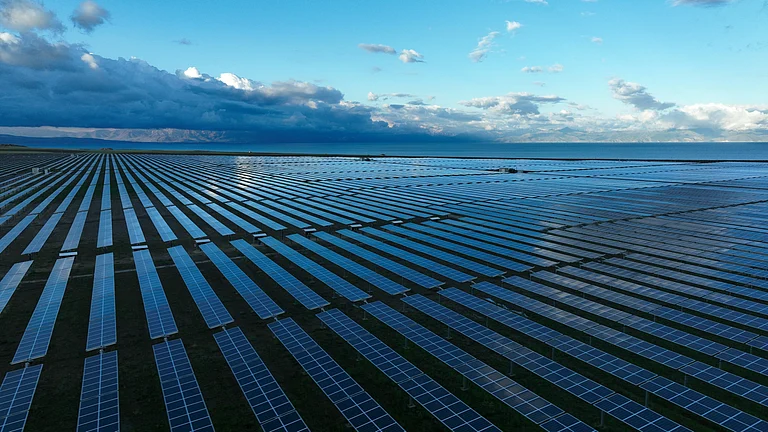
It is firmness - storage, smarter contracts and a demand curve that bends to the sun.
First, let’s look at storage. The Central Electricity Authority’s adequacy plan calls for 174 GW of storage delivering 888 GWh by 2035-36, split between 80 GW of batteries and 94 GW of pumped hydro. The economics finally allow it. Discovered BESS tariffs have collapsed 79%, from ₹10.84 lakh/MW/month in late 2022 to ₹3.81 lakh by late 2024. A merchant battery that charges at ₹2.6/kWh in the afternoon and discharges into the evening peak clears about ₹2.5/kWh per cycle, with internal rates of return of 17 to 24%. Storage is now a bankable asset class, not a subsidy line.
Advertisement
Second, the way India buys power must change. The standard solar contract pays the developer for whatever the panels produce. That model is finished. SECI, the government’s solar buyer, has launched a 500 MW tender requiring developers to deliver a fixed block of evening power between 6 pm and midnight, straight into the exchange. A price guarantee covers them if rates fall, with windfalls clawed back when rates spike. The older ‘firm-power’ contracts have stalled, states refused to sign for nearly 40 GW because the costs and penalties were too high. This is what a high-solar grid need.
Third, demand must move. Time-of-day pricing already lets factories save 10–20% on their bill by running heavy machinery during sunshine hours. Farms take nearly a fifth of demand in Maharashtra, Punjab and Rajasthan; pumps do not mind when they run. Dedicated solar lines from 11 am to 3 pm absorb the surplus and lift the same load off the evening peak. EV chargers at offices turn the 6 pm crunch into a midday opportunity. None of this need new generation. It needs markets that price the hour as carefully as they price the kilowatt.
The manufacturing flank sharpens the stakes. Domestic module capacity has grown from 8 GW in 2017 to 68.4 GW today; US tariffs of 126% crashed exports by 35% in early 2026. Cheap modules will keep flowing into a grid that cannot absorb their daytime output unless storage and demand reform run alongside. Without that pairing, every new megawatt makes curtailment worse, not better.

Harnessing Solar Hours
The CEA’s blueprint for 1,121 GW of installed capacity by 2035-36 is, at its core, a flexibility plan. Capacity wins headlines. Flexibility wins lender confidence — and the manufacturing FDI that follows a stable grid. India has spent fifteen years installing the panels. The next ten will be decided by what it builds around them. The grid does not need more solar. It needs more solar hours.
(Sumedh Agarwal is Director - Smart and Resilient Power and Mobility, Alliance for an Energy Efficient Economy. The views expressed are personal.)