India–Russia trade tops $70bn but stays sharply skewed towards Russian imports.
India exports pitched in autos, electronics, machinery, textiles and food.
2% import share for India in Russia seen as major growth headroom.
Russia’s 3mn skilled-worker deficit framed as talent opportunity for India.
Commerce and Industry Minister Piyush Goyal on Thursday called for a more balanced and broad-based trade relationship with Russia, urging Indian industry to seize what he described as an unprecedented opportunity in the Russian market. Speaking at the India–Russia Business Forum organised by FICCI, Goyal said Indian firms now have a clear opening to expand their footprint across multiple sectors.
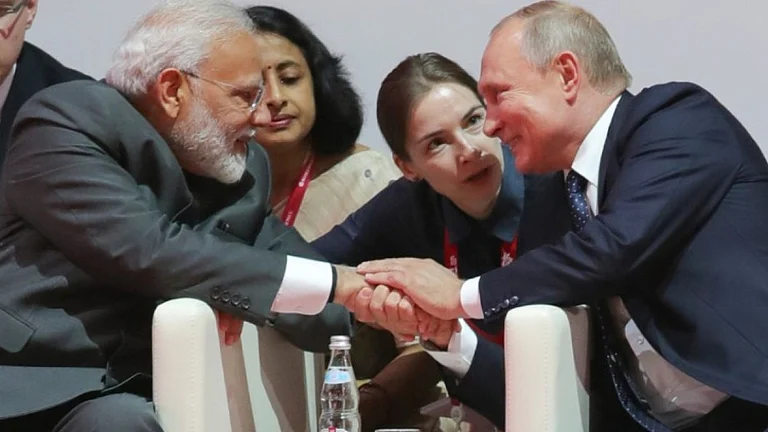
Goyal said bilateral trade has already surged past $70bn, more than double the target set by Prime Minister Narendra Modi and President Vladimir Putin for 2025. But behind the headline number lies the real story: the trade is heavily tilted in Russia’s favour, and India wants to correct that imbalance.

1 September 2026
Get the latest issue of Outlook Business

According to official data, India–Russia trade reached a record $68.7bn in FY2024–25, nearly 5.8 times the pre-pandemic level of $10.1bn. India exported $4.88bn worth of goods to Russia, while imports stood at $63.84bn, mostly driven by energy purchases. Both countries have now set a fresh target of pushing trade to $100bn by 2030.
Advertisement
“If our business communities take a leap of faith, I am confident we can unlock this untapped potential, address the trade imbalance, reduce barriers and create the right conditions for businesses on both sides to grow. This is why the theme of today’s forum — ‘Sell to Russia’ — with its focus on balanced and shared growth, is so timely,” Goyal said.
He highlighted strong demand in Russia for automobiles — from cars and tractors to heavy commercial vehicles — as well as electronics, smartphones, data-processing equipment, heavy machinery, industrial components, textiles and food products.
Advertisement
The Minister also pitched India’s workforce as a strategic offering. Russia is estimated to have a shortage of around three million skilled workers, a gap Goyal believes India can help bridge, given its 2.4mn annual STEM graduates.
“I can assure you, our young people are not only extremely hard-working; they won’t complain that it’s Friday evening or Saturday and time to switch off. Our young men and women are driven, and if the need arises, they are willing to work seven days a week,” he said.
Maxim Oreshkin, Deputy Chief of Staff of the Presidential Executive Office of the Russian Federation, echoed the sentiment, noting that the Russian delegation had arrived with a “very specific goal” — to significantly increase purchases of Indian goods and services. He added that India’s share in Russia’s total imports is still below 2% and needs to rise substantially.