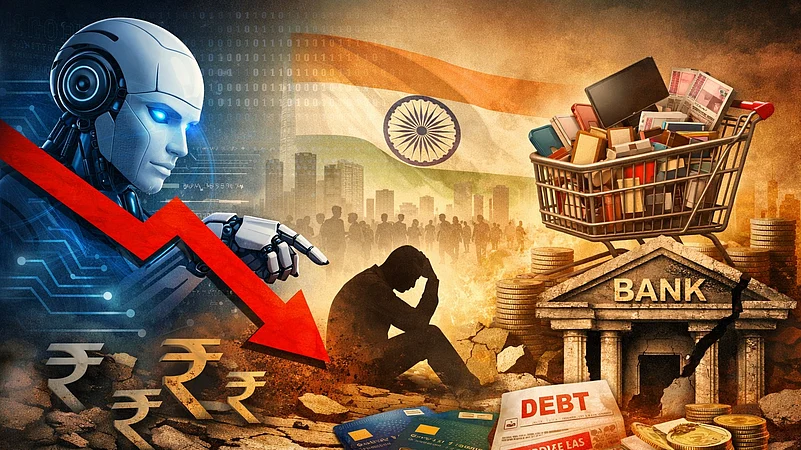

IT and BPO jobs face disruption from generative AI dominance abroad.
Manufacturing remains shallow, with high import dependence (e.g. EV batteries).
Agriculture inefficiencies and rising subsidies weigh on long-term productivity.
India faces a narrowing window to restructure its economy or risk entrenching itself as a low-productivity, technology-dependent nation, according to an open letter written by Bernstein to Prime Minister Narendra Modi on Thursday.
"The last six years demonstrate what India can do when policy is aligned," the note said, citing stronger macro stability and earnings growth driven by a shift toward capital expenditure. "But they also carry a risk: the temptation to extrapolate recent success and underplay how much further there is to go."

1 September 2026
Get the latest issue of Outlook Business

The Employment
The note's central concern is jobs. India's IT services and BPO sectors, which employ roughly 10-15mn people and underpin what Bernstein describes as the aspirational middle class, are directly exposed to automation by generative artificial intelligence (Gen AI).
The surplus value from those technologies — models, platforms, intellectual property — remains concentrated in the United States and, to a lesser extent, China. India, the report warns, risks becoming a permanent consumer in the AI economy without building domestic capability in foundation models or compute infrastructure.

Advertisement
Manufacturing's Shallow Roots
Manufacturing offers limited relief. Despite momentum from production-linked incentive schemes, the sector's share of GDP remains at roughly 16-17%, with employment concentrated in low-productivity informal services.
Even in electric vehicles, battery cells accounting for 30-40% of vehicle costs are largely imported. The China-plus-one opportunity, the report notes, has proved considerably harder to convert into actual factories and jobs than early headlines suggested.
Agriculture Unreformed
Around 42-45% of India's workforce remains tied to a sector contributing only 15-16% of GDP. Average landholdings sit below one hectare, close to half of cultivated land remains monsoon-dependent, and policy continues to rely on loan waivers and input subsidies — now costing ₹3 to 4trn annually. Bernstein calls for these to be phased out and replaced with post-procurement transfers that avoid distorting retail prices and input use.
Advertisement
The subsidy drag
State-level cash transfer schemes directed at women alone now carry combined annual outlays of approximately ₹1.7-2.5trn, or around 0.5 per cent of GDP. In states where such schemes absorb 2-3% of gross state domestic product, the report argues they inevitably squeeze capital expenditure on roads, irrigation, power distribution and hospitals — areas with higher long-term productivity multipliers.