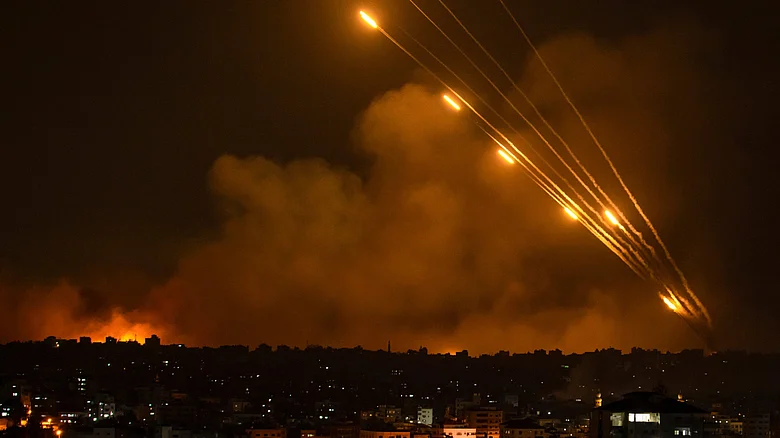

The Iran-Israel conflict threatens to disrupt the Strait of Hormuz, through which 20% of global oil passes daily, directly hitting India's fuel and import costs.
The last Gulf War left India with barely two weeks of import money, forcing the government to secretly airlift 67 tonnes of gold abroad just to avoid bankruptcy.
India enters this crisis far stronger with $720 billion in forex reserves, but the Finance Ministry warns the risks are real.
As the conflict between Iran and a US-Israel alliance crossed nearly a week of fighting, the Finance Ministry released its Monthly Economic Review for February. The report cautioned that the war's economic consequences for the country could be far-reaching and may not be immediately visible.
"The implications of this conflict for India are significant and may be longer-lasting in ways that are not immediately understood," the review stated, adding that no one yet knows how the conflict will eventually end.

1 October 2026
Get the latest issue of Outlook Business

Why Should India Be Worried?
It comes down to one thing, oil. A critical shipping lane, the Strait of Hormuz, a narrow stretch of water near Iran, is the passage through which roughly 20% of the world's oil supply travels every day. If this route gets disrupted or blocked, the price of crude oil worldwide would shoot up almost immediately.


India imports over 85% of its crude oil needs, making it one of the most oil-dependent large economies in the world. A spike in oil prices means higher costs for fuel, transport, electricity, and manufactured goods.
Advertisement
The Finance Ministry's review warned that if the strait stays vulnerable, "the geopolitical risk premium in oil prices will inevitably return." It also cautioned that even if the conflict appears to end, the calm could be temporary if the deeper tensions between the major powers in the region are not actually resolved.

The 1991 Flashback
Ministry analysts compared the current situation to the 1991 Gulf War, a conflict that pushed India to the very edge of economic collapse.
The 1991 balance-of-payments crisis is widely regarded as one of the most severe economic emergencies in India's post-independence history. At its peak, the crisis forced the government to pledge part of the country's gold reserves to raise foreign currency and avoid default. The immediate trigger was the Gulf War, which erupted after Iraq's invasion of Kuwait in 1990.
Advertisement
Point to note: Foreign exchange reserves are the stock of foreign currencies, gold, and other international assets held by a country’s central bank, like Reserve Bank of India (RBI). These reserves are used to pay for essential imports, service external debt, and stabilise the national currency during crises.
In early 1991, India's foreign exchange reserves had fallen to just $1-1.2 billion, barely enough to cover two to three weeks of imports.
This was a genuine crisis; if no dollars came in quickly, India would not have been able to pay for the oil it needed to keep the economy running.
How Did India Get There?
India's finances were already under strain in the late 1980s. The government had been borrowing heavily to fund growth, leaving the country vulnerable to any outside shock, according to assessments by the International Monetary Fund.
Then, in August 1990, Iraq invaded Kuwait, triggering the Gulf War. Three things hit India at once. First, oil prices surged, making India's already large import bill even bigger. Then, trade routes in West Asia were disrupted, hurting Indian exports. And, third, Indian workers in the Gulf returned home, cutting off a major source of remittances (money sent back to families in India).
The Gold Airlift
When India's foreign exchange ran critically low, the government turned to its most fundamental financial backstop, that is, gold.
Point to note: Gold is the ultimate emergency asset. Unlike currencies, which can lose value overnight, gold holds universal worth and can be pledged as collateral (security) to borrow money from international lenders.
According to official RBI records, India pledged approximately 67 tonnes of gold to raise emergency funds. Around 47 tonnes were airlifted to the Bank of England and 20 tonnes were pledged to the Union Bank of Switzerland. Together, this raised roughly $600 million in foreign currency, enough to meet India's immediate payment obligations and avoid defaulting on its international debts.
The operation was carried out in complete secrecy in May 1991. The government feared that if ordinary citizens or financial markets found out that India was literally flying its gold reserves abroad, it would trigger widespread panic.
When the news eventually became public, it caused a massive political storm. Critics accused the government of "pawning the nation's gold."
Journalist Vinay Sitapati, in his acclaimed biography Half Lion: How P.V. Narasimha Rao Transformed India, described the moment vividly. When Prime Minister Narasimha Rao took office in June 1991, his officials warned him that India could default on its international obligations within weeks. The gold pledge was "politically humiliating but economically unavoidable," Sitapati wrote.
RBI itself later acknowledged that the gold pledge was a temporary fix. It eased the immediate pressure but was "not sufficient to completely absolve the country of the crisis."

Reforms That Followed
The 1991 crisis ultimately forced India to completely rethink its economic model. Under Prime Minister Narasimha Rao and Finance Minister Manmohan Singh, the government launched sweeping economic reforms. Industries were deregulated, the Licence Raj was largely dismantled, import restrictions were reduced, and foreign investment was welcomed into sectors that had been closed off for decades.
These reforms fundamentally reshaped India's economic trajectory and set the stage for the rapid growth that followed through the 1990s and 2000s.

Where Does India Stand Today?
The Finance Ministry is clear that India's position in 2026 is vastly stronger than it was in 1991.
The country's foreign exchange reserves currently stand at over $720 billion, enough to cover months of imports. This gives RBI huge capacity to defend the rupee and absorb external shocks without any panic.
The ministry's review summarised India's current macroeconomic position favourably. "Growth is solid, inflation is moderate, credit growth is healthy, the fiscal deficit is under control, and external stability is intact," the review mentioned.