Global Cooperation Barometer 2026 reveals pressure on multilateral institutions caused global cooperation to evolve than retreat.
While multilateral forms of cooperation declined, smaller coalitions of countries maintained overall cooperation levels.
Climate and tech saw strong increases in cooperation even in face of headwinds.
Global cooperation has shown resilience even as traditional multilateralism faces strong headwinds, according to the World Economic Forum’s Global Cooperation Barometer 2026.
The parameter, which uses trade, climate, natural capital as well as technology as its “pillars”, shows that despite continued fragmentation, geopolitical tensions and increasing trade barriers, global cooperation is proving resilient and is evolving rather than retreating.

1 October 2026
Get the latest issue of Outlook Business

The findings come on the same day the United States government, led by President Donald Trump, announced its exit from 66 international organisations, including those of the United Nations. Since coming to the White House for the second time in 2025, President Trump has disrupted global trade alliances with massive tariffs and threats of US sanctions on China, Russia and other geopolitical rivals.



The World Economic Forum and McKinsey & Company has not named President Trump in their report.
However, Børge Brende, President and CEO of the World Economic Forum, said, “Amid one of the most volatile and uncertain periods in decades, cooperation has shown resilience.”
Advertisement
“While cooperation today may look different than it did yesterday, collaborative approaches are essential to grow economies wisely, accelerate innovation responsibly and prepare for the challenges of a more uncertain era. Flexible, nimble and purpose-driven approaches are most likely to withstand the current turbulence and deliver results,” he added.

According to the Global Cooperation Barometer 2026, global cooperation is “reinventing itself”. The Global Cooperation Barometer – first launched in 2024 – evaluates global collaboration across five interconnected dimensions: trade and capital; innovation and technology; climate and natural capital; health and wellness; and peace and security.
Advertisement
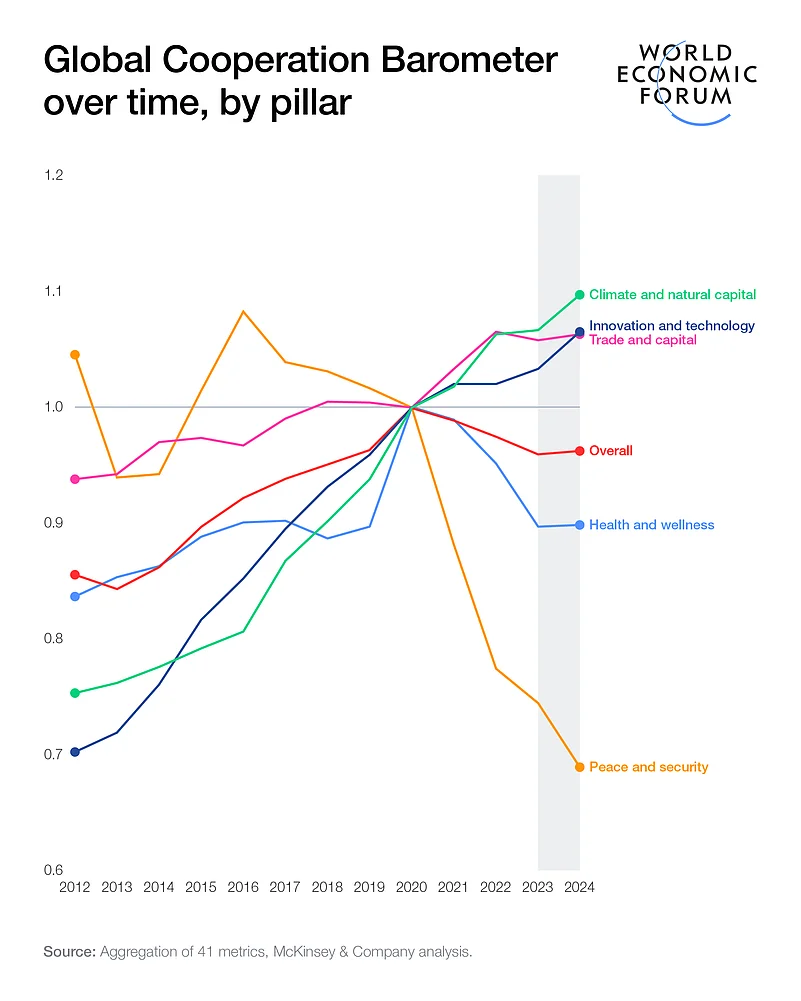
Its parameter shows that trade and capital cooperation remained flat until 2025, staying above 2019 levels but changing in composition.
Goods trade grew more slowly than the global economy, with flows shifting towards aligned partners. Services and select capital flows gained momentum, particularly where they support domestic capabilities.
Innovation and technology cooperation rose despite tighter controls, the report noted. IT services, talent flows and international bandwidth expanded, now four times pre-COVID levels.
Restrictions on critical technologies increased, especially between the United States and China, but new cooperation formats emerged in areas such as AI and 5G among aligned economies.
Climate and natural capital cooperation increased but remains short of global goals. Clean technology deployment hit record levels in mid-2025, driven by global supply chains and financing. While China accounted for two-thirds of new solar, wind and EV capacity, other developing economies also stepped up. With multilateral talks becoming harder, blocs like the EU and ASEAN are linking decarbonisation with energy security.
Global Cooperation Reinventing Itself
“Leaders are reimagining collaboration across borders,” said Bob Sternfels, Global Managing Partner at McKinsey & Company. “Cooperation may look different today, and involve different partners, but importantly, it continues to deliver on some critical shared priorities.”
Health and wellness cooperation has held steady, as per the WEF Barometer, supported by improving post-pandemic outcomes. However, this stability masks growing strain, as pressures on multilateral institutions reduced support flows. Development assistance for health contracted sharply, with further tightening in 2025, hitting low- and middle-income countries hardest.
Peace and security cooperation continued to decline, with all indicators falling below pre-COVID levels. Conflicts intensified, military spending rose and multilateral mechanisms struggled. By end-2024, forcibly displaced people reached a record 123 million, though rising pressures are prompting renewed efforts through regional peacekeeping initiatives.
However, overall cooperation still falls short of what is needed to tackle major economic, security and environmental challenges.
The Global Cooperation Barometer shows countries are rewriting the way they engage in cooperation, but concludes by stressing the need for leaders to focus on “rebuilding an effective dialogue with partners” as the foundation for identifying and advancing shared interests.