
Taxation must not dictate business decisions, including those related to buybacks and dividend payouts
Higher taxes may curb speculative participation in futures and options, but the result will show in changes in volumes and investor profiles
Government will no longer dictate investment decisions through taxation
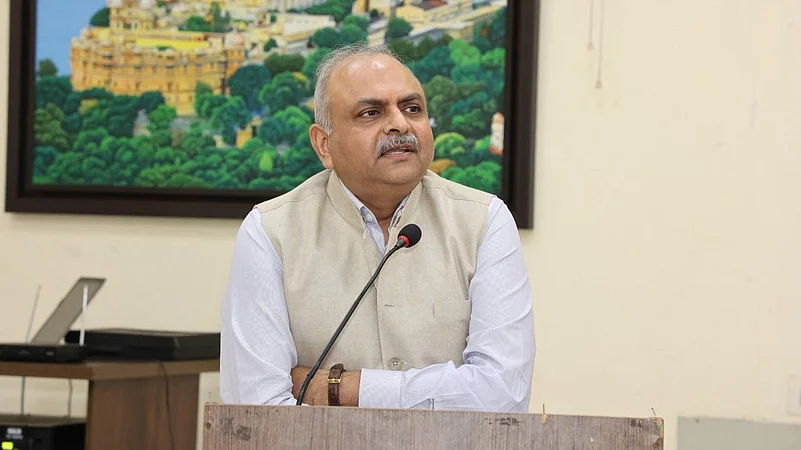
The impact of the increase in the Securities Transaction Tax (STT) on futures and options (F&O) trades will be reflected in changes in trading volumes and investor profiles, and only time will tell whether the move serves its intended purpose, said Ravi Agrawal, Chairman of the Central Board of Direct Taxes (CBDT).
In one of her Budget announcements, Finance Minister Nirmala Sitharaman said the STT on futures contracts has been increased to 0.05% from 0.02%, marking a 150% hike. For options, the STT on the premium has been raised to 0.15% from 0.10%, a 50% increase, while the STT on exercised options has been increased to 0.15% from 0.125%, a 20% hike.

1 September 2026
Get the latest issue of Outlook Business

The higher levy is expected to increase trading costs and discourage speculative bets in the market, particularly among traders from financially weaker sections. “It is, in effect, a form of digital gambling, and the participants are unequal,” said Agrawal in an interview with Outlook Business.
Apart from this, the CBDT Chairman also spoke about the decision to tax buybacks as capital gains for all categories of shareholders. Edited excerpts:
The move to tax buybacks as capital gains, along with an additional buyback tax for promoters, is said to influence business decisions. In that sense, is it more than just a tax measure?
Advertisement
We should not go into how to run a business; that is not the domain of the tax department. But it (taxation) should not be disruptive and should be based on principles. Buyback is of the nature of capital gains, and therefore we have honoured that.
In the case of a buyback, as against a reduction of capital, only a few shareholders take a call on whether to go in for a buyback or not. In a reduction of capital, it is across shareholders and proportionate, and therefore it is considered a dividend. In a buyback, it is a call of the taxpayer—one shareholder may choose not to participate, while another may choose to do so.
The buyback is essentially driven by the promoter and is, by and large, a distribution of general reserves. Apart from general reserves, there may also be share premium, but broadly it is a distribution of reserves which otherwise would have been taxed under normal applicability.
Taking all these things together, the promoter is expected to factor this in and then take a call. It should not be driven by tax considerations alone.
Advertisement
How does the tax department view the low dividend payouts in India?
If dividends are not distributed and remain within the liquidity or kitty of the company, and are then deployed for business purposes, it ultimately advances the business. In that sense, it is good for the economy.
However, while every step of the company should keep taxation in mind, taxation should not be the driving factor. The question then becomes whether dividends are not being distributed purely because of taxation.
Ultimately, this call has to be taken by the shareholders or the management on how to run the company, based on the rules of the game.
Do you believe a tax increase alone is enough to discourage speculative bets in the futures and options market?
First, this very discussion we are having has value. The debate on whether retail investors should participate and incur losses—whether it is becoming an addiction or a speculative activity—provides value because it makes people think.
If because of taxation, the cost itself makes it less attractive, then it may help dissuade people from participating. Only time will tell what the end result will be. But an effort has to be made, and we have to move in that direction.
At one end of the spectrum, you have the retail common person who is not very well versed and is driven largely by speculation, incurring losses. On the other end, there are professional algorithm-driven traders. So what is the competition? We are also talking about people coming from tier-two and tier-three backgrounds. It is, in effect, a form of digital gambling, and the participants are unequal.
But these people are gambling to make quick and easy money out of desperation. Do you think higher taxes will actually discourage such behaviour?
What we need to see is whether there is a change in the volume or in the profile of people who participate in the activity, and to what extent that profile changes. As I said, only time will tell. But we have to be conscious that this element exists and think about how best to address it. This is one way of doing so.
Has the government stepped back from directing households’ investment decisions?
Yes, it is the choice of the people. Ultimately, they are the best judges. Earlier, there was criticism that choices were being driven through taxation. That was the old approach. People wanted choices, and therefore, those choices are now available.