
The Budget cut customs duties in strategic sectors to lower costs and support manufacturing
Some of the biggest beneficiaries are sectors where US firms have a strong presence
The CBIC says the intent is competitiveness and exports, not alignment with any particular trade deal
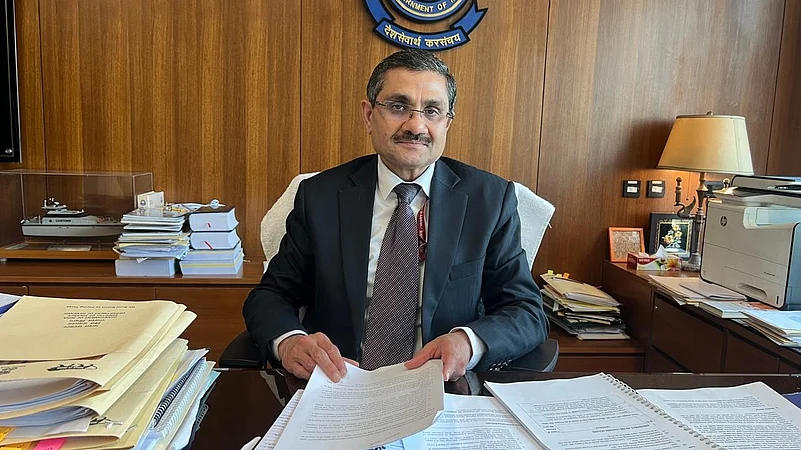
The customs duty exemptions announced in the Union Budget 2026–27 were aimed at meeting the needs of the Indian economy and should not be read as being aligned with the trade deal announced by US President Donald Trump a day later, said Vivek Chaturvedi, Chairman of the Central Board of Indirect Taxes and Customs (CBIC).
“Our focus has been largely on criticality and on ensuring that industry gets what is required,” said Chaturvedi in an interview with Outlook Business.

1 September 2026
Get the latest issue of Outlook Business

After Finance Minister Nirmala Sitharaman presented the Budget on Sunday, trade experts pointed out that several of the sectors targeted by duty exemptions are ones where the US has a strong competitive presence.
For instance, the decision to reduce customs duty to zero on aircraft components and maintenance, repair and overhaul inputs sharply lowers costs for US aerospace firms, engine manufacturers, and maintenance providers supplying India’s fast-growing aviation market.
“India’s Union Budget 2026–27 is officially country-neutral. But in practice, it opens doors for US exporters in exactly the sectors where America is strongest,” said Ajay Srivastava, founder of the Global Trade Research Initiative, in a social media post. He added that duty exemptions in the energy and medical sectors would also support US exports.
Advertisement
A day after the Budget presentation, Trump announced the much-awaited India–US trade deal in a post on Truth Social, lowering the reciprocal tariff on Indian goods to 18% from 25%. Prime Minister Narendra Modi later confirmed the headline announcement in a post on X. Details of the agreement are yet to be made public.
Chaturvedi, however, argued that trade deals have become a reality and that, going forward, the government wants Indian industry to make full use of them. The customs duty cuts, he said, are therefore aimed at making industry competitive enough to leverage such agreements, rather than at favouring any one country.
Advertisement
“A trade deal works both ways. While we open up, the other side also opens up its markets,” said Chaturvedi. “Hopefully, industry takes advantage of this, becomes competitive enough to expand its export footprint, and is able to access new markets for its products.”
Even before the US announcement, India had finalised another long-awaited trade deal with the European Union, widely described as the “mother of all deals”.
Notably, the Economic Survey presented last week by Chief Economic Adviser V Anantha Nageswaran argued that India needs to step up manufacturing to reduce its cost of capital and boost exports. Reflecting this approach, the Budget this year, as in previous years, has reduced or removed duties on critical minerals required by manufacturing industries such as electronics, telecommunications, renewable energy, space, and defence.
“As far as the rates are concerned, the focus has been on strategic sectors and manufacturing,” said Chaturvedi. “The second part is the process reforms we have undertaken in customs. Unless these reforms are in place, industry will not be able to fully take advantage of the changes or operate in a significantly better environment.”
Apart from customs duty cuts, the Budget also announced several ease-of-doing-business measures aimed at helping businesses and taxpayers while trying to increase trust in the system. Officials in the finance ministry believe the key challenge will lie in effective implementation.