
The Centre rejected claims that the redefinition of the Aravalli Hills weakens environmental protection.
Mining will be allowed only in a limited area and under strict regulation.
Environmental groups and opposition leaders have criticised the move, warning of ecological risks.
Union Environment, Forest and Climate Change Minister Bhupendra Yadav on Monday rejected allegations surrounding the redefinition of the Aravalli Hills, asserting that nearly 90% of the Aravalli landscape will remain protected. The Aravalli range spans over 700 km across four northern Indian states.
The clarification comes after the Supreme Court, on November 20, upheld a revised definition of the Aravalli Hills, a move that drew criticism from opposition leaders and environmental groups who warned that it could pave the way for increased mining, quarrying, and land exploitation.

1 October 2026
Get the latest issue of Outlook Business

Responding to the criticism, the Centre said mining would be permitted only in a minimal area and would remain subject to strict scrutiny by the apex court. Yadav reiterated that only around 2% of the total Aravalli area is eligible for mining, while the rest would continue to enjoy legal protection.
Rajasthan Deputy Chief Minister Prem Chand Bairwa also sought to allay concerns, saying that nearly 98% of the Aravalli area across Rajasthan, Haryana, and Gujarat is already protected. “The remaining one to two per cent will not cause any harm to Rajasthan,” he said.
Opposition leaders, ecologists, and conservationists have argued that diluting protections for the Aravalli range could cause irreversible ecological damage, including increased air and water pollution and greater vulnerability to environmental risks.
Advertisement
Revised definition
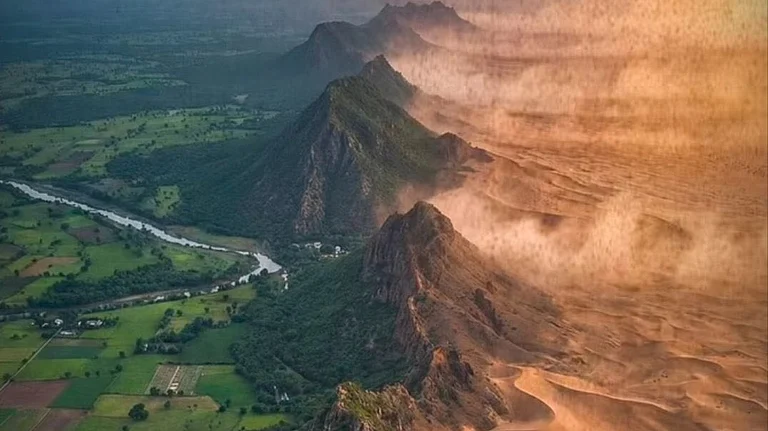
Under the new legal framework, a landform qualifies as an ‘Aravalli Hill’ only if it rises at least 100 metres above the local relief. A cluster of such hills within a 500-metre radius will be classified as an ‘Aravalli range’.
The Centre said the revised definition was introduced to address ambiguities in earlier interpretations, which allowed states to adopt inconsistent standards while seeking approvals for mining and quarrying. However, the changes sparked protests and backlash from environmental groups and some state governments.
Yadav said misinformation, particularly on social media and YouTube platforms, had misrepresented the revised definition. “Some YouTube channels are incorrectly interpreting the 100-metre criterion as referring only to the top portion of the hills. This is not true. The 100 metres refers to the vertical spread of the hill from top to bottom, and even gaps between hill ranges will be considered part of the Aravalli range,” he said, adding that nearly 90% of the area remains protected under the revised framework.
Advertisement
He stressed that mining activity would remain tightly regulated. “The total Aravalli area is about 1.47 lakh square kilometres. Only around 217 square kilometres—nearly 2%—is eligible for mining. Even then, the Supreme Court has directed that a Management Plan for Sustainable Mining be prepared, and prior clearance from the Indian Council of Forestry Research and Education (ICFRE) will be mandatory,” Yadav said.
The minister also reiterated that mining in the Delhi segment of the Aravalli range remains completely prohibited. He added that the Centre has been implementing the ‘Green Aravalli Project’ for the past two years and described the controversy around the redefinition as a “false narrative”.