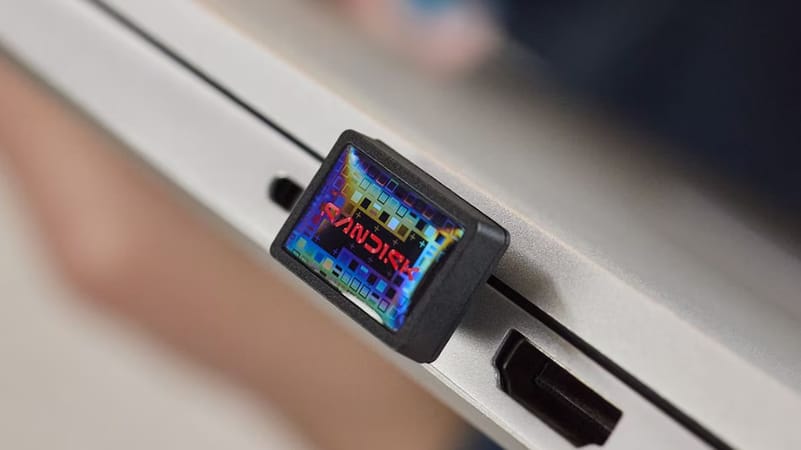

Ultra-compact design makes it ideal as a plug-and-forget storage solution.
Offers reliable speeds for everyday transfers and basic usage.
Best for portable convenience, not heavy-duty high-speed workflows.
Good things come in small packages. At least, that’s how the saying goes.
Well, SanDisk has proven it right once again with the Extreme Fit USB-C flash drive. Minimalism over here has once again delivered. With a device so small, you’d be wondering just how it can achieve storage capacities of up to 1TB. Well, that’s an engineering marvel, and something that would take a much larger article to explain.

1 September 2026
Get the latest issue of Outlook Business

It weighs just 3 grams, and most of the time, you have this sense that it’s going to be left behind or lost. There’s no way of telling because it is that small.



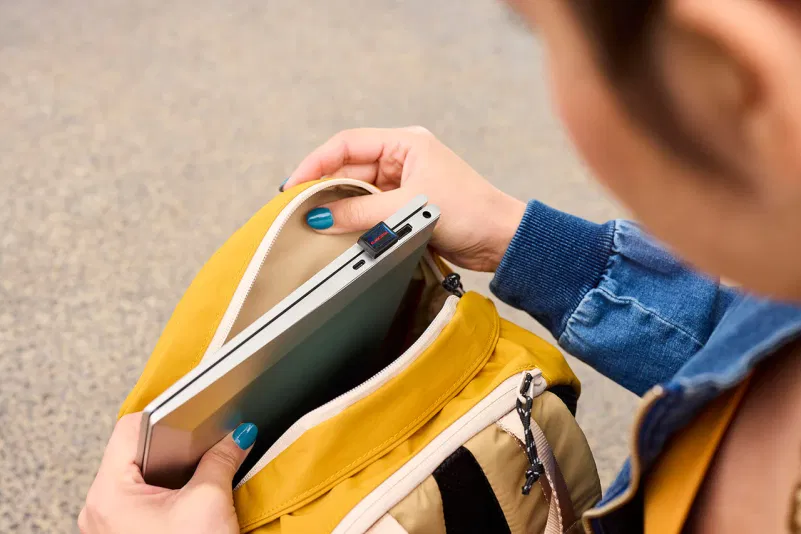
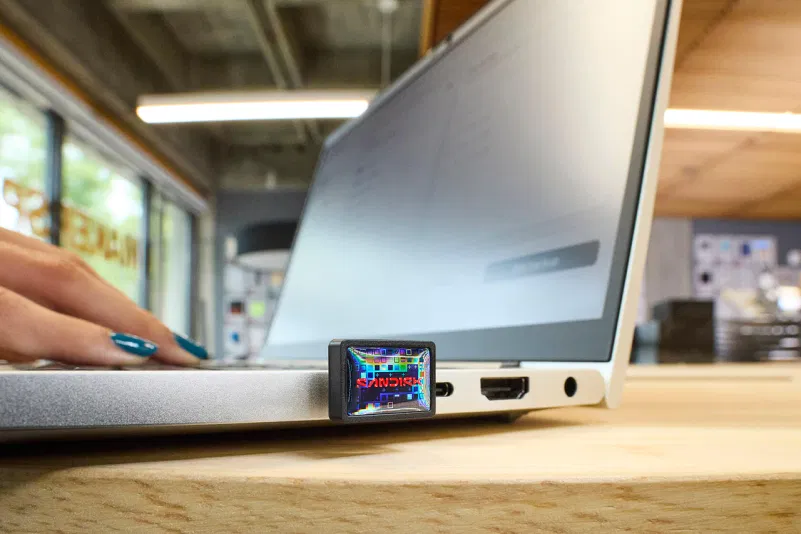
Laptop accessory manufacturers have had to evolve thanks to us being in the age of the disappearing ports. Yes, this USB-C flash drive is meant to be plugged in, to sit flush with the laptop, and to be forgotten about. The flash drive solves a very simple problem. To help the consumer with expanded storage without getting in the way.
One advantage of it sitting flush with the laptop is that even if you close the lid and throw the laptop into your bag with the Extreme Fit attached, there won’t be any damage. It won’t just fall off and get ‘lost’.
Advertisement
The SanDisk Extreme Fit USB-C Flash Drive is available exclusively on Flipkart in 64GB (₹2,049), 128GB (₹2,799), 256GB (₹4,899), 512GB (₹8,999), and 1TB (₹17,299) sizes.
As I said above, the Extreme Fit uses a USB 3.2 Gen 1 interface. Despite it having a theoretical top speed of 5Gbps, the drives, including the one I’m testing, deliver read speeds of up to 400MB/s. All of them except the 64GB model, which has only a peak read speed of 300 MB/s.
Performance is quite good, but flash drives can never match up to SSDs. But the advantage here is that the Extreme Fit is faster than a standard USB drive. It may have been built for the laptop, but it can also work with your smartphone or tablet, thanks to its USB-C interface.
Advertisement
The only downside of the size is that the device heats up during extended transfers. One upgrade I would love to see in the next iteration from SanDisk is support for the USB 3.2 Gen 2 standard. Alas, that might just have been too costly for the company to have considered.
The other suggestion I have is to have a metal shell going forward. The casing for the Extreme Fit is plastic, and despite being solidly built, it seems like it could break over time.
The SandDisk Extreme Fit USB-C flash drive has been built for a very specific target audience, and for them, it has delivered like no other. SanDisk is constantly innovating, and it's good to see year-on-year improvements. I’d much rather use this on a smartphone than a laptop, though.
It’s definitely a value-for-money product, but a niche one at that. It’s good for daily data storage and transfers more than anything. Don’t expect the moon, and you’ll be very happy with the product at the end of the day. Mostly, you’ll just be smiling at the small package that delivers more than its heft.