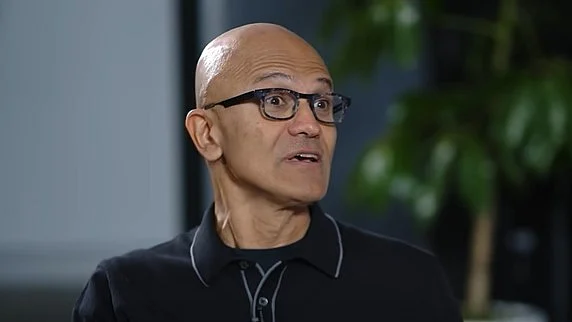

Microsoft Chairman Satya Nadella introduced the 'Reverse Information Paradox' framework to address AI intellectual property risks
The framework reverses Kenneth Arrow's classic economic theory, warning that AI buyers risk giving away proprietary knowledge to model providers
Nadella cautioned that companies leak institutional know-how through 'intelligence exhaust' such as employee prompts and model corrections
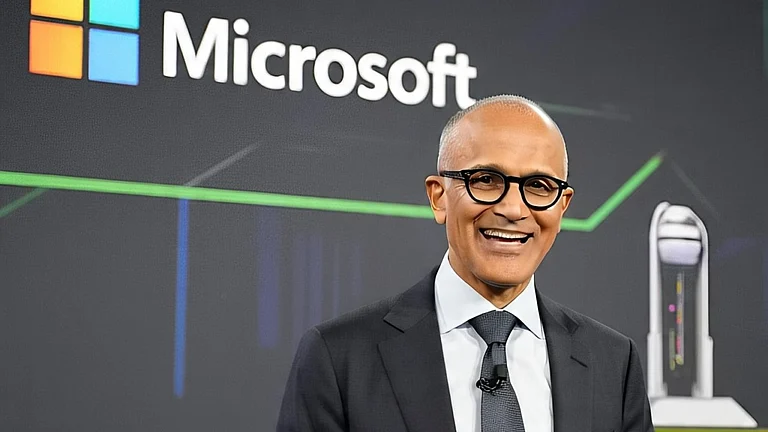
Microsoft Chairman and CEO Satya Nadella has proposed a new framework for how companies should protect their intellectual property in the era of artificial intelligence (AI), calling it the "Reverse Information Paradox."
Nadella built on Nobel Prize-winning economist Kenneth Arrow's "Information Paradox," under which sellers of information risk losing its value the moment they disclose it to a prospective buyer.

1 October 2026
Get the latest issue of Outlook Business

Nadella, in an article on X (formerly Twitter), argued that AI inverts this dynamic. It is now the buyer, or the enterprise using an AI model, who risks giving away proprietary knowledge simply in order to use what they've paid for.
"You essentially pay for intelligence twice, once with money, and again with something even more valuable: the proprietary knowledge you must reveal to make that intelligence useful," Nadella wrote, adding that this information asymmetry compounds over time as the model provider learns more about a company while the enterprise learns little in return.
Advertisement
"Intelligence Exhaust" and Institutional Know-How
Nadella wrote that this problem requires more than data protection, since models learn from what he called "exhaust," the prompts employees write, the tools AI agents use, and particularly the corrections people make when a model gets something wrong.
Drawing on economist Friedrich Hayek's concept of dispersed knowledge, Nadella argued that the intelligence a company creates while using AI, reflecting its own sense of time, place, and circumstance, should belong to that company.
He also took issue with the prevailing industry practice on this front, saying he finds it "ironic" that model providers who benefit from fair-use rights to train on public data then turn around and impose restrictive terms on distillation, while reserving the right to learn from customer usage data themselves. If learning flows only one way, Nadella wrote, economic value shifts toward those who own the learning infrastructure rather than those who create the knowledge in the first place.
Advertisement
Nadella's Proposed Fix
Nadella called for enterprises to build a "trust boundary" around what he described as their combined human and token capital — a hard boundary across which nothing, including intelligence exhaust, crosses without consent.
He said enterprises should demand rights to use model outputs to fine-tune or train their own models, framing this as every firm's right to align models to its own accountability obligations.
He listed five things enterprises need to do to protect this boundary:
Control: Build private evaluations, since evals define what "good" looks like inside an organisation, and retain ownership of institutional memory, traces, feedback, and decisions.
Capability: Build proprietary learning environments within their own tenant boundary, so models can be trained or tuned against real workflows without exposing company knowledge externally.
Choice: Keep the orchestration layer decoupled from any single model, so a company retains the ability to operate and optimise for its own evals even if a specific model is withdrawn.
Cost: Use that decoupled orchestration layer to combine context, models, and tasks efficiently without sacrificing quality.
Compound: Bring these four together and create a continuous learning loop (i.e. hill climbing machine) that will allow your AI investments to compound the value of the firm.
Nadella argued that "we need to confront" this reverse information paradox, saying that a company should be able to use a model without giving up the knowledge that makes it unique.