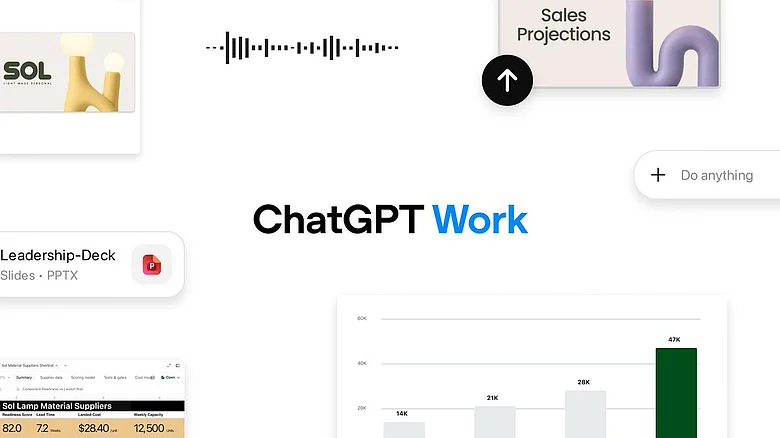

OpenAI introduced ChatGPT Work to independently produce documents, presentations, spreadsheets, and websites by merging its chatbot with Codex
The new AI agent is powered by GPT-5.6, OpenAI's latest large language model which was also released today
ChatGPT Work rolls out immediately for Pro, Enterprise, and Edu plans, with Plus and Business users gaining access within days
OpenAI introduced ChatGPT Work on Thursday, an artificial intelligence agent that merges its chatbot with its Codex coding tool. The system can independently produce documents, presentations, spreadsheets, and websites, the company said in a blog post. The agent runs on GPT-5.6, OpenAI's newest large language model.
ChatGPT Work is rolling out on the web and mobile for Pro, Enterprise, and Edu plans. It will expand to Plus and Business users within days, the company said.

1 October 2026
Get the latest issue of Outlook Business

OpenAI is also merging the standalone Codex application into a new unified ChatGPT desktop app. This will provide Chat, Work, and Codex functions across all tiers, including the Free plan. The older desktop application has been renamed ChatGPT Classic.

Autonomous Workflows and Adoption
The new agent can gather information across connected applications and workflows. ChatGPT Work breaks goals into smaller steps and operates independently for hours, OpenAI said.
Advertisement
More than 5 million people use Codex every week. Over 1 million of these users now use it for non-coding work, according to OpenAI.
Usage of ChatGPT Work is metered similarly to the existing structure for Codex. Enterprise administrators can set spending controls and apply usage limits for their teams.
How to Get Started With ChatGPT Work
Connect the tools and context where your work already happens, using plugins.
Plugins link ChatGPT to apps and systems such as Slack and Microsoft Teams, Google Drive and SharePoint, email, calendars, CRMs, project trackers, and other internal tools.
ChatGPT automatically detects when to reference a plugin based on your prompt — or you can direct it to a specific app by typing "@" followed by the app name.
A new unified plugins directory brings all plugins into one place, and ChatGPT can suggest relevant ones mid-conversation.
Once apps and tools are connected, ChatGPT can understand the task at hand, pull in information from relevant sources, create documents, decks, and analyses, and keep refining drafts in the background — while the user stays in control.
The system aims to eliminate repetitive chores. Through a feature called Scheduled Tasks, users can instruct the agent to execute one-off actions, run recurring jobs, trigger tasks based on specific events, or track changes over time.
The tool connects with external applications and web browsers to automate these workflows.
These automated routines can handle several administrative tasks. The agent can scan weekly Slack updates to refresh meeting agendas or review dashboards each morning to compile summary reports. It can also analyse incoming customer feedback to identify product trends and automatically update presentations when new emails arrive.
Advertisement
Competitive Enterprise AI Market
The launch showcases a new AI agent designed to help white-collar workers access the power of coding tools without the associated cost, according to Reuters.
The news agency described ChatGPT Work as a direct response to Claude Cowork from Anthropic. Anthropic launched its agent in January to plan and execute multi-step tasks autonomously. The release reflects intensifying competition for lucrative enterprise business rather than consumer products. Both OpenAI and Anthropic are preparing for possible public offerings.
Reuters reported that the US government requested a delay in the public rollout of GPT-5.6 last month due to national security concerns.
Efficiency and Model Performance
The new model applies its coding ability to solve problems across every industry, Ty Geri, a ChatGPT Work product manager at OpenAI, said in an interview. Geri described GPT-5.6 as competitive with far more expensive rivals at twice the speed and much lower cost.
The smallest version of the new model can complete tasks about as well as the largest version but at a fraction of the cost, Max Weinbach, an analyst at Creative Strategies, said. Weinbach added that it was the first time he had seen small models complete this kind of task.