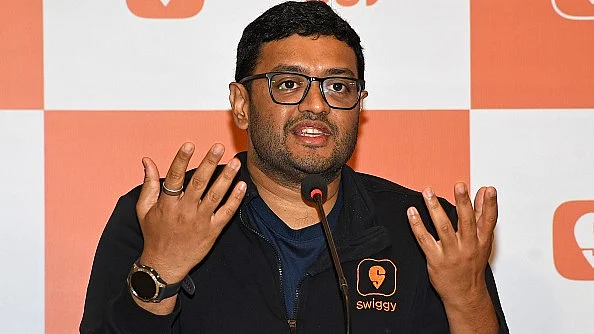
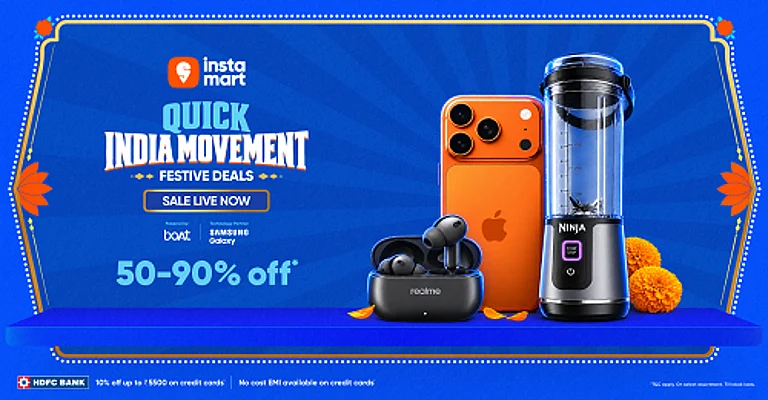
Food delivery and quick commerce company Swiggy is pulling back on spending, even as rivals Flipkart and Amazon ramp up discounts and race to cut delivery times to as little as 10 minutes, according to a Bloomberg report.
Chief Executive Officer Sriharsha Majety said the company has deliberately chosen not to match the aggressive push from Walmart-owned Flipkart and Mukesh Ambani's Reliance Retail, who are competing to reach more customers faster. Swiggy is willing to lose some users in the short run to hold on to its most loyal and profitable ones, Majety told Bloomberg.
The Case for Restraint
"Joining the spending only postpones the problem," Majety reportedly said, referring to Swiggy's quick-commerce unit, Instamart. He added that investors want to see a clear path to both growth and profitability before they are convinced the business is on track.

1 October 2026
Get the latest issue of Outlook Business

Swiggy reportedly raised about $1 billion in December. Its shares have fallen more than 30% this year, putting pressure on the company to show stronger results. Analysts at JM Financial warned in April that Swiggy risks losing relevance if it cedes momentum in quick commerce.



Differentiation over Discounts
Rather than matching competitor incentives, Majety said Swiggy's strategy is to give customers reasons to return that are harder to replicate. Central to this is a private-label grocery line focused on fresher, harder-to-find products, including Indian cottage cheese with a shelf life of just a few days and fresh clotted cream not typically available in large retail chains.
Advertisement
Majety said customers who buy these products show significantly higher repeat purchases and retention. He compared the approach to how different US retailers serve different customer segments, citing Whole Foods, Walmart, Costco and corner stores as examples of distinct models that can each succeed.
Swiggy says the strategy is already showing results. Instamart improved its unit economics by five to six percentage points over the past four quarters. Growth in food delivery also accelerated to its fastest pace in nearly four years in the March quarter, though the company added only seven Instamart stores during that period, against over 1,100 currently operating.
Advertisement
IOCC Status Failure
The company recently faced a separate challenge when a shareholder resolution to amend its Articles of Association failed to secure the required 75% supermajority at a May 21 meeting.
The resolution was part of a broader effort for Swiggy to qualify as an Indian Owned and Controlled Company (IOCC), a status that would allow its quick-commerce business to operate on an inventory model rather than the marketplace model currently required under foreign investment rules.
Majety earlier told the Economic Times he is confident the vote outcome will be reversed, downplaying governance concerns over the failed resolution.