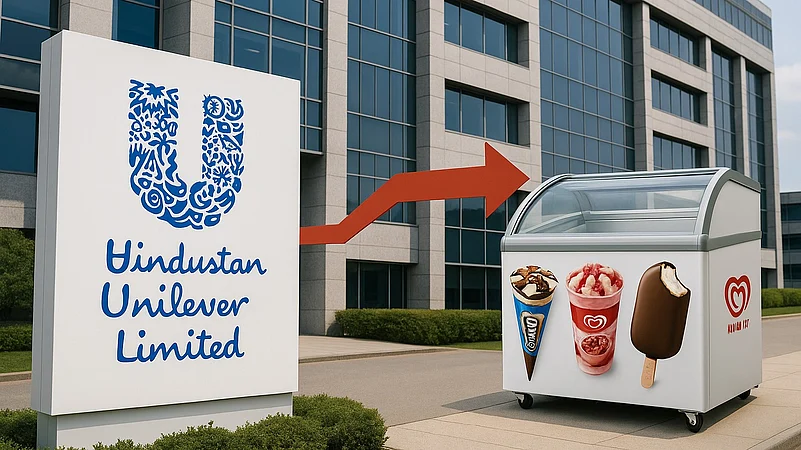

HUL has moved into the final phase of spinning off its ice-cream unit into a standalone company called Kwality Wall’s
Brokerages expect the new entity to list in early 2026, supported by GST cuts and a dedicated board
Analysts also expect the separation to improve HUL’s profitability and strategic focus in the coming years
The much-awaited ice cream demerger of Hindustan Unilever has now entered its concluding phase. The company has fixed December 5 as the record date to identify shareholders eligible for stocks in the newly created entity called Kwality Wall’s (India). The separation officially came into effect on December 1.
According to the approved structure, The Magnum Ice Cream Company will hold 61.9% stake in Kwality Wall’s after acquiring it from the Unilever Group following the spin-off process. It houses well-known brands, including Cornetto, Magnum, Feast and Creamy Delight.

1 September 2026
Get the latest issue of Outlook Business

The company’s shares slipped 7% on the BSE, logging an intra-day low at ₹2,289 per share. The selling pressure came on HUL shares due to the record date of its ice cream business demerger. By 10.30 am, HUL shares were down 2.18% at ₹2,371.05 on the BSE, even as the broader BSE Sensex inched up to 0.21% to 85,442.08.
Currently, HUL commands a market capitalisation of ₹5,58,145.4 crore. The stock has touched a 52-week high of ₹2,779.7 and a 52-week low of ₹2,136.
Advertisement

What This Means For Investors?
The demerger has become HUL’s first major portfolio split in years. The move aims at unlocking value by spinning off one of HUL’s fastest-growing categories into an independent company. Initially, the proposal was announced in January which even received the stock exchange approvals in May.
For investors, the record date means that anyone holding HUL shares at the end of December 5 will automatically received one share of Kwality Wall’s for every HUL share, once the new entity is listed. In short, investors who hold HUL shares will receive shares of the new entity in a 1:1 ratio.
Advertisement
The conglomerate’s ice cream revenue remained almost flat compared to the previous year. The company posted a net profit of ₹2,685 crore for Q2FY26, supported by a one-time tax settlement. Its revenue rose 2% year-on-year to ₹16,241 crore, though margins edged down amid a patchy demand climate.
However, HUL views the ice cream segment as a highly promising business with significant growth potential, said ICICI Securities in a previous report.
“…the company highlighted its focused management approach and the flexibility to implement strategies tailored to the unique dynamics of the ice cream business. It also emphasised that Kwality Wall's benefits from the portfolio, branding, and innovation expertise of its parent company, Unilever, the world's largest ice cream manufacturer,” it added.
When Should Investors Expect Kwality Wall’s Listing?
Brokerage firm Nuvama Equities, as quoted by The Economic Times, expects that Kwality Wall’s may get listed on the bourses in February 2026, becoming India’s first pure-play listed ice cream company. It also estimates the possible valuation at ₹50-55 per share, translating to about 5x EV/sales, well about HUL’s 9x multiple but consistent with the category’s seasonal dynamics.
Nuvama added that the recent GST reduction on ice-cream from 18% to 5% should materially lift affordability and spur impulse purchases, giving the segment a meaningful tailwind. "The GST reduction is a structural positive and should aid volume recovery, pushing category growth above the estimated 11% CAGR for FY25–30," the ET report, quoting Nuvama added.
Kwality Wall’s (India), meanwhile, has also announced several appointments to its board of directors ahead of its demerger from HUL. The company has announced seven appointments, including one non-executive director, two executive directors and four independent directors.
The newly formed board brings together seasoned corporate leaders with extensive experience across consumer goods, finance, governance, regulatory affairs, risk management and strategic mergers & acquisitions.

Why HUL Is Carving Out Kwality Wall’s?
It is pertinent to note that HUL is one of India’s largest fast-moving consumer goods (FMCG) companies. It offers a diverse portfolio of products across categories such as personal care, home care, foods, and beverages. And most of their brands contribute a significant percentage is HUL's revenue.
However, that does not hold for the ice cream business. It contributed only 2.7% to HUL's overall revenue. For FY24, the total revenue by the ice cream segment was ₹1595 crore, said ICICI Securities. Also, ice cream is a low-margin segment for the company. We don't have net profit margins for the ice cream segment of HUL's business.
Vadilal is its listed competitor, and its profit margins for the past 5 years are 7.2%. If we can assume HUL's ice cream segment is somewhere close, then, there is a significant difference in this segment's margins and HUL's overall profit margins, which is 17%. Add to this, this business comes with a significant capital burden, which includes the cold chain infrastructure required for distribution.
The second reason, according to the brokerage firm, is that the parent Unilever announced plans to split off its ice cream business globally earlier in 2024. HUL's decision is on the same lines. And it made sense for the HUL to do it sooner rather than later, it added.
What’s Next for HUL?
PL Capital also believes the business is positioned for a gradual volume recovery, supported by easing GST pressures, stable commodity prices and stronger execution under the new CEO.
“The second quarter was disrupted by GST 2.0 implementation and an extended monsoon, but we expect volumes to pick up from November as the trade adjusts and fresh stock flows through,” said Amnish Aggarwal, Director of Consumer Research at PL Capital.
He added that the demerger enhances the company’s profitability profile: “Management continues to guide for EBITDA margins of 22–23%, and the ice-cream separation should add close to 50 bps to margins once fully executed.”
Aggarwal said the company’s strategic priorities remain intact. “HUL is doubling down on premiumisation, modernising core brands and scaling high-growth platforms such as Beauty & Wellbeing and Nutrition. These areas are already showing strong momentum and should support mid-single-digit volume growth in the second half”.




The company is projecting mid-single-digit volume growth in the second half of FY26, supported by stable margins in the 22-23% range, excluding any gains from the demerger, the brokerage said.
Post the ice-cream separation, PL Capital expects that earnings may expand at an estimated EPS CAGR of around 8.3% between FY26 and FY28. With structural levers strengthening and the demerger set to unlock margin upside, the brokerage believes the move positions HUL for sharper strategic clarity, improved profitability and stronger medium-term value creation.