A new player is emerging in India’s rocket launch space with an engine that takes a different, and considerably more complicated, route to space: the full-flow staged combustion (FFSC) engine.
While the engine is yet to be tested, Bengaluru-based space-tech startup Astrobase Space Technologies unveiled its 800 kN-class rocket engine, Everest, on Friday.
The high-thrust FFSC engine powers a reusable, orbital-class rocket, a category that almost every serious rocket player is now eyeing because of the business opportunity it offers.

1 September 2026
Get the latest issue of Outlook Business

With an expendable rocket, manufacturing becomes a cost attached to every launch: the vehicle goes up once and is then destroyed or discarded. A reusable rocket changes that equation. Most of the manufacturing cost becomes a one-time capital cost spread across dozens of flights.
SpaceX’s Falcon 9 boosters now routinely fly 30-plus times and SpaceX’s engine called Raptor also uses the FFSC architecture. This is what Astrobase is looking to crack.
The company’s co-founder, Neeraj Khandelwal told that the vehicle’s first orbital flight is targeted for December 2028. If that happens, India would be the third country after US, China to have developed an FFSC engine.
But What Makes This Engine So Rare?
While FFSC is considered one of the most efficient rocket-engine cycles, it is also among the most complicated to execute because both propellants must be fully gasified and routed through separate turbomachinery before entering the main combustion chamber.
Advertisement
In a conventional rocket engine, fuel and oxidiser do not necessarily enter the combustion chamber in the same fully gasified state. FFSC takes a more demanding route: both propellants are first fully gasified and then sent through the engine’s combustion system before they burn together in the main chamber.
That architecture allows the engine to operate at very high pressures while extracting more energy from the propellants. It also makes the turbomachinery—the pumps and turbines that move the propellants through the engine—more efficient, improving the performance and efficiency needed for reusable rockets.
This is one reason FFSC is particularly attractive for reusable rockets, where efficiency and durability matter flight after flight.
Advertisement
Astrobase’s Everest uses liquid oxygen and methane as its propellants and is designed to produce 800 kN of thrust. Astrobase describes it as India’s first fully integrated FFSC engine developed by a private company.
A more efficient engine can mean more payload for the same launch, or less propellant for the same mission.
But there is an important qualifier to all of this: Everest has not yet been fired.
The engine is currently at the pre-hot-fire-test stage, with Astrobase expecting to begin hot-fire testing in the coming months.
Before it can power an orbital mission, it will have to go through repeated ground firings, performance validation, qualification and, eventually, integration into a complete launch vehicle.
In FFSC, managing two fully gasified propellant streams, extremely high pressures, high temperatures and heavily loaded turbomachinery inside the same system leaves very little room for error. On top of that, the entire rocket launch space already has no margin for error.
Around 70% of Astrobase’s Everest is indigenously developed and manufactured in India, with the engine being designed and manufactured in Bengaluru.
If executed, Astrobase will be among only a handful of commercial players globally to have fully designed, manufactured and integrated an engine of this kind.
India Is Chasing A Different Launch Market
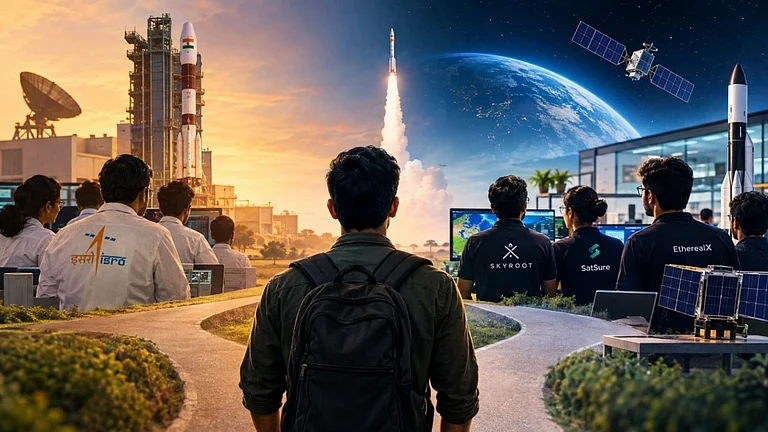
Astrobase’s ambitions come at a time when India’s private rocket industry is finding its commercial rhythm.
Agnikul Cosmos is slated for an orbital launch later this year. Its rocket is reusable, while Skyroot Aerospace, which earlier this year successfully completed its first orbital launch, is also looking to develop a reusable rocket in the future.
Most of India’s private rocket players, meanwhile, are building around the small-launch market, a cab-to-space model, carrying smaller payloads and satellites into orbit.
This is the niche that India has been targeting.


Astrobase wants to move further up the ladder. This two year old startup initially wants to build the capacity to put 100 tonnes of payload into orbit each year, eventually scaling that to more than 1,000 tonnes annually.
Globally, demand and supply of rocket launches have a mismatch.
Companies queue up around SpaceX to launch their satellite and face a long waiting period, as SpaceX accounts for over 80% of the global launch capability. If India wants to achieve its goal of a 8-10% spacetech market by 2033 from less than 2% now, the success of players like Astrobase and others from India will be crucial.
India’s satellite fleet, fewer than 100 active satellites, is tiny compared to the US’s 12,000+ or China’s 1,400+. A bigger satellite fleet would boost demand for launches and help Indian companies grow.
To capture more of the global launch market, India will need larger, reusable launch vehicles. Bigger payloads and more frequent launches also spread costs, driving prices down.
The road from a fully integrated FFSC engine sitting in a Bengaluru facility to a reusable rocket returning from orbit is long.
With former ISRO scientist Devakumar Thammisetty and CoinDCX founder Neeraj as its cofounders, Astrobase now has to prove that it can make it happen.