




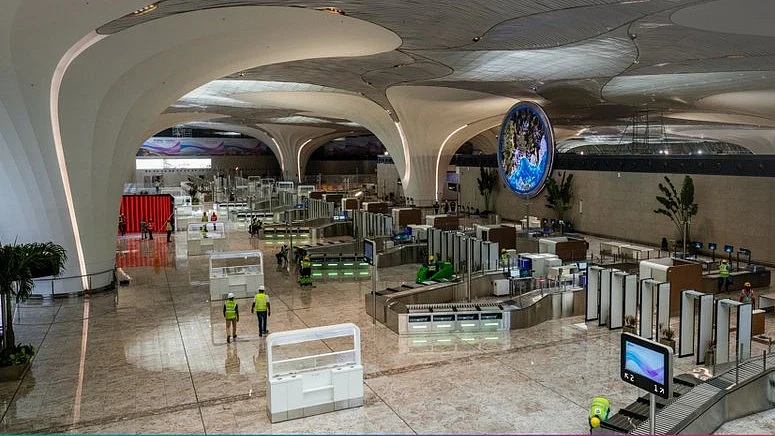

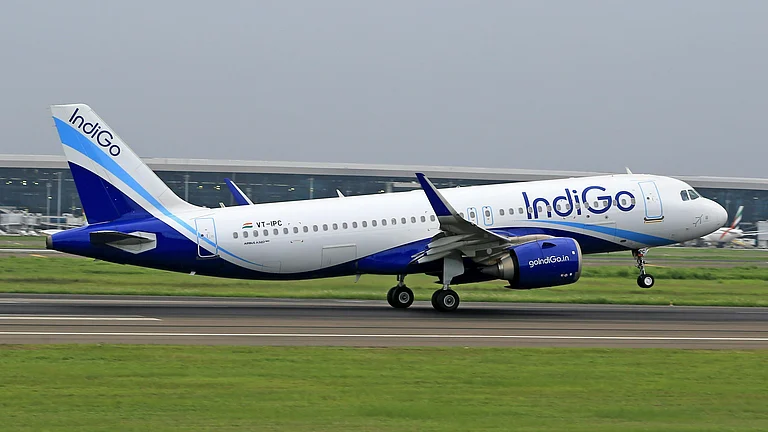
Adani Airports’ Navi Mumbai International Airport (NMIA) began commercial operations on Thursday, with IndiGo’s flight 6E460.
The airport completed its first commercial turnaround as IndiGo flight 6E882 departed for Hyderabad at 8:40 am.
The opening day, airlines including IndiGo, Air India Express, Akasa Air and Star Air.
Adani Airports’ Navi Mumbai International Airport (NMIA) commenced commercial operations on Thursday. The airport’s first scheduled flight, IndiGo’s 6E460 from Bengaluru, landed at 8:00 am and was greeted with a ceremonial water cannon salute, traditionally used to mark inaugural arrivals.
Shortly thereafter, NMIA handled its first outbound service as IndiGo flight 6E882 departed for Hyderabad at 8:40 am, completing the airport’s maiden commercial turnaround.

1 September 2026
Get the latest issue of Outlook Business

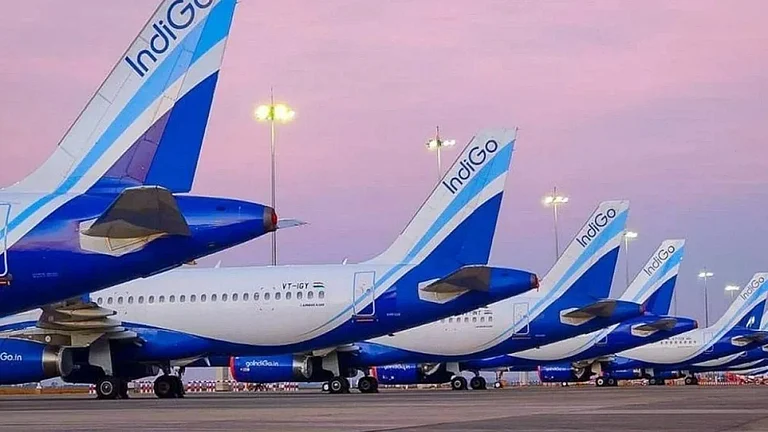
On the opening day, flights operated by IndiGo, Air India Express, Akasa Air and Star Air are connecting the new airport to nine cities across the country, the airport operator said on Wednesday.


The airport is scheduled to handle 15 outbound flights on day one. During the initial phase, operations will run for 12 hours, with plans to scale up to 24 daily departures serving 13 destinations. At full utilisation in this phase, the facility can handle up to 10 aircraft movements, including arrivals and departures, per hour.
The project is being executed in stages through a special purpose vehicle, Navi Mumbai International Airport Ltd (NMIAL), in which the Adani Group holds a 74% stake, while the remaining 26% is owned by Maharashtra’s city planning agency, the City and Industrial Development Corporation (CIDCO). Phase one of the five-stage development has been completed at an investment of ₹19,650 crore.
Advertisement
Covering an area of about 1,160 hectares, the airport will initially feature a single terminal and one runway, with the capacity to handle 20 million passengers annually.
Once all five phases are completed, the airport is expected to serve up to 90 million passengers a year, supported by dedicated cargo terminals and multimodal transport links.
Long-delayed milestone
First proposed in 1997 by CIDCO, the Navi Mumbai International Airport project took a major step forward when Prime Minister Narendra Modi laid its foundation stone in 2018. He inaugurated the airport on October 8 this year.
Advertisement
At the foundation-laying event, then chief minister Devendra Fadnavis had said the first flight would take off by December 2019. However, the project faced delays, including disruptions caused by the pandemic.
Since 2021, Adani Airports Holdings Limited, a subsidiary of Adani Enterprises, has overseen the airport’s development and construction, steering it from accelerated building activity to phased commercial operations.
After nearly eight years, the airport has now begun operations, marking a key milestone in infrastructure development in the Mumbai Metropolitan Region.
The new facility is expected to ease congestion at the existing Mumbai International Airport while significantly expanding regional capacity. Operations are scheduled to gradually scale up to 24-hour services from February next year.









