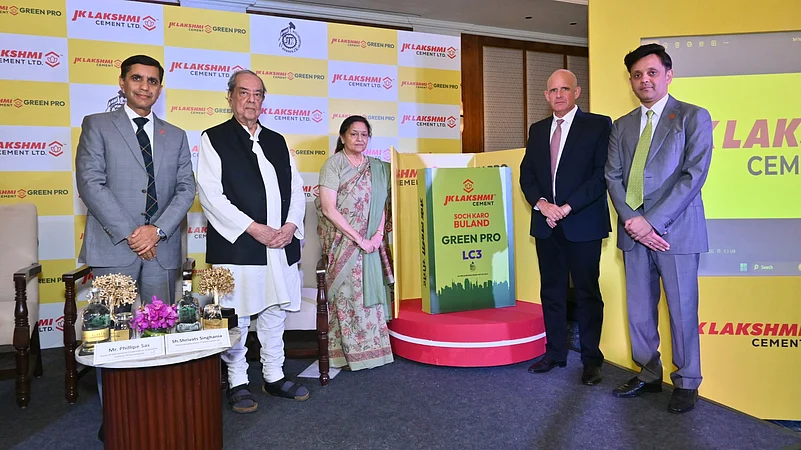

JK Lakshmi introduces Green PRO LC3, a low-carbon, durable cement solution.
LC3 reduces CO2 by 40%, improving long-term performance in critical infrastructure.
Commercial rollout begins in Rajasthan, supporting India’s sustainable construction and urban growth.
JK Lakshmi Cement Limited, a leading cement manufacturer in India, today announced the launch of Green PRO LC3, one of the country’s first commercially available Limestone Calcined Clay Cement (LC3). The product has been developed to offer lower carbon intensity, improved durability, and enhanced performance for large-scale infrastructure and high-exposure applications.
Green PRO LC3 will be produced at the company’s integrated Jaykaypuram plant in Sirohi, Rajasthan, with commercial rollout beginning in January 28, 2026. The initial phase will focus on institutional and project-led requirements across Northern and Western markets.

1 September 2026
Get the latest issue of Outlook Business

“As India builds the next phase of its infrastructure and urban growth, the choices we make today will shape the resilience and sustainability of what we leave behind. Our focus has been to steadily strengthen our manufacturing practices, resource efficiency, and product portfolio so that growth remains responsible and enduring,” said, Vinita Singhania, Chairperson & Managing Director, JK Lakshmi Cement Ltd in a press release.
“Green PRO LC3 reflects this long-term approach, where innovation is guided by care for people, communities, and the environment. Looking ahead, we remain committed to supporting India’s development journey with solutions that balance performance, sustainability and trust,” she added.
Advertisement
Commenting on the launch, Shrivats Singhania, Deputy Managing Director, JK Lakshmi Cement Ltd, mentioned, “LC3 gives India an important material choice at a moment when performance, durability, and sustainability matter more than ever. The science behind this cement helps manage permeability, thermal behaviour, and long-term structural resilience, which are critical for the scale and climate conditions of today’s projects. With the start of commercial dispatches from Jaykaypuram, our priority is to ensure independent home builders and project owners benefit from the full potential of this innovation. This launch reflects our continued commitment to responsible growth, operational excellence and a more sustainable product portfolio.”
Advertisement
“We have invested consistently in renewable power, resource conservation, and operational efficiency to strengthen the foundation on which such products can scale,” asserted Arun Kumar Shukla, President & Director, JK Lakshmi Cement Ltd in the press release.
“Green Pro (LC3) offers a dependable option for developers seeking materials that endure over time while lowering environmental impact. As we bring this cement to the market, our focus remains on supporting India’s evolving infrastructure needs through solutions rooted in care, integrity, and long-term value,” Shukla concluded.
Commercial dispatches of Green PRO LC3 will begin in February 2026 to Rajasthan. Additional phases of market rollout will follow based on institutional demand and regional requirements.
Contents of LC3
JK Lakshmi Green PRO (LC3) combines clinker, calcined clay, limestone and gypsum to deliver a refined microstructure with lower permeability and higher long-term stability.
When compared to regular Portland cement, the formulation allows for a 40% reduction in CO₂, making it a more environmentally friendly choice for building. Additionally, it improves lifecycle performance for public and industrial infrastructure, lowers the heat of hydration in mass-concrete structures, increases resistance to sulphate attack and chloride ingress and prolongs service life in high-temperature, coastal and marine environments.
These properties make LC3 suitable for bridges, ports, urban infrastructure, industrial corridors and large foundation works requiring controlled thermal behaviour and long-term structural integrity.
The introduction of Green PRO LC3 aligns with JK Lakshmi Cement’s sustainability commitments towards steady progress in environmental efficiency and operational resilience. In FY25, the company reported a 49% renewable power mix supported by waste heat recovery and solar additions, achieved 4.49× water positivity through conservation and recharge initiatives, and recorded meaningful CO2 avoidance through process optimisation and the use of alternative materials. The company also reduced its dependence on natural resources by expanding material substitution across its operations.