


India’s next phase of industrial growth will depend on how intelligently businesses use resources such as water, energy and materials
Connected sensors, advanced analytics and artificial intelligence can help companies optimise resource use, predict operational problems and improve efficiency
Water intelligence can strengthen India’s industrial competitiveness by reducing costs, improving operational reliability and helping businesses manage risks
Every industrial era has been defined by how its leaders thought about a resource. Coal built the first factories. Oil powered the twentieth century. Data reshaped the last two decades. Each of those eras was won by whoever could consume the most of the defining resource. The era now opening will be won differently. Its defining question is how intelligently a company uses the resources it already has. Industry is moving from an age of resource consumption to an age of resource intelligence, and India is entering its most ambitious phase of growth at exactly that turn.
India is building capacity at a scale few economies have attempted. Semiconductors, pharmaceuticals, electronics, data centres and clean energy are drawing historic levels of investment. The last phase of industrial growth was decided by capacity. The next will be decided by capability.

1 October 2026
Get the latest issue of Outlook Business

How Intelligence Compounds
For most of industrial history, growth meant consuming more — more energy, more material and more water. The economics of that model are breaking down. Input costs are volatile. Supply chains reward resilience over scale alone. Investors and regulators increasingly read resource performance as a signal of how well a business is run.




What makes the alternative possible is intelligence. Connected sensors, advanced analytics and artificial intelligence now let an enterprise see its operations as a single interconnected system, in which a decision about water is simultaneously a decision about energy, output and emissions. Utilities stop being separate cost centres and become one system that can be optimised as a whole. Management moves from reacting to problems to predicting them. Efficiency, resilience and sustainability improve together, because the enterprise is at last being managed as a system.
Advertisement
The industrial leaders of the next decade will be separated by a single discipline: how much value they create from every unit of energy, material and water they use. Consumption has a ceiling. Intelligence compounds.
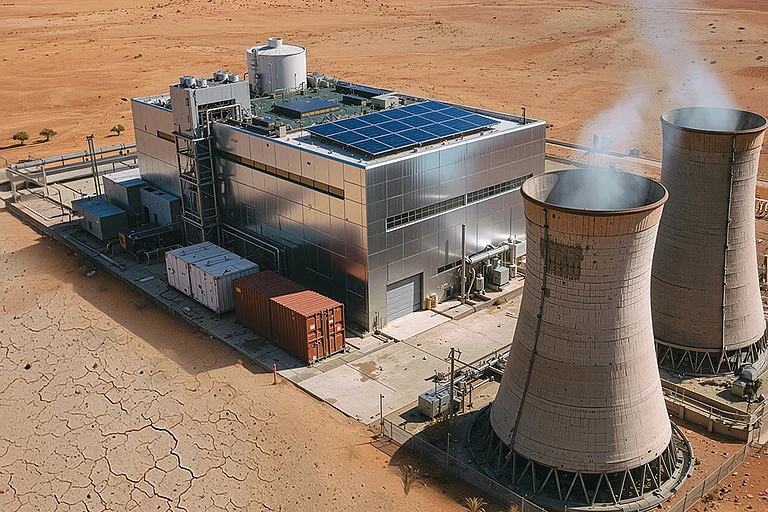
Ubiquity of Water
Among all resources, water reveals this shift most clearly. It touches manufacturing, energy, product quality, community relationships and the continuity of operations. It is also the resource with the least slack. India supports nearly a fifth of the world's population on about four per cent of its freshwater, and every new plant, fab and data centre competes for that share with farms and cities.
Advertisement
This is why water performance is increasingly read as a signal of management quality. In my experience, companies that manage water with precision tend to manage energy, emissions and operations with the same rigour, because the discipline is the same. Water intelligence, the ability to see, predict and manage water as a system, is the most visible expression of resource intelligence as a whole.
Water has therefore moved beyond facility management to become a strategic priority. It now shapes where facilities can be built, how reliably they run, how investors price risk and how communities extend trust. A resource with that much influence on continuity and competitiveness belongs on the Boardroom agenda.
The questions a Board should be asking are direct. Where will the water sustaining this asset come from across its operating life? How exposed is our continuity to it? How much of what we draw can intelligence help us recover and return? Boards that can answer these questions are laying the foundation for long-term resilience. Boards that cannot are carrying a risk they have yet to price.
Advantage India
Here lies India's distinctive advantage. Much of the infrastructure that will define the Indian economy of 2035 has yet to be built. The factories, data centres and energy assets of the next decade are on drawing boards today.
Older industrial economies must retrofit intelligence into legacy operations. India can design it in from day one. Every new facility is a chance to embed connected, predictive, resource-intelligent operations at the foundation. When done at national scale, this becomes a structural advantage: a manufacturing base that is more reliable, more efficient and more resilient than the systems it competes with.
As global businesses reorganise supply chains around resilience and responsible production, that advantage compounds. India has the opportunity to define the next industrial transformation and to set the standard others follow.
Reinforcing Growth with Sustainability
The old trade-off between growth and sustainability is dissolving. Improvements in water stewardship show up as lower costs, higher reliability, stronger stakeholder confidence and reduced risk. The companies proving this are expanding with greater confidence, because their growth rests on operations built to endure.
India's competitive advantage will not be measured by how much it builds. It will be measured by how intelligently it operates what it builds. Water is where that intelligence is tested first and seen most clearly. Build it in from the start, and India will show the world what resource-intelligent industrial leadership looks like at scale.
(This article is authored by Manish Khandelwal, Managing Director for India at Ecolab Inc. Views expressed are personal.)