
Is the water crisis in India going to worsen over the coming decade?
I'd say it is essentially a management crisis and a governance crisis, not a water availability crisis.
We are actually blessed with abundant water resources. Look at our rainfall, our groundwater, our rivers, the Himalayas, the Western and Eastern Ghats—these are all tremendous natural assets in terms of water availability. India has significant water resources.
The problem is the way we have governed and managed water assets. We have managed them very poorly. These assets are on a downward trend, both qualitatively and quantitatively, and we don't seem to be doing enough to reverse that process.
To explain this further, consider groundwater. Today, most of the water India uses comes from groundwater. Over the last four-and-a-half decades, about 90% of the additional water India has used has come from groundwater—perhaps even more.
Groundwater is an incredible blessing. You don't have to pay to create that storage. It is decentralised and available across the country, although its availability is uneven. Historically, India also had remarkable traditional technologies and management systems that ensured the sustainability of groundwater resources. Even in the driest parts of Rajasthan or the wettest parts of Meghalaya, we had effective traditional systems.
Today, the government tends to view water resources primarily through the lens of large infrastructure projects. The focus is on building big dams, river-linking projects and long-distance water transfers. Combined with the way we extract groundwater, this has created an illusion that we can keep moving from one crisis to another without facing major consequences.
The crisis is evolving gradually and hasn't hit us dramatically yet. However, if we don't change course, it will worsen in the years ahead.
Groundwater levels are falling, water quality is deteriorating, and in some places, it's practically exhausted. We could have made much better use of our rainfall.
Even during the periods of deficit, India receives substantial rainfall. If we had systems in place to harvest rain, store and recharge groundwater locally, and build the necessary infrastructure, groundwater would not have been in crisis. The quality would also have been much better.
The same applies to our rivers. I was telling my daughter yesterday that India is perhaps the only country in the world that worships its rivers the way we do. Our scriptures, festivals and prayers all revere rivers. My mother used to sing her daily prayers, and they included the names of rivers from across India.
Yet look at the condition of our rivers today. They are possibly among the worst in the world, including the Ganga, our most revered river.
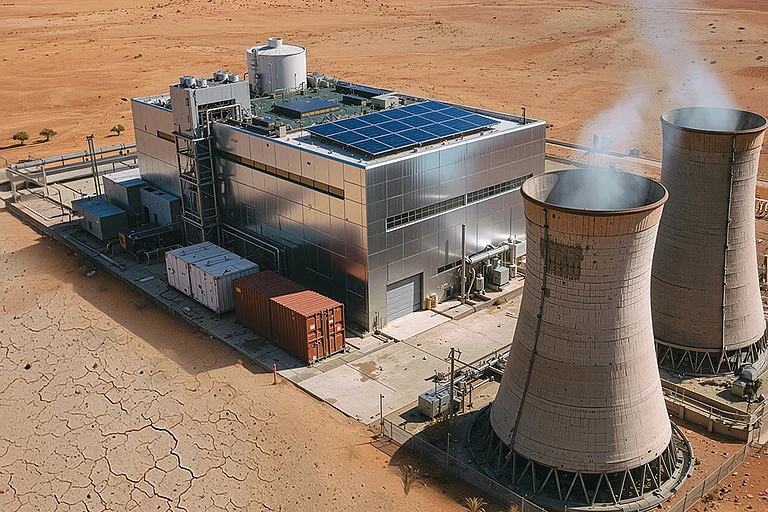
Do we have enough water resources to support the expansion of industries like data centres, semiconductor and nuclear energy?
Singapore uses treated wastewater for drinking. So, data centres can certainly use treated wastewater.
The real problem is that India's cities do not treat their wastewater properly. There is an arrogance in the way we deal with water. We use it, dump untreated wastewater into natural ecosystems and assume nature will take care of the problem. This mindset exists across urban and rural India.
If we had the right policies and governance systems, backed by appropriate technology and investments, then yes, there would be enough water for development. Of course, there are limits.
Take the example of ethanol production. A significant amount of ethanol is being promoted in Marathwada. Paddy is also increasingly being diverted for ethanol production in some places. Paddy itself requires thousands of litres of water to produce every kilogram. Converting it into ethanol further increases the water footprint.
When concerns are raised about this, critics are sometimes labelled anti-national. If this is how we continue to manage our water resources, then there is very little hope. We will only create more water crises.
Similarly, sugarcane should not be cultivated extensively in Marathwada, which receives only about 400 to 600 millimetres of rainfall annually. Yet it has become one of the country's largest sugarcane-producing regions.
There has to be region-specific limits based on local water availability. Agricultural production, industrial development and energy projects should all be planned according to the ecological conditions and water resources of each region.
Second, industries such as data centres, nuclear power plants and semiconductor facilities do not all have to depend on freshwater. Many of these industries can be set up along the coast, where they can desalinate seawater for their needs. Others can use treated wastewater from cities and industries by recycling it.
If we divert and treat wastewater for industrial use while allowing rivers to retain clean, flowing freshwater, we can turn that curse into a blessing.
The water crisis hasn't hit us dramatically yet. However, if we don't change course, it will worsen in the years ahead
Do you think these industries will further worsen the water situation?
Of course. Water crises inevitably affect the economy. Any large-scale disruption caused by water shortages will have major economic consequences. For some time, it may seem possible to exploit natural resources without facing the consequences. But it is no longer sustainable.
Take the Ken–Betwa river-linking project as an example. It is expected to result in the loss of around 4.6mn trees and affect the Panna Tiger Reserve, yet the hydrological benefits remain unclear. This is a ₹45,000cr project, and it raises serious questions about how we are making decisions on water management.
Every water resource has a certain level of dependable availability, and planning must be based on those ecological realities, not assumptions.
These industries require a 100% dependable water supply. However, reliability of water resources varies depending on the source. As more water-intensive industries come up, they will increasingly claim the most dependable water supplies, making other users more vulnerable.
Take Visakhapatnam, for example. It lies in the Godavari basin, which the government considers a surplus river basin with relatively abundant water resources. Yet, as you pointed out, the region is already facing water shortages. If that is the situation in a basin considered water-surplus, imagine what conditions will be like in more water-stressed regions.

1 October 2026
Get the latest issue of Outlook Business

Do we need a dedicated industrial water policy?
What India really needs is better governance. Many industries are officially classified as zero-liquid-discharge industries. In reality, they regularly receive notices from pollution control boards warning them over illegal discharge of polluted wastewater into ground-water. This is happening even in areas close to the National Capital Region.
The boards know these violations are happening, but instead of effectively stopping them, it publishes advertisements warning industries not to break the law. That reflects the weakness of our enforcement system.
Let me give you another example. Near Delhi, there is a Common Effluent Treatment Plant (CETP) equipped with online monitoring sensors. These sensors are supposed to transmit real-time water quality data directly to the pollution control board so that regulators can continuously monitor compliance.
A colleague who visited the plant discovered that the sensor had been placed inside a drum filled with clean water rather than in the actual treated effluent. As a result, the monitoring system kept reporting clean water, while untreated wastewater continued to be discharged.
This is the level of governance we are dealing with, even near the national capital.
Could the expansion of industrial clusters in places like Bengaluru or Navi Mumbai deteriorate the situation further?
Yes, it certainly could. Mumbai and Navi Mumbai receive enormous amounts of rainfall. Yet, as soon as summer arrives, they begin facing water shortages. The problem is the attitude of our urban areas.
We do not harvest rainwater. We do not protect our rivers or water bodies. We do not adequately treat wastewater. We do not practise demand-side water management. Yet, we continue demanding more water and ask for more dams to be built.
That is the arrogance of urban India today,. For now, cities are getting away with it because that is how the political system functions. But this approach will have serious consequences in the years ahead.
The further we continue down this path, the greater the problems will become.