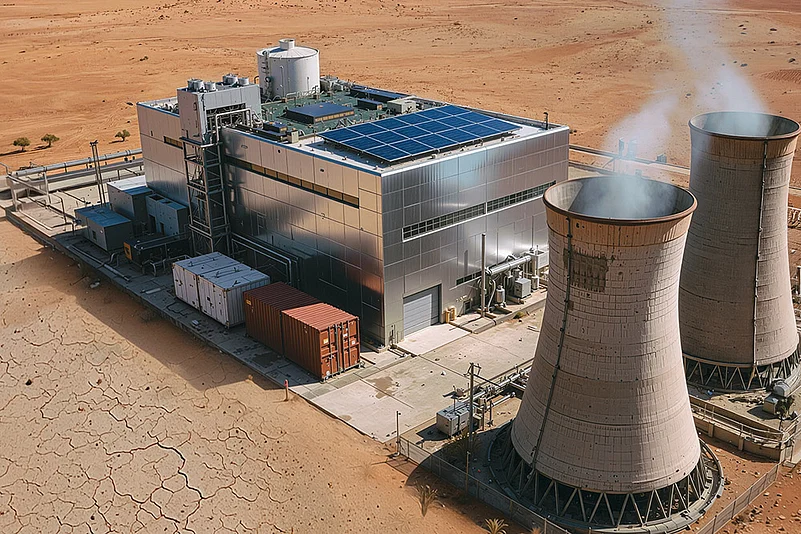
It’s a humid morning in Tarluvada village near Visakhapatnam, but the crowd of farmers and residents gathered outside a government office remains unfazed by the sweltering heat. This is a protest, not against the smoke of a steel plant or the sludge of a coal mine. They are up in arms against one of the world’s biggest technology companies.
This sight is commonplace in and around Tarluvada, the site where Google’s multi-billion-dollar artificial intelligence (AI) data centre is coming up.
The opposition to the large-scale project continues to echo through the streets of Andhra Pradesh’s capital city. “We cannot drink DATA”, reads a banner carried by activists and children during one such march in Visakhapatnam.

1 October 2026
Get the latest issue of Outlook Business

To policymakers, the project is a landmark leap into the future. To the people of Tarluvada, it looks like a thirsty giant that could drain an already dying well. “They consume vast amounts of fresh water and electricity, leaving us with a heavy burden,” says one of the protesters.
“These projects primarily benefit large technology companies and corporate profits rather than the public,” he adds.
This clash between technological ambitions and the public is not an isolated flashpoint. For decades, the dusty streets of Patancheru, an industrial zone located near Hyderabad, has been the centre of one such struggle.
In the shadow of a lucrative pharmaceutical hub, villagers spent years filing petitions, taking to the streets and fighting legal battles. Their fight is against the chemical effluent from bulk drug manufacturers that has slowly turned local groundwater toxic, poisoned lakes and rendered backyard borewells unusable.
The decades-long Patancheru movement proves that when industrial growth threatens water security, communities will eventually push back.
The water crisis is simple maths. India supports 18% of the world’s population with just 4% of its global freshwater resources.
“Policymakers tend to treat water as a secondary constraint for many of India’s priority industries,” warns Anjal Prakash, professor of public policy at FLAME School of Liberal Education.
“In reality, not land, capital or power, but water could become the biggest industrial bottleneck by 2035 unless urgent action is taken.”
The warning signs are already flashing red. Data from the NITI Aayog Composite Water Management Index reveals a stark reality: nearly 600mn Indians currently face high to extreme water stress, and around 200,000 lives are lost each year simply due to inadequate access to safe water.
As India races to build industries like AI data centres, semiconductor and pharmaceutical hubs that will power its next phase of economic growth, water could become the biggest constraint. And the community pushback points to a defining question: can India’s next phase of growth survive a water crisis?

Water-Stressed Future
If you look at a map of India’s industrial boom, a strange paradox is visible. In the north, the large river systems of the Ganga, Yamuna and Brahmaputra are fed by the snow and melting glaciers of the Himalayas. Add monsoon rainfall to the equation, and the flows are sustained throughout the year.
But look south to peninsular India, and the landscape changes. Here, life and industry rely almost entirely on the whims of the monsoon. When the rains fail, rivers and reservoirs become vulnerable to prolonged dry spells.
Yet, it is precisely in this water-stressed regions of the country that India’s most power-hungry and water-guzzling tech engines are situated or being constructed.
Almost all of India’s growth engines—from semiconductor fabs in Gujarat to AI data centres in Andhra Pradesh, Telangana and Tamil Nadu, pharmaceutical clusters around Hyderabad, and nuclear power plants along the southern and western coasts—are anchoring themselves in regions where groundwater is already under stress. Increasingly erratic rainfall and intense competition for water are adding to the burgeoning stress.
India’s challenge is to pursue these water-intensive industries without undermining its water security
But why choose the already-stressed regions? The logic is simple as these states already have business-ready infrastructure.
Gujarat, Maharashtra and Tamil Nadu offer good ports, reliable power and established industrial hubs, making them attractive despite limited water availability.
But Prakash cautions that if the country wants to build the future without running dry, it has to change how it maps its progress. “Water-intensive industries should preferably be in regions with low water risk,” he argues.
He advocates for the governments to step in and identify suitable locations or develop dedicated industrial parks with assured supplies of recycled or, wherever feasible, desalinated water.
Thirsty Industries
India is betting its future on four industrial pillars—AI, semiconductors, pharmaceuticals and nuclear energy. And these have one thing in common: a huge appetite for water.
Water is a critical raw material for these industries. It cools the servers that power AI, rinses silicon wafers during chip fabrication, sterilises pharmaceutical equipment and medicines, and keeps nuclear reactors operating safely. Without dependable access to water, production slows, costs rise and investment becomes increasingly vulnerable.
Among these, AI data centres are the most intense water-guzzlers. Thousands of servers process complex algorithms, consume massive amounts of electricity and generate intense heat. To keep them from crashing, many facilities rely on evaporative cooling systems, where water absorbs the heat and evaporates into the atmosphere. The scale of this consumption is staggering.
According to the Environmental and Energy Study Institute (EESI), a single large-scale data centre can gulp up to 5mn gallons of water every day—a volume that could easily sustain a town of 50,000 people.
This problem is only compounding. In the pre-AI era, data centres hummed quietly at capacities of just 2–5 megawatts (MW). Today, the high-performance computing required for AI has sent power and water requirements skyrocketing.
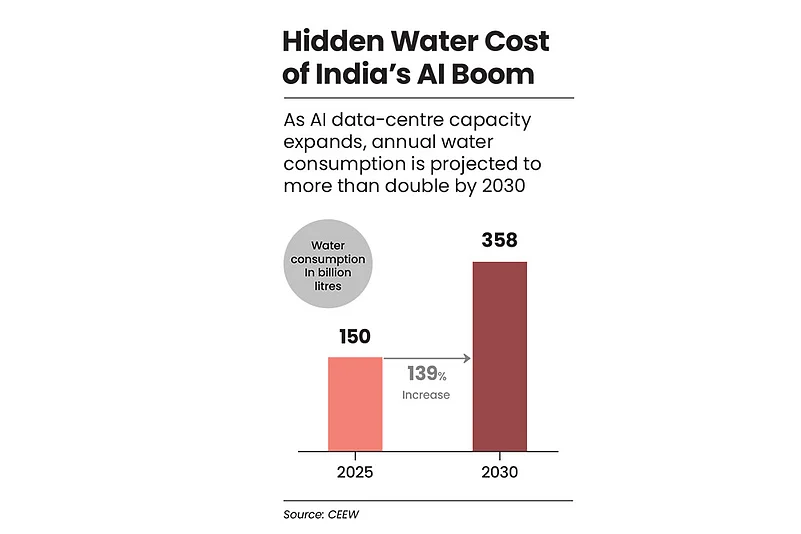
In fact, according to media reports citing Mordor Intelligence, India’s data centres consumed roughly 150bn litres of water in 2025, a figure projected to more than double to 358bn litres annually by 2030.
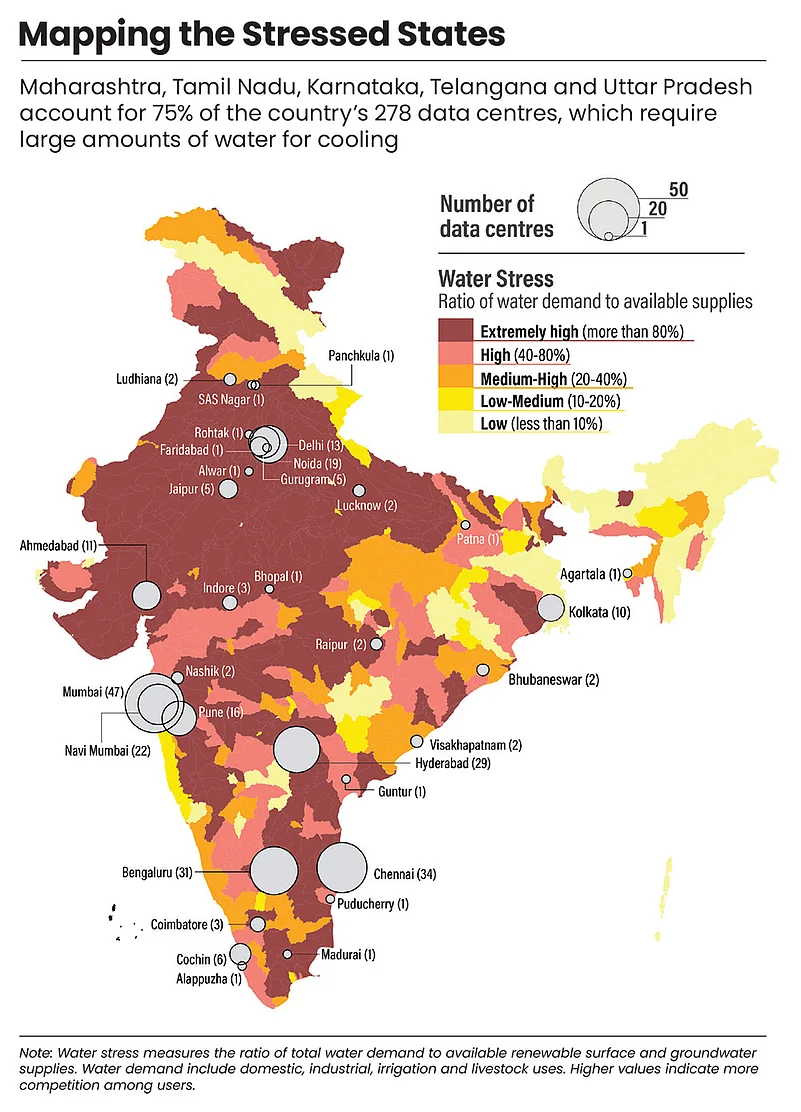
What’s worse is that 75% of the country’s 278 data centres, as per WRI India, are concentrated in just five states: Maharashtra, Tamil Nadu, Karnataka, Telangana and Uttar Pradesh. The vast majority of these high-tech hubs are operating in zones already classified as experiencing high to extremely high-water stress.
Prakash warns that the explosive growth of these thirsty tech hubs could severely worsen local water stress. “As industries become increasingly dependent on reliable water supplies, fragmented water governance is emerging as a significant business risk.”
Access to water now dictates where mega-factories are built, how global supply chains expand and where multinational companies choose to invest
Semiconductor-fabrication plants are also a drain on water resources. The tiny chips that power everything from smartphones to advanced AI hardware require millions of gallons of water during manufacturing. But standard tap water will not do.
The industry relies on ultrapure water (UPW)—a liquid thousands of times purer than drinking water, used to rinse silicon wafers after every single stage of fabrication. A single microscopic contaminant can ruin an entire batch of microcircuits.
Creating this hyper-pure liquid takes anywhere from 1,400 to 1,600 gallons of municipal water just to filter out 1,000 gallons of UPW. Consequently, a modern chip-making factory can consume a staggering 10mn gallons of UPW a day, roughly matching the daily water footprint of 33,000 American households.
In the global race to secure chip supply chains, access to water is becoming just as critical as electricity or engineering talent.
This dependency on water is also visible in India’s massive pharmaceutical hubs. Here, highly purified water is mandatory, serving as a base ingredient for life-saving medicines, vaccines and injectables, as well as a sterilisation agent for heavy equipment.
Meanwhile, along the coasts and riverbanks, nuclear power plants require an endless supply of water to cool their reactors and condense the steam spinning their turbines, making water indispensable for both power generation and public safety.
Each of these industries represent a strategic priority for India’s economic future. Yet, there is a hard truth to brace for. Reliable water supplies will ultimately dictate where factories can be built, how effectively they can operate and whether India’s industrial ambitions will thrive or wither.
“As these industries expand, they are likely to secure the most reliable water resources, intensifying competition and leaving others more vulnerable to shortages,” warns Himanshu Thakkar of the South Asia Network on Dams, Rivers and People (SANDRP).
Polluting Growth
Villages surrounding the Patancheru Industrial Area is the epicentre of one of India’s longest-running battles over industrial pollution.
Farmers and residents have been protesting for decades, flooding courts with petitions and waging gruelling legal battles against bulk drug manufacturers.
They watched in real time as untreated pharmaceutical effluents poisoned local lakes and turned vital backyard borewells into conduits of toxic waste.
What began as a localised environmental feud fast evolved into a nationwide case study on the hidden cost of rapid industrialisation.
Hundreds of kilometres away, in Tamil Nadu’s Tirunelveli district, a battle is raging against Kudankulam Nuclear Power Plant. Here, fishermen and residents have raised concerns that effluent discharged into the sea could affect fish quality and threaten their livelihoods and those of future generations.
Protests reached a fever pitch when Japan’s Fukushima nuclear disaster shocked the world in 2011. Safety and nuclear-waste concerns have compounded local anxieties.
These are not isolated cases. Today, industrial effluents are choking rivers like the Yamuna, Ganga, Sabarmati and Jojari. Smaller tributaries have transitioned into open drains.
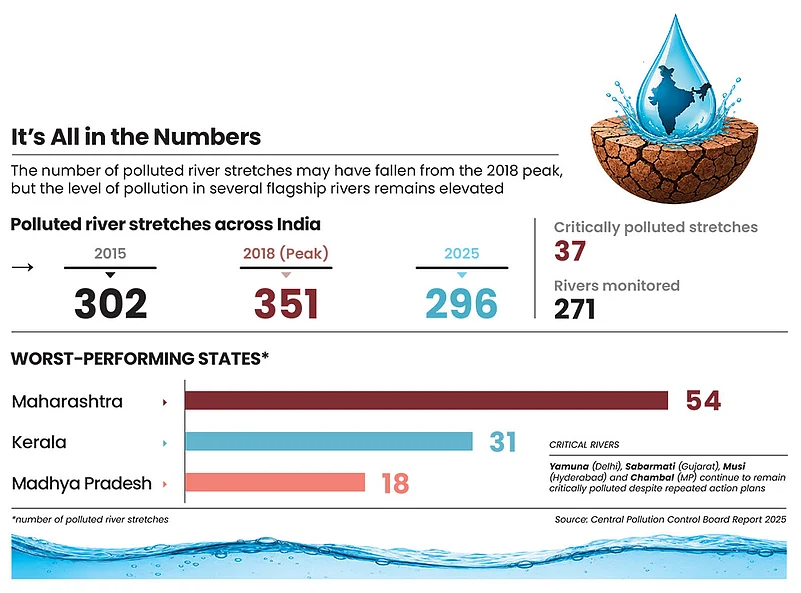
The number of polluted river stretches may have fallen from 351 in 2018 to 296 in 2025, but the same report by Central Pollution Control Board (CPCB) says that the level of pollution in several flagship rivers remains elevated.
Water-heavy sectors like textiles and tanneries swallow clean water by millions of gallons and discharge complex, difficult-to-treat effluents.
While India’s rivers have survived centuries of droughts and shifting climates, the current crisis is overwhelmingly human made, driven by unchecked industrial pollution, weak regulatory enforcement and persistent institutional neglect.
The Hindon river, one of the critical tributaries of the Yamuna just outside the national capital, is one such proof of failed water governance. Decades of unmonitored industrial dumping and raw sewage have turned vast swathes of the river toxic.
Yet, thousands of impoverished families rely on this toxic water, trading serious health risks for daily washing and drinking needs. The severity of the matter has now led to proceedings before the National Green Tribunal (NGT).
On paper, India has crucial regulations like the landmark Environment (Protection) Act, 1986, and the Water (Prevention and Control of Pollution) Act, 1974, to monitor the discharge of pollutants into water bodies. Enforced by the CPCB and its state-level counterparts, this framework relies on a system of environmental clearances, strict discharge standards and a push towards a circular water economy.
Bulk consumers are legally required to treat and reuse their wastewater. For the most visible polluters—textiles, tanneries and chemical plants—the state mandates zero-liquid-discharge (ZLD) systems, demanding the use of advanced reverse osmosis and thermal evaporators to recycle every single drop.
But even if the technology exists, the political will to enforce it frequently falters.
“Many industries are officially classified as ZLD industries. Yet, violations continue,” says SANDRP’s Thakkar. “Instead of effectively stopping them, pollution control boards publish advertisements warning industries not to break the law. That reflects the weakness of our enforcement system.”
Bane or Boon?
In the mid-1990s, Ismail Serageldin, then vice-president of the World Bank, issued a chilling prediction: “If the wars of this century were fought over oil, the wars of the next century will be fought over water.”
At the time, it was largely viewed through the lens of geopolitics. Three decades later, Serageldin’s prophecy is unfolding as water transitions from a basic natural resource into a strategic economic asset.
As climate change disrupts rainfall, shrinks groundwater reserves and turns freshwater scarce; access to water has become critical to most industries. It now dictates where mega-factories are built, how global supply chains expand and where multinational companies choose to invest billions of dollars.
Not just water and land availability, but a host of factors like government incentives, a large domestic market and a young working population are helping India attract investment in high-growth industries today. But FLAME’s Prakash thinks India must engender caution. “The challenge is to attract these investments without bearing a disproportionate share of their environmental and social costs.”
Today, the challenge for India is whether it can build its digital future without draining its water resources. This hurdle requires an overhaul of the national blueprint
For decades, economists used a concept known as the Pollution Haven Hypothesis to map corporate migration. It explained why multinational giants routinely uprooted their resource-heavy factories from developed economies—where environmental regulations were strict and compliance was costly—and replanted them in developing countries that offered cheap land, loose oversight and better incentives. Today, this pattern is emerging in the global data-centre industry.
Across Europe, data centres have hit a wall. Communities are pushing back against the massive land allocations, rising power demands and millions of gallons of water required to keep servers from overheating.
In the Netherlands, authorities slapped temporary restrictions on massive hyperscale data centres, citing a desperate need to protect limited land, power grids and water supplies. Ireland has radically tightened its approval processes: new grid connections around the Dublin region are now capped. Spain has witnessed protests and regulatory debates over water-intensive data centres during periods of drought.
In the US, the story is identical. In Arizona and Virginia, local residents are questioning why tech conglomerates should be allowed to deplete local aquifers to cool servers.
This tech-community friction has made building data centres difficult and expensive. So, these developed economies are now increasingly shifting these water-guzzling facilities towards developing countries like India, where states are competing to roll out the red carpet.
And as scarcity intensifies, water has become the ultimate strategic linchpin in South Asia.
Brewing Battles
On the frozen plateau of Tibet, China has begun construction on a massive five-cascade hydropower project along the upper reaches of the Yarlung Tsangpo—the same river that flows directly into India as the Brahmaputra.
With a planned capacity of 60GW and a price tag nearing $167bn, this project has made downstream nations like India and Bangladesh concerned over likely disruptions to water flows and river ecosystems.
Further west, water scarcity has only added to India-Pakistan tensions. Today, New Delhi is arguing that the Indus Waters Treaty of 1960 is obsolete, pointing out that its population has more than tripled, agricultural and industrial appetites for water have surged, and climate change has changed rainfall patterns, rapidly melting Himalayan glaciers and altering river flows.
Yet, India’s water wars are not just brewing at its borders.
The bitter, generational feud over the Cauvery between Karnataka and Tamil Nadu, and the rising legal and political clashes across the Krishna and Godavari basins show how dwindling and unevenly distributed water is becoming a source of conflict.
These conflicts show that water is now a strategic economic resource.
As India sprints to become a global hub for AI, semiconductors, pharmaceuticals and cutting-edge manufacturing, the availability of reliable and clean water source is critical and far harder to secure.
India’s challenge is not whether it should pursue these industries, but whether it can do so without undermining its water security. That will require integrating water into industrial policy, pricing water more rationally, strengthening enforcement against pollution, expanding wastewater recycling and ensuring that new investments are aligned with local water availability.
Today, the challenge for India is whether it can build its digital future without draining its water resources. Surviving this bottleneck requires an overhaul of the national blueprint.
“Since water is a state subject in, state governments can reveal and regulate the hidden water footprint of AI,” says Ulka Kelkar, a climate-change researcher.
Thus, the policy choices made in the next few years will be crucial.
Going forward, India’s success will not be measured by how many microchips it manufactures or how many algorithms its servers process, but by how sustainably it guards, recycles and respects its most precious resource.