

Dear Reader,
Artificial intelligence is no longer just about breakthroughs in labs or pumping billions of dollars into data centres — it’s in our hospitals, courtrooms, classrooms, and on the battlefield. At Outlook Business, we believe that India needs a sharp, nuanced, and people-first lens on this transformation.
The Inference is our attempt to make sense of a world being rewritten by AI. In this newsletter, we bring you frontline narratives, boardroom insights, and data you can trust. Whether you’re an investor, founder, policymaker, or just curious — this is where the signal cuts through the noise.

1 November 2026
Get the latest issue of Outlook Business

In this edition of the newsletter:
The joy of building ridiculous things
A unicorn without cash burn
India’s AI stack missing key pieces
When AI works for the wrong people
Humans In The Loop
The joy of building ridiculous things
In the early 2000s, a fantasy adventure show used to air on television and was all the rage among children. The protagonist had a magical pencil that would turn anything he drew into reality. The pencil was a fantasy, but we have a digital version of it today that lets people turn their wishful ideas into reality. The easy availability of AI tools like ChatGPT and Claude has led to a flood of passion projects on the internet. From quirky music websites that play songs once heard in buses and saloons, and WhatsApp bots that search documents and photos, to gaming websites that let you play games like penfight and Road Rash, people are building anything and everything. Most of these projects are works of passion and do not necessarily have a business case.
These projects reflect a shift in what makes an idea worth pursuing. For years, even a modest interactive website required coding skills, illustrations and often money to hire someone. A passing idea could become a commitment of time and resources, leaving many abandoned before they were built. Vibe coding, where users describe what they want and AI writes the code, is lowering that barrier. Much of the conversation around generative AI has revolved around productivity and business opportunities. But it is also allowing people to build things simply because they find them funny, useful or nostalgic, making room for a more personal internet.
“Earlier, if I was going to build something, it usually had to be a serious idea,” says Yash Bhardwaj, creator of saloon.wtf, which recreates the music and atmosphere of a 2000s barbershop. He says the website itself took around 30 minutes to build, although refining the illustrations took longer. What would once have been stressful had become a relaxing activity.
The falling cost of experimentation changes what people are willing to attempt. A website does not have to solve a problem for thousands of customers. It can recreate a memory, entertain a few friends or save someone the irritation of repeatedly searching for a document. If it does not work, there is less money and effort tied to it.
That is why nostalgia lends itself so well to this wave. Browser recreations of Road Rash and GTA Vice City, classroom games and music websites turn shared memories into something people can revisit. The appeal lies in the small details: the chatter of a classroom or the songs associated with a bus journey. AI can handle much of the execution, while the creator decides what makes the experience familiar.
The difference in resources required can be substantial. Rinkesh Gorasia, creator of Penfight.xyz, says an earlier attempt would have meant hiring developers and designers, putting in money upfront and figuring out how to recover it. He built the first version in a 30-hour sprint. Today, he puts the entry cost at roughly $20 or $100, depending on the AI charges.
Other projects may never need a public audience. Anirudh Kejriwal built a WhatsApp companion that helps his family retrieve documents after his father asked for a passport copy. Using mostly free systems and interfaces, he completed it in roughly 10–12 hours over a weekend. Without AI, he doubts he could have done it even in a month.
The assistance also extends beyond getting something built. When Penfight faced a bot attack on its second day, automated activity flooded its match counts and leaderboard. Gorasia turned to Claude in the wee hours of the morning and built countermeasures in around 3.5 hours while keeping the game available. “I didn’t have any clue how to mitigate this,” he says.
A passion project can also find an audience large enough to warrant further investment. Gorasia’s Penfight recorded 1 lakh matches and 17 lakh shots in its first four days, including more than 21,000 multiplayer matches, with 5,100 simultaneous players at its peak. It has since added six-player support, and an app version is planned. Growing server bills and retaining players bring their own challenges, but the idea could be tested before making a larger commitment.
As building becomes easier, the internet is likely to fill with more such experiments. Many will remain small, some will be forgotten and a few may become viable businesses. The more interesting change is that they no longer need the promise of becoming a business to exist. A little spare time, a memory or a personal irritation may be reason enough to start.
From the Trenches
A unicorn without cash burn
The age of easy capital has turned business fundamentals on their head. The fight to win market share, backed by easy money, has made profitability an afterthought. The emergence of AI is accelerating the demand for even more capital.
However, businesses cannot always bank on the next funding round, particularly if their underlying economics are not competitive, believes Fireflies.ai co-founder and CEO Krish Ramineni. “You can’t fund bad economics,” he says.
Fireflies entered the unicorn club at a valuation of $1 billion last year. Unlike most companies in the AI-powered meeting intelligence space, it has been profitable for the past three years. “We got to profitability within that first $5 million of seed money. We never really touched our Series A money,” Ramineni says.
The contrast is striking. As per Crunchbase, AI companies raised $202.3 billion in 2025, accounting for nearly half of global startup funding. Fireflies has raised only around $19 million since it was founded in 2016.
But the journey was neither short nor easy. Its early products attempted to analyse emails, conversations and workplace relationships at a time when the technology was not mature enough. After several failures, the founders focused on a simpler gap: meetings could not be searched or recalled like emails. Even imperfect transcription had utility if it helped users remember what had been discussed.
Fireflies, which records, transcribes, summarises and analyses workplace conversations, began concentrating on meetings in 2019. The pandemic accelerated adoption. An investment by Khosla Ventures later led to an introduction to OpenAI’s Sam Altman and early access to GPT-3. “That is when we finally realised the potential of the product,” Ramineni says.
Its focus on cost, however, predates the generative-AI boom. Meetings require calling infrastructure, transcription and real-time processing, with every additional interaction adding to the bill. Fireflies built its own infrastructure, server capacity and clusters, while continually optimising its systems. “Then the market moved. LLMs got significantly cheaper. Transcription got significantly cheaper,” he says. Without those declines, Ramineni estimates that processing all of Fireflies’ historical calls at 2019 rates would have cost $3 billion.
Having already solved the costliest part of the problem gives Fireflies an advantage as it expands from a note-taker to an “AI teammate” across email, chat and other workflows. “One meeting is equivalent to around 300 emails,” he says. “We started with the hardest problem.”
Cost discipline is tied closely to utility. Fireflies has never raised the price of its meeting assistant. Ramineni says human note-takers in the US once charged by the hour; two meetings could cost as much as an annual Fireflies subscription, costing around $10 a month.
But falling AI-processing costs have created a different challenge. It is now easier than ever to build the first version of an AI product, making it much harder to stand out and retain customers. “You are now competing with a thousand other Version 1 products,” Ramineni says. Distribution, marketing and explaining what makes a product different have consequently become more important.
Ramineni also believes founders should first build useful applications around existing models instead of raising vast sums to create their own. He points to Cursor, which built a multibillion-dollar business using models developed by OpenAI and Anthropic before creating its own models at scale. The same shift, he says, creates room for smaller, niche AI businesses serving specific customer groups profitably. Not every useful AI product needs to become a unicorn or raise hundreds of millions of dollars.
Numbers Speak
The pay divide in AI
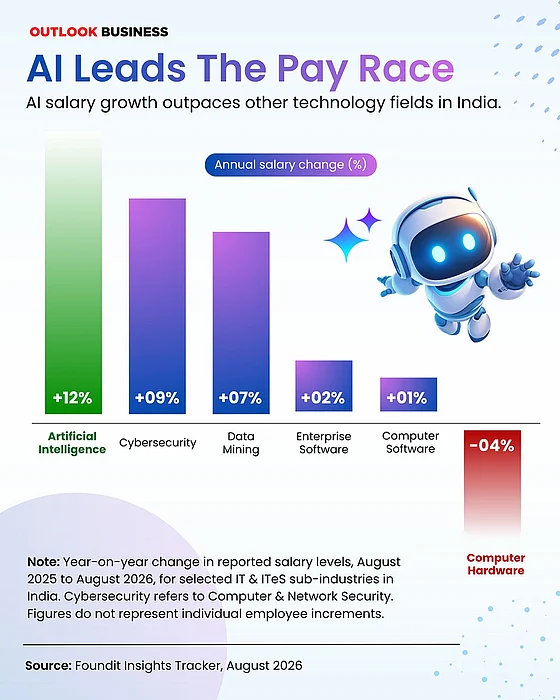

India’s technology hiring slowdown is not being felt equally. Even as employers pull back on recruitment, salaries in artificial intelligence are rising faster than in other technology fields.
According to the foundit Insights Tracker report, hiring activity in IT–software and services fell 11% from a year earlier. foundit, formerly known as Monster India, is a leading online job search and talent platform operating across India, Southeast Asia and the Middle East. Its findings point to a market becoming increasingly selective about the skills it rewards.
The salary picture illustrates that divide. Reported salary levels in artificial intelligence rose 12% year-on-year, compared with just 1% in computer software. Computer hardware saw a 4% decline. The contrast suggests that a slowdown in technology hiring can coexist with strong demand for particular capabilities.
For employees, this makes the nature of their expertise increasingly important. A career in technology does not automatically offer the same prospects across specialisations. Employers may be cautious about expanding their workforce while remaining willing to pay more for skills needed in areas such as AI and cybersecurity.
The wider employment picture reinforces that selectivity. Across the job market tracked by foundit, professionals with seven to ten years of experience were the only experience group to record annual hiring growth in August. Employers appear to be prioritising people who can take responsibility for implementation and delivery.
Words of Caution
When AI works for the wrong people
The same AI tools that help people build websites and automate work are also helping others develop weapons, conduct surveillance and run scams.
In a threat report, Anthropic detailed operations it disrupted involving misuse of Claude. The cases show how small groups can use AI to undertake work that would otherwise require considerable technical expertise.
In Mali, a suspected consultant for the state intelligence service used Claude to build a surveillance platform targeting roughly 25 million SIM cards. In northern Yemen, a weapons-development cell used it to develop rocket and missile guidance software. Anthropic found no evidence of an operational weapon; a rocket test apparently failed.
Other cases were closer to everyday digital life. Iranian actors built a malicious browser extension disguised as a prayer-times utility to harvest social-media identities. A China-based studio used Claude across more than 20 deceptive dating apps, with over 4,700 AI personas engaging at least 25,000 people in two weeks.
Anthropic says it banned the associated accounts and strengthened safeguards. But disrupting access does not erase software already built.
Best of our AI coverage
Why India Doesn’t Have AI Start-ups in Growth Stage (Read)
Narayana Murthy's Message to India's Youth: Don't Settle for Being the World's Back Office (Read)
Bhavish Aggarwal's Speed is Breaking India's Only AI Unicorn (Read)
India’s Healthcare AI Start-ups Grapple with a Broken Data Ecosystem (Read)
AI Start-Ups Ride a Wave of ‘Curiosity Revenue’, VCs Rethink What It’s Worth (Read)
What Exactly Is an ‘AI Start-Up’ — and Does India Have 5,000 of Them? (Read)