A new trade deal between India and the US under President Donald Trump and Prime Minister Narendra Modi would further enhance the bilateral relationship, a top US official has said, underlining that Washington's partnership with New Delhi is critical.
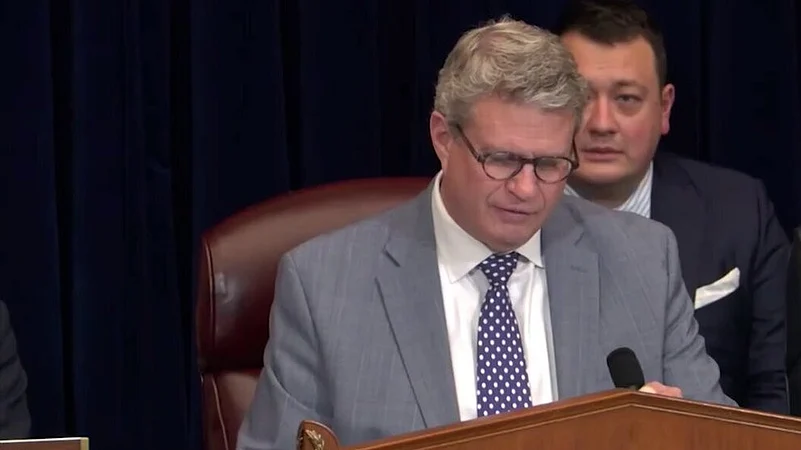
These remarks were made by House Foreign Affairs South and Central Asia Subcommittee Chairman Bill Huizenga on Wednesday at a subcommittee hearing titled 'The US India Strategic Partnership: Securing a Free and Open Indo-Pacific'.
"The US-India relationship is no longer just important. It is a defining relationship of the 21st century. If America wants a free Indo-Pacific, resilient supply chains and a world where democracy, not authoritarianism, sets the rules, then our partnership with India is critical,” Huizenga said in his opening remarks.

1 September 2026
Get the latest issue of Outlook Business

The hearing heard from witnesses, Director of Asian Studies Centre, Heritage Foundation, Jeff Smith, Executive Director of the Observer Research Foundation America, Dhruva Jaishankar and External Senior Advisor, Special Competitive Studies Project, Senior Fellow, Indo-Pacific Programme, German Marshall Fund of the United States, Sameer Lalwani.
Describing India as one of the fastest-growing major economies in the world, Huizenga said American companies increasingly see India not just as a market but as a partner to innovation, especially in AI, communications, and advanced technologies, where collaboration already exists.
“American companies are eager to enter the Indian market on a level playing field. A new trade deal with India under President Trump and Prime Minister Modi would further realise this goal and enhance the relationship. Open markets, strengthening supply chains and driving innovation, all of which would chart a new beginning in our storied partnership,” he said.
Advertisement
Huizenga stressed that every American administration, whether Republican or Democrat, has “strengthened ties, or certainly at least attempted to, making clear that the United States does not see India as a temporary or transactional partner.” Referring to Russian President Vladimir Putin's recent visit to India and Prime Minister Modi’s participation at the Shanghai Cooperation Organisation summit in China in September, Huizenga said, “we must view this moment with clear eyes.



“President Putin's warm visit to India last week and India's participation in China's Shanghai Cooperation Organisation summit this September raised some understandable concerns.” “Moreover, authoritarian powers like China and Russia are redrawing borders by force, undermining democratic norms and coercing their neighbours. Nowhere is this more evident than in the Indo-Pacific, where an increasingly aggressive China threatens regional stability, global prosperity and the open flow of commerce," he said.
Advertisement
"China's string of pearls ideology is no longer just a theory, but rather an overt attempt to encircle and control the Indian Ocean, its sea lanes, and expand the militarisation of these strategic ports and trade routes. We cannot allow this to happen. India knows these risks firsthand,” Huizenga said.
He also noted that India has agreed to purchase more American energy, thereby significantly reducing its reliance on Russia.
Huizenga underscored that US-India cooperation today spans defence, technology, counterterrorism and trade.
On counterterrorism cooperation, which he described as “significant”, Huizenga noted that organisations responsible for the heinous April 22 Pahalgam attack - Lashkar-e-Tayyiba (LeT) and The Resistance Front (TRF) - were designated by the Trump administration as foreign terrorist organisations in July this year.
The designation reflected "our shared commitment to fighting terror wherever it occurs”.