Tata Power CEO Praveer Sinha is seeking distribution opportunities in states expected to undergo structural reforms
The company is focusing on transmission infrastructure build-out to support the rapid addition of renewable energy capacity
Tata Power's solar cell and module manufacturing facilities are operating at 93–95% efficiency
Tata Power CEO Praveer Sinha on Monday said the company is evaluating a long list of states for potential distribution opportunities, with a clear focus on regions where structural reforms are expected.
Uttar Pradesh, he noted, is likely to invite bids for distribution reforms when the process formally opens, while Goa is one state where Tata Power has already submitted an application. “As and when opportunities formally open up, we will participate in the bidding process,” he said.

1 September 2026
Get the latest issue of Outlook Business

Speaking at TP Central Odisha Distribution Limited, Sinha said several states are facing acute financial stress in their distribution businesses, creating the need for deep reforms and private sector participation.



Transmission, he added, is another critical focus area, as the rapid addition of renewable energy capacity, characterised by lower plant load factors and requires a disproportionately higher build-out of transmission infrastructure to ensure grid stability.
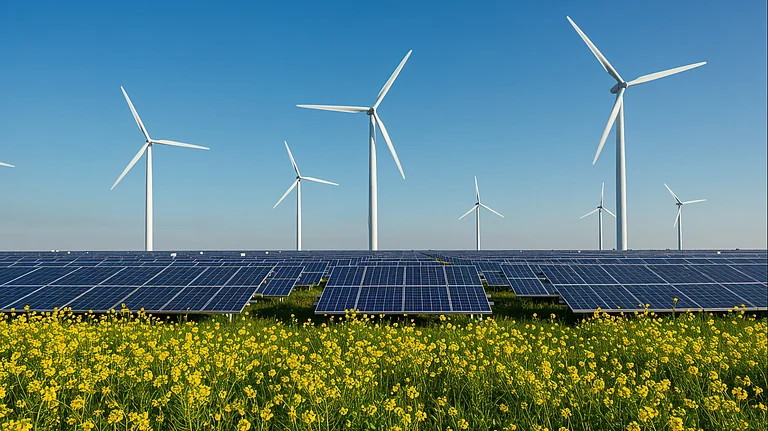
On manufacturing, Sinha said Tata Power’s solar cell and module facilities are currently producing around 11 MW per day, with operational efficiency levels of 93–95%. In contrast, many plants across the country operate at utilisation rates of 60–70% and struggle to sustain performance.
Advertisement
He attributed Tata Power’s strong execution to its prior experience in running a similar manufacturing facility in Bengaluru, which helped stabilise operations quickly. As a result, revenues from the manufacturing business have been strong and are expected to remain consistent. The company also plans to set up a 10 GW integrated manufacturing facility for ingots and wafers, with the location yet to be finalised. Discussions with multiple state governments are underway, and a final decision is expected by January.
Highlighting the turnaround at Odisha Distribution, Sinha said the business was valued at around ₹22,000 crore at the time of acquisition, compared with about ₹10,000 crore in 2012, and is now valued at approximately ₹20,000 crore. Over the past five years, the business has doubled in value, driven by improvements in supply quality that have encouraged more consumers—particularly industrial users—to shift to Tata Power’s network. Odisha Distribution, he said, has delivered consistently strong performance.
Advertisement

He underscored the complexity of managing a geographically vast distribution area like Odisha, which spans nearly 154,000 square kilometres across villages, towns, and cities, compared with compact urban networks such as Mumbai or Delhi, each covering around 1,500–1,600 square kilometres. Despite challenges in remote and sensitive regions, Tata Power has ensured reliable electricity supply and sustained collections across the state.
“Our performance in Odisha has consistently exceeded regulatory benchmarks every year, and this trend is expected to continue until 2031,” Sinha said. The company continues to invest annual capital expenditure to strengthen the network across both rural and urban areas, with sustained capex supported through regulated returns as loads grow and the network expands.