: Narayanan said ISRO will remain a government organisation and that greater industry participation is aimed at expanding India’s space economy.
Around 80% of ISRO’s budget is already invested in industry, with nearly 450 companies working with the space agency.
The agency plans to focus more on advanced research, human spaceflight, next-generation launch systems and deep-space missions, while industry handles mature technologies and routine manufacturing.
ISRO Chairman V Narayanan has sought to allay concerns over the space agency’s growing engagement with private companies, saying the organisation is not being privatised and will continue to remain a government institution.
Speaking on the sidelines of the Bengaluru Space Expo on Monday, Narayanan said private-sector participation was aimed at expanding India’s space ecosystem and economy, rather than reducing ISRO’s role.

1 October 2026
Get the latest issue of Outlook Business

“My colleagues have some genuine concerns and it is our responsibility to clarify. ISRO is not being privatised, it is a government organisation and we are working with government investment,” Narayanan said. He added that expanding the country’s space ecosystem and space economy was the objective of the ongoing changes.


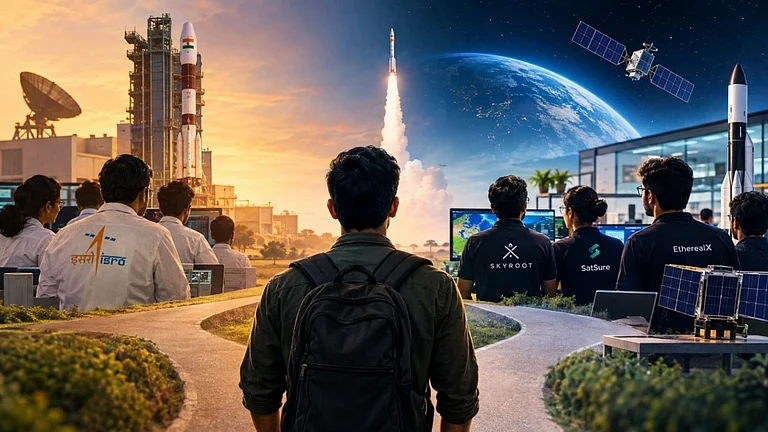

ISRO Says Private Sector Already Has Major Role
Narayanan said ISRO currently has 56 satellites in space, while the country needs around 50 launches every year.
He also highlighted the extent to which the private sector is already involved in the space programme. Around 80% of ISRO’s budget is invested in industry, with approximately 450 industries working with the organisation, he said.
Advertisement
“Whenever a PSLV is lifting off or GSLV is lifting off, please don’t think everything is done in ISRO, or inside,” Narayanan said.
The clarification came after employee associations raised concerns over the direction of the government’s space-sector reforms and the implications for ISRO’s workforce and future responsibilities.
ISRO To Focus On Advanced Missions
In a statement issued on Sunday, ISRO said greater private-sector participation would not diminish its role as India’s principal institution for advanced space research.
The agency said it would increasingly focus on areas requiring specialised scientific expertise, including frontier research and development, advanced technologies, human spaceflight, next-generation launch systems, deep-space and planetary missions, and strategic national capabilities.
Advertisement
At the same time, mature and routinely manufactured systems could increasingly be produced by private industry and public-sector undertakings through competitive processes.
This could include the manufacturing of established launch vehicles, routine satellites and other mature systems. According to ISRO, shifting such activities to industry would allow it to devote greater resources and scientific manpower to next-generation technologies and missions.
Employee Associations Raise Concerns
The clarification followed a report that at least nine ISRO employee associations had written to Narayanan seeking greater clarity on the organisation’s future.
The associations raised concerns over comments by IN-SPACe Chairman Pawan Goenka suggesting that ISRO would eventually stop manufacturing launch vehicles.
The employee groups said such statements had not been accompanied by formal communication from the Department of Space outlining the policy’s legal basis, timeline or implications for existing employees and future recruitment.
Their letter also sought clarity on ISRO’s future role as a public institution, whether public-sector undertakings would continue to participate in manufacturing, and what safeguards would be available for current employees.
The associations further questioned how publicly funded technologies would be transferred to private companies and whether employee representatives would be consulted before any irreversible changes to ISRO’s structure, mandate or staffing are finalised.
Narayanan’s latest comments seek to draw a distinction between privatisation of ISRO and greater private-sector participation in India’s space programme, with the agency arguing that the latter will allow it to concentrate on more advanced scientific and strategic missions.