Things were looking bleak.
With factories shut, hardware development on hold and dozens of people still on the payroll, Skyroot founders Pawan Kumar Chandana and Naga Bharath Daka were having sleepless nights. The $1.5mn that the Hyderabad-based start-up had raised was fast running out. There was no working prototype of a rocket to show. And it looked as if the lightbulbs might have to go off in a few months.
That was 2020. All this was happening while the Covid pandemic singed the world. Six years down the line, a lot has changed.

1 October 2026
Get the latest issue of Outlook Business

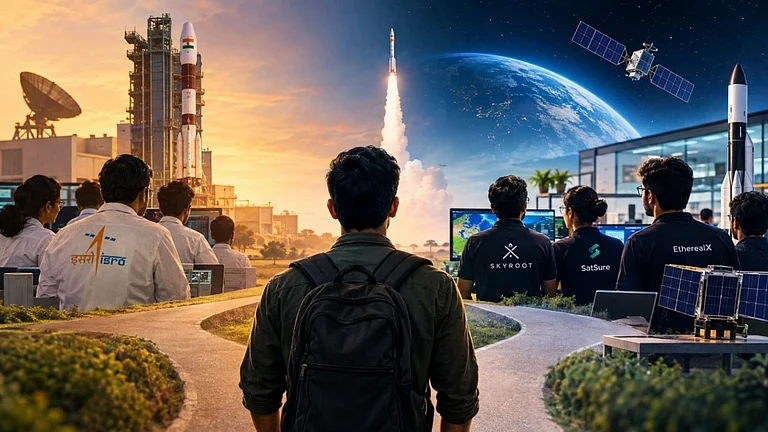
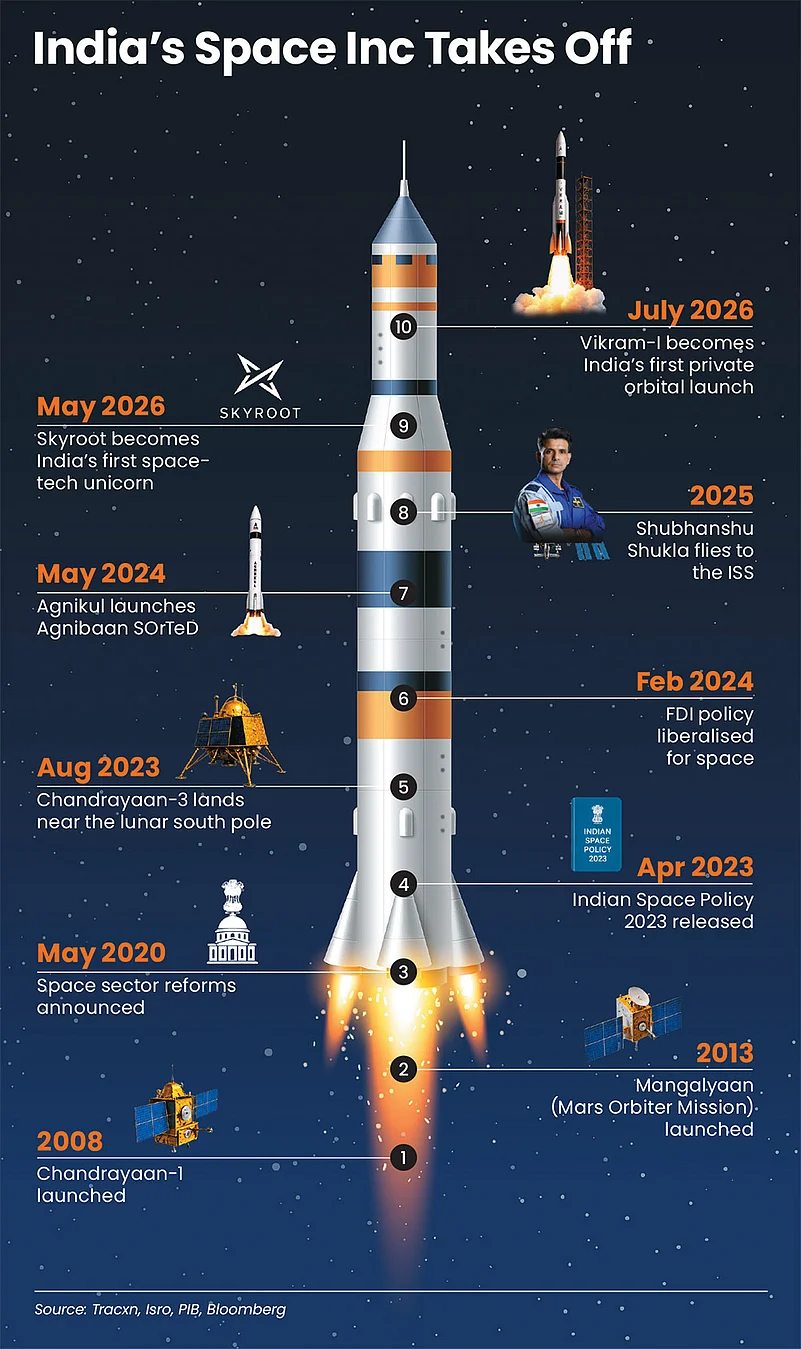
One could say that Skyroot is currently in the middle of an annus mirabilis, a year of miracles. Within a span of a few months, it became India’s first space company to be valued at a billion dollars or more, achieved the rare feat of successfully launching a rocket in its maiden attempt, and in doing so, helped India enter the elite club of three nations which can boast of private companies that can plug satellites into orbit.
Meanwhile, prospective investors are reportedly banging at the start-up’s door to join the party at double the last valuation.
For a long time, the Indian Space Research Organisation (Isro) was the country’s only gateway to space. Every celebration of success or anguish of failure was tied to it.
There was little to no ecosystem for private players, no formal policy framework, and hardly any support for entrepreneurs looking to turn ideas into businesses.
But all that is beginning to change as India’s private spacetech ecosystem seems to be coming of age.
Agnikul Cosmos has developed the world’s first 3D-printed rocket engine and has got its own rocket launchpad up and running. Pixxel Space is building satellites that provide Earth observation data to customers like Nasa and the US department of defence. Bellatrix is taking a gamble on a rare technology—very-low-earth-orbit satellites—which is being attempted by only a few other companies globally.
Each of these companies are aiming for major technological or operational leaps by this year.
“India’s private space ecosystem has come a remarkable distance in a relatively short time,” says Lt Gen (retd) AK Bhatt, director general, Indian Space Association (ISpA).
“India is emerging as a full-stack space economy, with growing strengths across launch, satellite infrastructure and a range of downstream space applications,” he adds.
Now, India boasts of roughly 450 spacetech start-ups, an over nine-fold jump from 47 in 2021. The growth is astronomical considering the country was home to a solitary private space company in 2014.
While satellite launches were once the sole purview of Isro, the times are changing. Non-Isro satellites have boomed: 18 private satellites have been launched by six private entities in the past five years. The number was zero in 2021.
These are more than milestones for India’s space ambitions at a time when space infrastructure is fast becoming as consequential to modern economies and militaries as telecom networks, semiconductors and energy systems.
“Developing capabilities gives India greater control over critical infrastructure,” says Sireesh Pallikonda, co-founder of spacetech start-up Red Balloon Aerospace.
The urgency is clear from the reignition of the global space race. The US has joined hands with private giants such as SpaceX, Blue Origin and Virgin Galactic to build a massive constellation economy, with around 12,000 satellites.
China, meanwhile, has built a formidable space-industrial base on the back of sustained state funding for universities and institutions, commanding more than 1,000 payloads. India’s satellite fleet, by comparison, remains minuscule at fewer than 100.
“India may not yet match the scale or maturity of the US or China, but it has built a strong foundation and is closing the gap faster than many expected,” observes Jashank Pohani, head of family-office relationships at Artha Group.

The Turning Point
When rocket start-ups like Skyroot and Agnikul started about a decade or so back, some thought that they were ‘illegal’ companies.
The problem was that India still did not have a law or regulatory mechanism to allow any player apart from Isro to launch a rocket.
It was during that time that Tushar Jadhav, co-founder of propulsion systems start-up Manastu, was courting an expert to come on board as an adviser. Though interested, the person was not convinced that it was legal for a private company to put anything into space.
Almost everything related to space exploration was a strict state monopoly in India to safeguard sensitive national security assets.
“Spacetech was viewed as a highly specialised domain with very little public understanding,” says Pohani.
But globally, the tides were shifting. In the US, disruptors like SpaceX and Planet Labs had proved that private enterprises could conquer space. And Chinese start-ups were beginning to raise serious capital and attempt launches.
While New Delhi realised that reforms in the space sector were urgently needed, it was still bogged down by its bureaucratic morass. Over the past decades, one thing that has remained consistent about Indian policymaking is that big, possibly debilitating crises—political upheavals, economic shocks or natural calamities—are the lifeblood of reforms.
Then came Covid-19. The world ground to a halt and businesses teetered on the brink. Before the year was halfway through, another shock arrived: the Galwan Valley clash, one of the bloodiest India-China confrontations in decades. These crises sharpened New Delhi’s anxiety over strategic dependence and accelerated the push for self-reliance. Across industries, the government rolled out schemes to strengthen domestic capabilities and reduce vulnerabilities in critical supply chains.
Space was among the biggest beneficiaries. In June 2020, Finance Minister Nirmala Sitharaman unveiled a sweeping opening up of the sector, allowing private companies to conduct end-to-end space activities, including building rockets, launching satellites and providing downstream data services.
For start-ups such as Agnikul, it was a watershed. “Suddenly, space got its atmanirbhar moment. That was a big stroke of luck,” co-founder Srinath Ravichandran reportedly said in 2021.
India’s space ecosystem essentially became a layered structure. Isro’s focus moved towards research and development for frontier technology and ambitious space missions.
NewSpace India (NSIL), set up in 2019, became Isro’s commercial arm. It owns and operates commercial launches, and transfers Isro-developed technologies to industry.
Meanwhile, the Indian National Space Promotion and Authorisation Centre (IN-SPACe) was created as a regulator, authorising private missions and sharing Isro’s infrastructure for nominal fees.
This momentum solidified into law with the Indian Space Policy of 2023. The cherry on top was the easing of foreign direct investment (FDI) rules in 2024. It made way for up to 100% FDI via the automatic route to pump global capital into Indian spacetech.
Today, forged by these initiatives, the number of spacetech start-ups has surged past 1,200, including roughly 450 core players alongside allied and supply-chain companies.
The impact is also visible in the growing investor interest. Driven by institutional backing, including a strategic ₹1,000cr Venture Capital Fund, cumulative private investment surged past $705mn.
Liberalisation opened virtually every major segment of the space value chain for private participation, observes Pohani. “The reforms addressed three major challenges: access to capital, access to talent and reducing brain drain.”
Manastu’s Jadhav has seen the talent part unfold. The very same expert who had once refused the start-up’s offer has now joined the team.
Fountainhead of Talent
In the winter of 2004, millions of Indians were mesmerised by Swades. On the silver screen, Shah Rukh Khan portrayed Mohan Bhargava, a brilliant engineer working at the prestigious US space agency, Nasa.
Afterall the movie served up a familiar trope. In the early 2000s, there was a widespread belief that Nasa’s corridors were overflowing with Indian minds.
Back then, choices were painfully few. Space was a strict state monopoly.
If you were a young, brilliant Indian engineer or scientist, you either secured a rare spot at Isro, or you packed your bags for Nasa or the European Space Agency.
Today, the tide has turned in a way no one in 2004 could have predicted.
In India, the central government’s Department of Space recently had to issue a dramatic directive: no scientist can resign from Isro without official approval.
According to reports, scores of Isro scientists and engineers are quitting the organisation to either join a start-up or found one. They need not be torn between making money while pursuing their calling and staying back in the country.
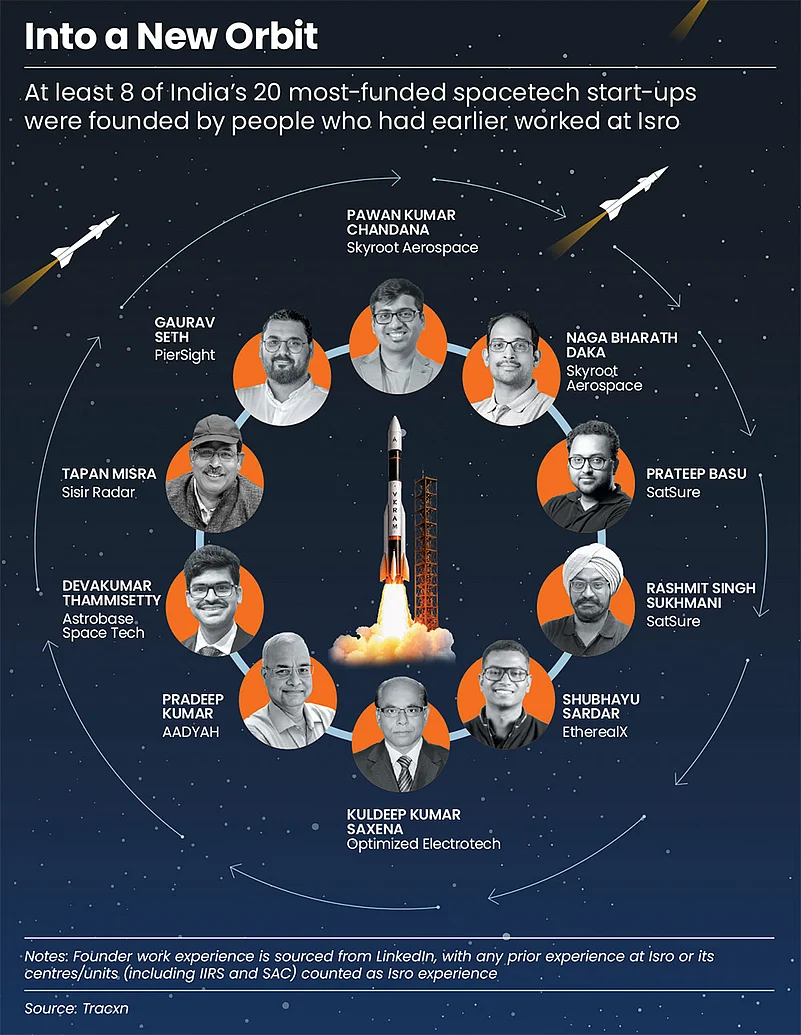
Of the 20 most-funded spacetech start-ups in India, at least eight were founded by former Isro scientists, according to data-platform Tracxn.
For instance, both the co-founders of Skyroot are former Isro scientists. According to Chandana, before the entrepreneurial bug bit him, his plan was to spend his entire professional life in Isro and retire from it.
“Leaving Isro was certainly not an obvious decision. Bharath and I had the privilege of working on launch vehicles there, and we understood first-hand both the complexity of the technology and the depth of capability India had built over decades,” says Chandana.
While some believe that the spate of exits from Isro may become an impediment for its flagship missions like Gaganyaan, this talent pipeline is bringing the much-needed expertise to the private space ecosystem.
At a meeting with spacetech start-up founders in August, Prime Minister Modi said that India’s aim should be to build an ecosystem that attracts the best in the world.
“We must create such an aura that people all over the world feel that if they want to build their life [in the spacetech sector], they should come to India. Join some Indian start-up. Join some Indian space agency,” he said.
Stage Fright
A rocket does not blast its way into orbit in one push. It climbs in carefully choreographed stages. The first stage generates the brute force needed to break free from the pull of Earth. The next stage ignites, taking over as the vehicle climbs higher and accelerates towards orbital velocity.
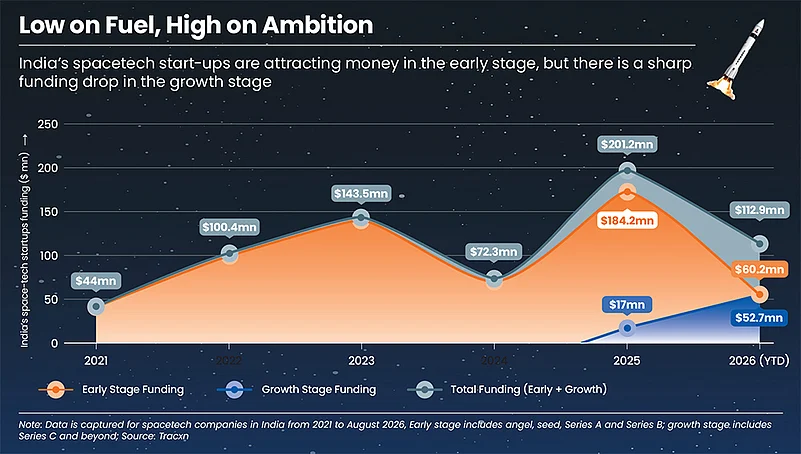
That is remarkably similar to how a start-up grows. Seed capital gets a company off the ground; Series A and B provide the thrust to prove its technology and business model. Then comes growth capital needed to scale manufacturing, expand capacity and reach the market. Without it, a start-up can have the technology and momentum to fly, but not enough thrust to reach orbit.
And that’s where Indian spacetech start-ups are hitting a roadblock.
According to Tracxn, India’s spacetech start-ups have attracted close to $636mn in early-stage funding from 2020 till date.
Cash-rich conglomerates must play a far more bigger role. They have been surprisingly slow to deploy serious capital
In comparison, about a tenth of it—a mere $70mn—came as growth-stage capital.
Investors say the growth-stage funding paradigm in India is based on models that work well for software-as-a-service, fintech and consumer-tech start-ups.
“[Spacetech] start-ups follow a very different path. By Series B, they may have spent a lot of time and capital on building and validating complex technology rather than on generating large revenues,” Bluehill VC’s Manu Iyer had told Outlook Business earlier.
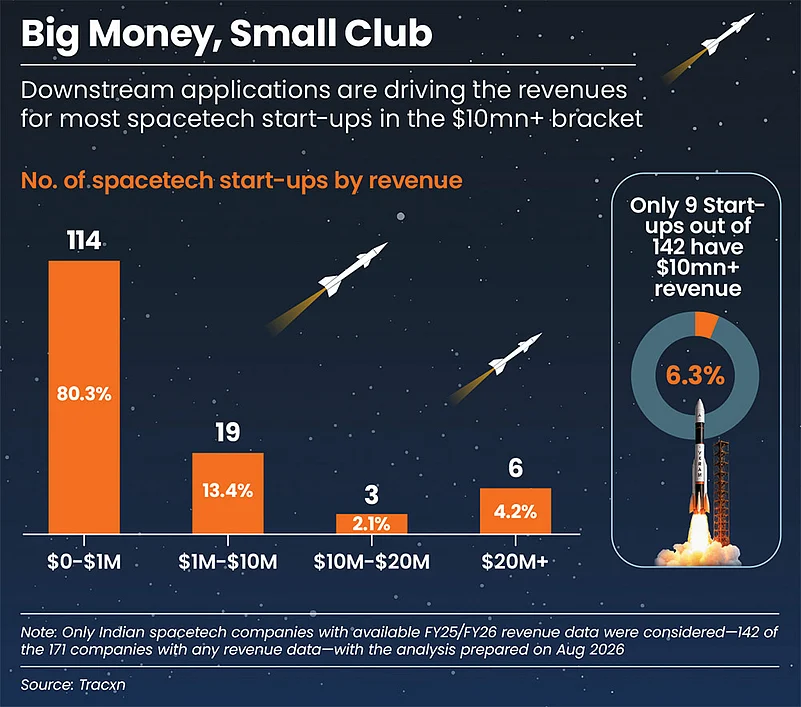
Growth-stage investors need more than vision to deploy capital; they require a proven, predictable revenue foundation. Meanwhile, only nine spacetech start-ups have revenues above $10mn, according to Tracxn. In stark contrast, the US has around 10 spacetech companies with revenues over $100mn-plus revenue. For India, that number is zero.
The pertinent question to ask then is why is Indian spacetech struggling to generate meaningful revenues?
A recurring challenge is that spacetech start-ups need prospective clients to shell out money for early-stage technology testing or pilots. And India’s corporates are a tough nut to crack when it comes to selling high-tech products and services to them.
“They want the solution to work from day one. If it’s not ready immediately, they expect a free pilot,” Awais Ahmed, founder of space-tech start-up Pixxel, told Outlook Business in May.
However, experts argue that spacetech solutions are still far removed from ground realities. Most are still chasing the glamour of the launch when the most durable margins reside in downstream applications. “Commercialisation should not be viewed narrowly as supplying hardware to Isro,” says Red Balloon’s Pallikonda.
Founders also need to be mindful of the product-market fit. Most build in isolation and only approach customers once the product is ready.
“We don’t pay enough attention to commercial viability. We don’t always ask whether there is a real market or if customers are willing to pay,” spacetech start-up Cosmoserve’s founder and former Isro scientist Chiranjeevi Phanindra B had told Outlook Business.
This ties into a broader structural issue. Indian companies tend to avoid R&D tie-ups with start-ups. In fact, they do not have enough research money to spend. In India, total R&D spending is around 0.7% of GDP, with a limited private-sector participation. The US spends about 3–3.5% of GDP.
Another critical challenge is delays in government procurement. Here, the system is inherently cautious. “Only the state can supply a multi-year, predictable stream of orders this early. Only that stream lets a young company plan expansion at industrial scale,” observes Pranav Pai, managing partner at 3one4 Capital, a VC firm.
The lowest-cost bidding system is of no help either as start-ups often struggle to meet eligibility criteria such as strong balance sheets.
Infrastructure constraint is another bottleneck. With just two operational launch pads in Sriharikota, Isro missions are prioritised. Private satellite operators face long wait times for a ride to orbit. This shows up in numbers too. While India has just 4–8 launches a year, the US conducts close to 200 and China carries out around 100.
Double-Edged Sword
Hunched over a desk strewn with complex blueprints, Isro scientist Tara Shinde was nearly at her wits’ end. While she was trying to design a space mission to Mars, she needed to find a way to use less fuel to power the rocket. The budget had to be curbed.
Her eureka moment arrived as she was frying puris in the kitchen. As the cooking stove ran out of gas, she was compelled to use the residual heat of the pan to continue frying.
At that moment, Shinde had a brilliant idea. She realised that by turning off the engines and letting the rocket coast on its own momentum, a massive amount of fuel could be saved. Less fuel meant less weight, and less weight meant a dramatic drop in launch costs.
Tara Shinde is a character that Bollywood actress Vidya Balan played in the 2019 movie Mission Mangal. While the puri-frying scene is more of a cinematic leeway, it captures India’s culture of jugaad, the art of frugal innovation born out of sheer necessity.
For decades, India’s public space programme turned financial scarcity into a world-class competitive strategy. More than any of its discoveries on the Moon, India’s historic Chandrayaan-2 mission made global headlines for costing less than the production budget of the Hollywood space movie Interstellar.
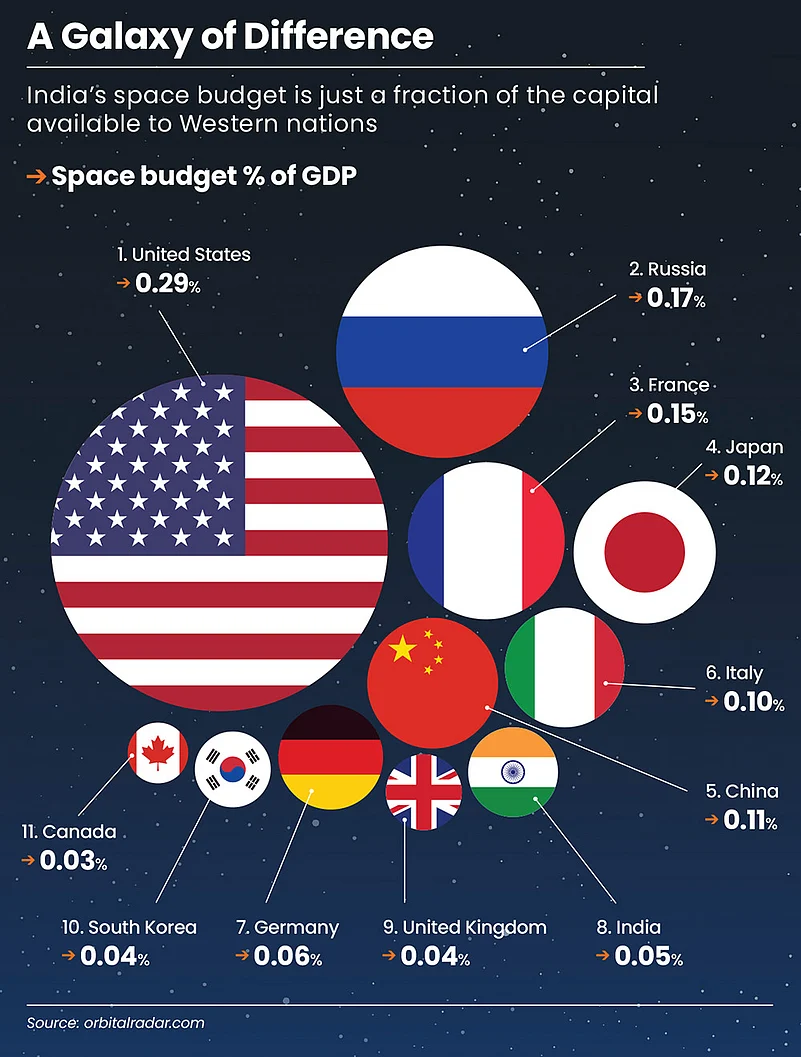
For a country working with only a fraction of the capital available to Western nations, frugality is tightly woven into its fabric. Numbers lay bare this reality. In 2024-25, Isro operated on a modest budget of roughly $1.5bn. In sharp contrast, Nasa had $25bn. Despite this massive gap, Isro has time and again pulled off some of the world’s most daring space missions.
However, there is a catch. When cost-cutting becomes the ultimate goal, companies face an overwhelming temptation to compromise on component quality and reliability testing. These shortcuts may prove to be devastating.
One such case in point is Bengaluru-based start-up GalaxEye Space. In May 2026, it successfully deployed Mission Drishti. Weighing 190kg, the craft became India’s largest privately built Earth-observation satellite. But the euphoria was short-lived. The satellite lost communication during a fierce geomagnetic solar storm barely two months later. Even more troubling was a report by business-news platform The Ken that a third-party vendor had supplied GalaxEye critical components that failed strict space-grade standards.
It’s a wake-up call for the Indian space ecosystem. Jugaad or cost-effective hacks can’t come at the expense of quality, reliability or mission performance. While frugality allows India to arrive at highly affordable solutions, the long-term global game requires to be the best in the business. “The cheapest can be the entry ticket, but it cannot be the finish line,” says VC firm Beenext’s Chinmaya Saxena.
Over time, the cost-effectiveness advantage will naturally tilt toward global players who can offer a combination of competitive pricing, high performance and flawless reliability.
This competitive reality becomes obvious when looking at Elon Musk’s SpaceX. Through its breakthrough technology of rocket reusability, the spacetech giant is successfully spreading manufacturing costs across dozens of flights, slashing the cost per launch. China has also achieved the reusability leap with its rocket firm LandSpace becoming only the fourth entity globally to recover a launch vehicle.
These highlight the existing reusability gap in India’s space ecosystem. Skyroot’s pioneering Vikram-1 is a single-use rocket and Agnikul is yet to demonstrate its promised reusable orbital launch capability. Given this scenario, can India’s private launch sector realistically compete globally?
According to a new study in Economics Letters, India’s cost of putting a kg into low-Earth orbit was at $13,302 in 2025 compared to Europe ($9,897), Russia ($6,682), China ($5,809) and the US ($3,225). The global average was $3,868.
The numbers puncture the idea that jugaad alone can make India the world’s cheapest launchpad. The study finds that the US and Europe have seen statistically significant cost declines as cumulative launches increased since 2010. India needs the same flywheel—technology plus scale, not jugaad alone.
“It’s a myth that things are cheap here...Cost is basically manpower because naturally in India, the cost of manpower is lower,” says Rohan M Ganapathy, founder of Bellatrix, which was one of India’s first spacetech start-ups to raise VC funding. “Every other thing is expensive because all your testing equipment, all your machinery, everything is imported. There is no local industry which is able to meet all these requirements,” he adds.
To truly capture a dominant share of the global commercial launch market, India has to pivot towards building larger, high-capacity, reusable launch vehicles. As yet, India’s private launch companies have built smaller rockets designed to carry relatively light payloads to specific orbital destinations.
India must rapidly develop heavy-lift capabilities to significantly lower per-kilogram launch costs and retain a fierce global edge, Deb Kumar Chakrabarti, member (services) of the Department of Telecommunications, told PTI recently.
After Escape Velocity
At the meeting of space-tech founders with PM Modi last month, one of them said his start-up was building a unique rocket engine. It piqued Modi’s interest. He asked if investors were confident about the idea.
“Yes, especially after Skyroot’s successful launch,” the founder remarked as everyone in the room broke into a chuckle.
The public adulation that Skyroot has received in the past couple of months has been a first for the sector. For anyone who has seen the technology sector for a long time, it is well-known that one big-bang success in a new sector attracts an asymmetric amount of fresh investments. This, in turn, kickstarts a virtuous cycle of talent density, innovation and even more funding. It happened with the likes of Flipkart in e-commerce, Paytm in fintech and Freshworks in SaaS.
Growth-stage investors need more than vision; they require a proven and predictable revenue foundation
But spacetech is a bit different. For one, it is not a consumer-facing sector where users can log into an app and make purchases. Neither is it the kind of vanilla business software like customer management or sales dashboards that millions of firms daily require. At least not yet.
The fact of the matter is that spacetech still continues to be a sunrise sector that is primarily at the mercy of government backing. Where the government and its allied agencies become big buyers, private spacetech flourishes. “Only the state can supply a multi-year, predictable stream of orders this early, and only that stream lets a young company plan expansion at industrial scale,” says Pai of 3one4 Capital.
Here the US and China offer two different structural blueprints for spacetech commercialisation. In the US, Nasa and the Department of Defence act as primary customers besides funding research. Nasa is increasingly tapping private entities to build rockets. Its private space sector is backed by deep VC markets willing to fund long-term, high-risk deep tech.
On the other hand, private Chinese space companies like LandSpace, i-Space and Galactic Energy are heavily backed by state-owned investment funds, provincial governments and municipal aerospace parks.
Examining these systems reveals how India can scale its space ecosystem beyond the excitement of rocket launches every now and then. “Neither condition applies here alone, so India will need a hybrid model with a third framework,” says Pai.
Experts say India’s cash-rich conglomerates must play a far more aggressive role. They have been surprisingly slow to deploy serious capital into spacetech.
Unlike the defence sector, where reforms were quickly followed by massive private investments, global joint ventures and long-term state contracts, the space sector has not yet fully received the same attention.
Consequently, India urgently requires policies that can aggressively incentivise and protect large-scale private investments in spacetech. Also, long-term government contracts can give start-ups the much-needed confidence and capital to explore complex technologies.
India must boldly look beyond its long-standing reputation for executing space missions cheaply. When the dust settles, spacetech start-ups that successfully fuse India’s frugality with component reliability and technological excellence will be the ones that conquer the cosmos.