India and Uzbekistan have elevated their relationship to a Comprehensive Strategic Partnership, backed by new institutional mechanisms including a foreign-minister-led Coordination Council.
The two countries are targeting $5 billion in bilateral trade by 2030, while seeking to improve market access, connectivity, banking and payment systems and expand infrastructure cooperation.
Uranium, defence and strategic technologies are key areas of the upgraded partnership, with both sides working towards a long-term uranium supply arrangement and greater cooperation in defence production, AI, critical minerals, space and nuclear energy.
India and Uzbekistan have upgraded their relationship to a Comprehensive Strategic Partnership, with the two countries also agreeing to work towards a long-term uranium supply arrangement for India. The move expands bilateral cooperation across defence, trade, energy, connectivity and emerging technologies.
Prime Minister Narendra Modi announced the decision after holding talks with Uzbek President Shavkat Mirziyoyev on Sunday, as the two countries marked 15 years of their strategic partnership.

1 October 2026
Get the latest issue of Outlook Business

Speaking at a joint press conference, Modi said the new framework would be backed by concrete goals to deepen bilateral engagement.


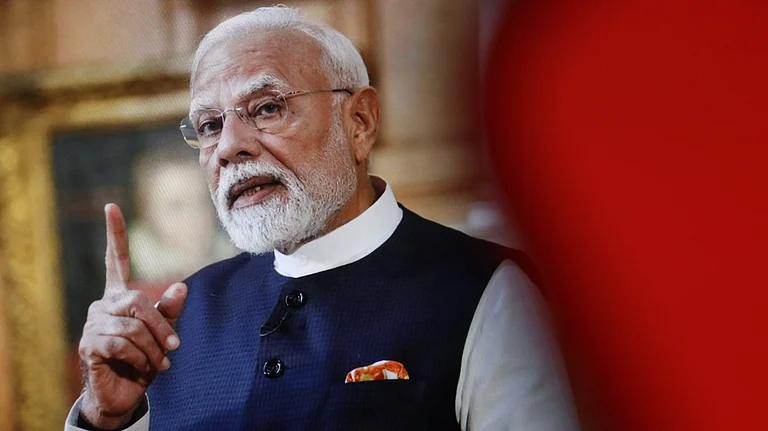
“On this special occasion, we have decided to elevate our relations to a Comprehensive Strategic Partnership. We will move forward by setting concrete goals within this new framework,” he said.
The two sides also agreed to strengthen institutional mechanisms, expand trade and step up cooperation in infrastructure, digital public infrastructure, space and nuclear energy.
Advertisement
New Mechanisms To Drive Trade And Cooperation
India and Uzbekistan will establish a Coordination Council headed by their foreign ministers to oversee bilateral cooperation. The existing joint commission will also be upgraded from the secretary level to the ministerial level.
Modi described Uzbekistan as being “at the heart of Central Asia” and an important partner in India's regional engagement.
Trade is another major priority. According to Modi, bilateral trade has crossed $1 billion, with the two countries now targeting $5 billion by 2030.
To achieve that goal, India and Uzbekistan will work on improving market access, connectivity as well as banking and payment systems. The countries will also organise a joint business summit and explore infrastructure projects that can generate benefits for both sides.
Advertisement
“We will work together to enhance win-win cooperation in infrastructure development,” Modi said.
Defence Cooperation To Deepen
Defence and security will form another important pillar of the upgraded partnership.
Modi said the existing defence relationship reflects the high level of trust between India and Uzbekistan and announced plans to expand cooperation between their defence industries.
The two countries intend to promote direct industrial linkages, co-production and co-development in defence in the coming years.
India and Uzbekistan also share concerns over terrorism, extremism and separatism. Modi said both countries consider these threats major challenges to regional stability and support a policy of zero tolerance towards them.
Uranium, Nuclear Energy On The Agenda
One of the key outcomes of the talks was an agreement to work towards a long-term uranium supply arrangement for India.
New Delhi has been seeking uranium supplies from Uzbekistan to support its civilian nuclear power programme. Nuclear energy was discussed alongside broader cooperation in clean energy and other strategic sectors.
The two countries also identified digital public infrastructure, artificial intelligence, critical minerals and space as areas with potential for expanded collaboration.
Modi said the partnership should extend beyond government-to-government engagement between New Delhi and Tashkent. India and Uzbekistan will look to establish partnerships between their cities and states to broaden cooperation at the regional and local levels.
Focus On Shared Development Goals
The Prime Minister also linked the upgraded partnership to the development priorities of both countries.
He said youth, innovation, inclusive growth and modern technology were central to the visions of “New Uzbekistan” and “Viksit Bharat 2047”.
“There is a deep similarity between the aspirations and thinking of India and Uzbekistan. Guided by this shared vision, we are working continuously for the welfare of our people,” Modi said.
The two countries are therefore looking to expand their relationship beyond traditional diplomatic and economic cooperation into areas such as technology, innovation, infrastructure and strategic resources.
Uzbekistan Confers Highest State Honour On Modi
The visit also carried significant diplomatic symbolism, with President Mirziyoyev conferring Uzbekistan’s highest state honour, the Order of “Oliy Darajali Dustlik”, on Modi.
The award is the 36th international honour received by the Prime Minister.
Modi said he was proud to receive the distinction and dedicated it to the friendship between India and Uzbekistan and to the 1.4 billion people of India.
Explaining the significance of the award, Modi noted that “Dostlik” means friendship and is related to the familiar Hindi word “dost”, or friend.
He said the honour should not be seen as a personal distinction but as recognition of the people-to-people friendship between India and Uzbekistan, describing “Dostlik” as an expression of the spirit underpinning the bilateral relationship.