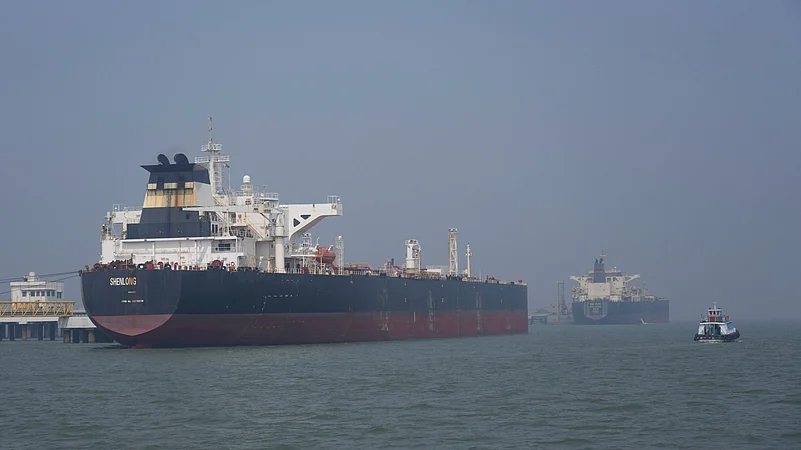

Saudi Arabia has increased crude exports through Yanbu as Red Sea security risks continue to reshape regional shipping routes
Several oil tankers are sailing through Bab el-Mandeb with tracking systems switched off
Regional security incidents continue to pose risks for commercial shipping
Saudi Arabia's Red Sea export hub at Yanbu witnessed a sharp rise in tanker activity over the weekend, as the kingdom continued to adapt its crude export routes amid ongoing security threats in the region.
Satellite imagery showed five very large crude carriers (VLCCs) berthed at Yanbu's oil-loading terminals on Saturday, making it potentially the port's busiest day since Iran-backed Houthi rebels announced a blockade targeting Saudi ports around two weeks ago, as per a report by Bloomberg (BBG).

1 September 2026
Get the latest issue of Outlook Business

The images were captured by the European Union's Sentinel-2 satellite, which passes over the area only every few days.




Yanbu has become increasingly important for Saudi crude exports after disruptions to shipping through the Strait of Hormuz during the US-Iran war.
Saudi has been transporting millions of barrels of crude daily via pipelines to the Red Sea port, allowing exports to continue without relying on the strategically sensitive waterway. A VLCC typically carries around two million barrels of oil, the report said.
Tankers Go 'Dark' By Switching Off Tracking Systems
The Greek-owned Suezmax tanker Lesvos and the India-flagged VLCC Desh Vaibhav crossed the Bab el-Mandeb Strait over the weekend carrying Saudi crude loaded at Yanbu while their Automatic Identification System (AIS) transponders were switched off, BBG reported citing shipping analytics firms Vortexa and Kpler.
Advertisement
Ship-tracking data later showed both vessels reappearing in waters off Oman after previously broadcasting positions near Yanbu.
While several tankers continue to sail openly through Bab el-Mandeb, including vessels transporting Russian crude, security concerns have prompted some Saudi-owned ships to take the longer route around the Cape of Good Hope.
Saudi Arabia has also redirected part of its Asia-bound crude exports through Egypt's Mediterranean port of Sidi Kerir, the report said.
Attacks On Shipments
The risks to commercial shipping remain elevated. A liquefied natural gas (LNG) tanker carrying cargo from Qatar was struck by a projectile while passing through the Strait of Hormuz late last week.
Advertisement

Separately, the UK Maritime Trade Operations said on Sunday that the master of a tanker heard an explosion near another vessel close to Oman's coastline.
A crude oil tanker also reported a near miss while entering the Gulf on Saturday.
Oil Flows Remain Resilient In 'Dark' Mode
Despite the security concerns, crude exports from the Persian Gulf have remained strong.
More than 8.4 million barrels of crude left the Gulf on Friday, one of the highest daily export volumes recorded since the Iran conflict began at the end of February, BBG reported citing ship-tracking data.
Much of this oil was transported by vessels that temporarily disabled their tracking systems.
According to Kpler data, 34 commodity vessels transited the Strait of Hormuz between Friday and Sunday, while 75 commodity ships crossed the Bab el-Mandeb Strait during the same period, the report said.
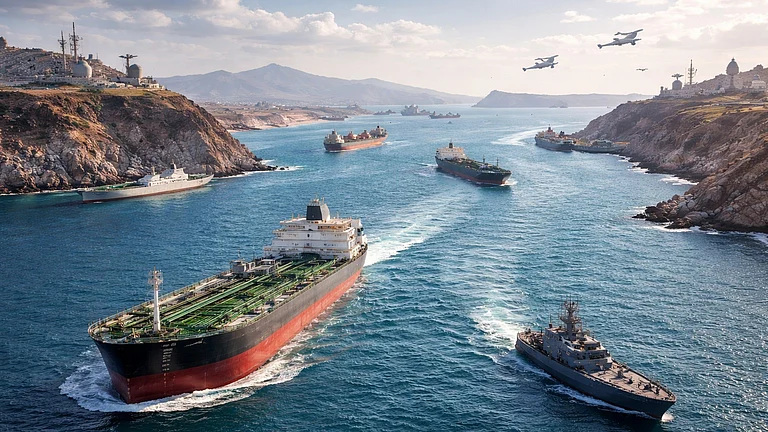
Outbound traffic through Bab el-Mandeb was largely dominated by Russian crude shipments, although cargoes from Saudi Arabia, Algeria and Sudan also made the journey, with some vessels travelling in "dark" mode.
A Taiwanese-owned supertanker reportedly crossed Bab el-Mandeb with its transponder switched off, although it was not immediately clear whether the vessel was carrying cargo.